Company Valuation Formula: Market, Income & Asset Approaches
I've spent years figuring out how to value businesses, and I'm going to share every formula I actually use. No academic theory. No confusing jargon. Just the practical stuff that works in the real world.
Look, I get it. Valuation feels intimidating. You've got finance people throwing around terms like "DCF analysis" and "EBITDA multiples" like everyone's supposed to know what they mean. But here's the truth: valuation isn't rocket science.
I've distilled everything down to three primary approaches, each with its own formulas. Once you understand these, you can value pretty much any business—from the lemonade stand on the corner to a publicly-traded tech giant.
The Three Valuation Approaches (In Plain English)
- 📊Market Approach: "What are other similar companies selling for?" We use ratios like P/E and EV/EBITDA.
- 💰Income Approach: "How much cash will this business generate?" We use DCF (Discounted Cash Flow) analysis.
- 🏢Asset Approach: "What's the stuff worth?" We calculate Net Asset Value (Assets - Liabilities).
The Market Approach: Compare to Peers
This is the most intuitive method. If your neighbor sold their house for $500K, yours is probably worth around that too (assuming it's similar). Same logic applies to businesses.
We use valuation multiples—ratios that compare a company's value to its financial metrics. The most common ones?

Formula #1: P/E Ratio Method (Price-to-Earnings)
Company Value = Annual Earnings × P/E Multiple
This is the simplest and most widely-used formula. Here's how it works:
Example:
Your company earns $500K/year. Industry P/E multiple is 6x.
Value = $500K × 6 = $3M
Typical Multiples:
- • Small businesses: 2-4x
- • Mid-market: 4-8x
- • Large caps: 8-25x
- • Tech/growth: 15-50x+
Pro tip: Use Net Earnings (after-tax profit) for this formula. If you're a small business, use SDE (Seller's Discretionary Earnings) instead, which adds back your salary and perks.
Formula #2: EV/EBITDA Multiple
Enterprise Value = EBITDA × EV/EBITDA Multiple
EBITDA stands for "Earnings Before Interest, Taxes, Depreciation, and Amortization." It's a cleaner measure of operating cash flow that's not affected by financing decisions or accounting choices.
Real Example:
Manufacturing company with $2M EBITDA. Industry EV/EBITDA multiple is 7x.
Enterprise Value = $2M × 7 = $14M
SaaS
8-15x
Manufacturing
4-7x
Retail
3-6x
Formula #3: Revenue Multiple (For High-Growth Companies)
Company Value = Annual Revenue × Revenue Multiple
For pre-profit companies (like early-stage startups or high-growth tech), we value based on revenue. It sounds crazy, but investors do this all the time.
Example:
SaaS startup with $5M ARR (Annual Recurring Revenue), growing 80% year-over-year.
Revenue multiple for high-growth SaaS: 10x
Value = $5M × 10 = $50M
Warning: Revenue multiples are risky. Use only for high-growth companies where profits are expected in the future. For stable businesses, always use profit-based multiples.
Want to Calculate Market Approach Valuations Instantly?
Use my free calculators to value your business using multiple methods.
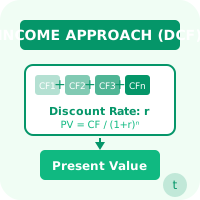
The Income Approach: DCF Analysis
This is the gold standard of valuation. Warren Buffett uses it. Investment banks use it. Serious buyers use it. Why? Because it values a business based on what actually matters: future cash flow.
DCF stands for "Discounted Cash Flow." Here's the logic in plain English:
The Core Idea:
A dollar today is worth more than a dollar tomorrow (because you can invest it). So we "discount" future cash flows back to today's dollars to find the present value.
The DCF Formula (Simplified)
Business Value = Σ [Free Cash Flow / (1 + r)ⁿ]
Free Cash Flow
The cash a business generates after paying for operations and capital expenditures. This is what owners can actually take home.
r = Discount Rate
Your required rate of return. Higher risk = higher discount rate. Typical range: 8-15%.
n = Time Period
The year. Year 1, Year 2, Year 3... Typically project 5-10 years, then add a "terminal value" for all years beyond.
Step-by-Step DCF Example:
Step 1: Your business generates $100K in free cash flow annually and grows at 10% per year.
Step 2: Discount rate is 12% (it's a bit risky).
Step 3: Calculate present value of each year's cash flow:
Year 1: $110K / (1.12)¹ = $98,214
Year 2: $121K / (1.12)² = $96,462
Year 3: $133K / (1.12)³ = $94,734
Year 4: $146K / (1.12)⁴ = $93,029
Year 5: $161K / (1.12)⁵ = $91,347
Total 5-Year PV: $473,786
Step 4: Add Terminal Value (assume 3% perpetual growth): $1.2M
Final Business Value = $473K + $1.2M = ~$1.67M
When to Use (And NOT Use) DCF
✅ Perfect For:
- • Stable, predictable businesses
- • Companies with consistent cash flows
- • Mature businesses in established industries
- • When you have reliable financial data
- • Professional valuations and M&A
❌ Avoid For:
- • Early-stage startups (no cash flow yet)
- • Highly cyclical industries
- • Turnaround situations
- • Companies with unpredictable earnings
- • When you lack quality financial data
Calculate DCF Valuation in Seconds
My free DCF calculator does all the math for you. Just plug in your numbers.
Use DCF Calculator Free →The Asset Approach: What's the Stuff Worth?
Sometimes the simplest approach is best. This method values a business based on what it owns minus what it owes. It's especially useful for asset-heavy businesses or when a company is being liquidated.
Think of it like selling your house piece by piece: the land, the building, the furniture, everything—then subtracting your mortgage. What's left is your equity.
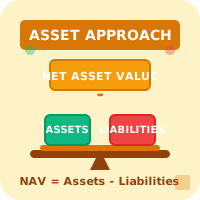
The Net Asset Value Formula
Net Asset Value = Total Assets - Total Liabilities
Total Assets Include:
- • Cash and cash equivalents
- • Accounts receivable
- • Inventory
- • Equipment and machinery
- • Real estate and property
- • Intellectual property (patents, trademarks)
- • Goodwill (if acquired)
Total Liabilities Include:
- • Accounts payable
- • Loans and debt
- • Mortgages
- • Accrued expenses
- • Deferred revenue
- • Tax liabilities
- • Other obligations
Real Example: Manufacturing Company
Total Assets
$5.2M
Total Liabilities
$2.8M
Net Asset Value
$2.4M
Important: This is the "book value"—what the accounting says. In reality, assets might be worth more (or less) than their book value. For example, old equipment might be worthless on paper but still functional. Real estate might be worth way more than its depreciated book value. Always adjust for fair market value when possible.
When to Use the Asset Approach
Best Situations:
- • Asset-heavy businesses (manufacturing, real estate, construction)
- • Holding companies
- • Liquidation scenarios
- • Businesses with minimal goodwill
- • When income approaches don't make sense
Limitations:
- • Ignores future earning potential
- • Doesn't account for brand value
- • Misses intangible assets (customer relationships, processes)
- • Book value ≠ Market value
- • Can undervalue service businesses
Advanced: Adjusted Net Asset Value (ANAV)
For more accurate valuations, professionals use ANAV, which adjusts book values to fair market values:
ANAV = (Assets at Fair Value) - (Liabilities at Fair Value)
Example adjustment: Your building has a book value of $500K (fully depreciated) but the market value is $2M. Your ANAV calculation uses $2M, not $500K.
This is especially important for businesses that have owned assets for a long time. I've seen cases where ANAV is 3-4x higher than book value because of appreciated real estate.
Which Valuation Formula to Use
| Method | Best For | Formula | Difficulty |
|---|---|---|---|
| Market Approach P/E, EV/EBITDA, Revenue Multiples | Companies with public comparables. Fast, intuitive. | Value = Metric × Multiple | EASY |
| Income Approach (DCF) Discounted Cash Flow | Stable, cash-flow positive businesses. Most accurate. | Value = Σ[FCF/(1+r)ⁿ] | MODERATE |
| Asset Approach Net Asset Value | Asset-heavy, holding companies, or liquidations. | Value = Assets - Liabilities | EASY |
Pro Tip: Use Multiple Methods and Triangulate
Serious investors and business appraisers don't rely on just one formula. We use all three approaches and see where they converge.
Example:
Market Approach (P/E)
$4.2M
Income Approach (DCF)
$4.5M
Asset Approach (NAV)
$3.8M
Fair Value Range: $3.8M - $4.5M
When all three methods give you similar numbers, you can be confident in your valuation. If they're way off, investigate why—is there something unique about this business the market is pricing in?
My Other Favorite Valuation Formulas
Benjamin Graham Formula (For Defensive Investors)
Fair Value = √(22.5 × EPS × Book Value Per Share)
Created by the father of value investing, Benjamin Graham (Warren Buffett's mentor). This formula is perfect for finding undervalued, defensive stocks with a margin of safety.
Example:
Company has EPS of $5 and Book Value Per Share of $40.
Fair Value = √(22.5 × 5 × 40) = √4,500 = $67.08 per share
Dividend Discount Model (DDM) - Gordon Growth Model
Stock Value = D₁ / (r - g)
For dividend-paying stocks only. Values a stock based on the present value of all expected future dividends.
D₁
Expected dividend next year
r
Required rate of return
g
Dividend growth rate
Example:
Stock pays $2 dividend, growing at 5% annually. Your required return is 10%.
Value = $2 / (0.10 - 0.05) = $2 / 0.05 = $40 per share
PEG Ratio (Price/Earnings-to-Growth)
PEG Ratio = (P/E Ratio) / (Annual EPS Growth Rate)
Peter Lynch's favorite metric. A PEG of 1.0 means fairly valued. Under 1.0 = undervalued. Over 1.0 = potentially overvalued.
Example:
Stock has P/E of 20 and is growing at 15% annually.
PEG = 20 / 15 = 1.33 (slightly overvalued, but acceptable for high growth)
Frequently Asked Questions
What's the most accurate company valuation formula?
There's no single 'most accurate' formula—it depends on the business. DCF (Income Approach) is theoretically the most rigorous because it values based on future cash flows, but it requires accurate projections. Market Approach is best when you have good comparables. Asset Approach is simplest and works well for asset-heavy businesses. Professional appraisers use ALL THREE and triangulate to a fair value range. If all three methods converge around similar numbers, you can be confident. If they diverge significantly, investigate why—there might be something unique about that business.
How do I value a pre-revenue startup?
Pre-revenue startups can't use traditional profit-based formulas. Instead, use: (1) Berkus Method - values 5 key areas up to $2.5M total, (2) Scorecard Method - compares to regional averages with adjustments, (3) Venture Capital Method - calculates based on expected exit value, or (4) Revenue multiples if they have some traction. For very early stage, it often comes down to 'what are investors willing to pay?' which is more art than science. I have a Startup Valuation Calculator that uses these methods—check it out for pre-revenue companies.
What's the difference between EBITDA and SDE?
Great question. EBITDA = Earnings Before Interest, Taxes, Depreciation, and Amortization. SDE = EBITDA + Owner's Compensation + Personal Expenses. SDE is used for smaller businesses (under $2M revenue) where the owner's salary is a major expense. EBITDA is used for larger businesses where the business can run independently of the owner. Example: If your business nets $200K but you pay yourself $150K, EBITDA is $200K but SDE is $350K. For valuation, small businesses typically use SDE × 2-4x multiple, while larger businesses use EBITDA × 4-8x multiple.
How often should I recalculate my company's valuation?
Recalculate whenever something significant changes: quarterly/annual financial results, major operational changes, new products/services, market shifts, competitive landscape changes, or if you're considering selling/fundraising. At minimum, review annually. I recommend tracking your valuation over time—it's motivating to see it grow as you build the business. Many business owners only calculate valuation when they're selling, which is a mistake. You should always know what your business is worth, even if you have no intention of selling.
Can I use these formulas for any type of business?
Mostly yes, but with caveats. DCF works poorly for: pre-revenue startups (no cash flow to project), highly cyclical businesses (unpredictable cash flows), and distressed companies (negative cash flows). Market Approach fails when: there are no public comparables, the business is unique, or the market is irrational (overvalued/undervalued). Asset Approach undervalues: service businesses (few tangible assets), high-growth tech (value is in future potential, not current assets), and companies with strong brand value. For these situations, you need professional judgment or specialized methods.
What discount rate should I use for DCF?
The discount rate should reflect the riskiness of the cash flows. Higher risk = higher discount rate. General guidelines: 8-10% for stable, large-cap companies (utilities, consumer staples), 10-12% for average-risk businesses, 12-15% for small/mid-sized businesses or higher-risk industries, 15-20%+ for startups or very risky ventures. You can also calculate WACC (Weighted Average Cost of Capital) for a more precise number. Many investors simply use 10% as a standard default. The important thing is: be conservative. It's better to underestimate value than overestimate it.
How accurate are online valuation calculators?
Online calculators (including mine) are excellent for quick estimates and understanding valuation concepts, but they're NOT replacements for professional appraisals. They're based on simplified formulas and don't consider: unique business characteristics, local market conditions, specific industry trends, intangible assets like brand value, or competitive advantages. For legal disputes, bank loans, tax purposes, or M&A transactions, you need a certified business appraisal. For planning, curiosity, and initial negotiations, online calculators are great starting points. Think of them as back-of-the-napkin estimates, not gospel truth.
What's the rule of thumb for small business valuation?
The most common rule of thumb is: Business Value = SDE (or EBITDA) × Industry Multiple. For small businesses under $2M revenue, typical multiples are 2-4x SDE. For larger businesses, typical multiples are 4-8x EBITDA. However, this varies WIDELY by industry. Restaurants might sell for 1.5-2.5x SDE. SaaS companies might sell for 8-15x EBITDA (or even 5-10x revenue for high-growth). The multiple depends on: growth rate, profitability, risk, customer concentration, and how dependent the business is on the owner. My Business Valuation Calculator uses this approach with suggested multiples by industry.
How do intangible assets affect valuation?
Intangible assets (brand, patents, customer relationships, processes, software, proprietary technology) can significantly increase valuation, but they're often undervalued or missed entirely in simple formulas. For example, a business might have $1M in tangible assets but $3M in brand value and customer loyalty. Market Approach (using comparables) captures this indirectly. DCF captures it if it leads to higher future cash flows. Asset Approach completely misses it unless you do an Adjusted Net Asset Value calculation that separately values intangibles. This is why professional valuations are expensive—identifying and valuing intangibles requires specialized expertise.
What's the difference between fair value and market value?
Fair value is an accounting concept—the price you'd receive in an orderly transaction between knowledgeable, willing parties. Market value is what something would actually sell for in the current market. In theory, they should be the same. In practice, they can differ significantly. For example, during market bubbles, market value might be way above fair value. During crashes, market value might be below fair value. For valuation purposes, fair value is what something SHOULD be worth based on fundamentals. Market value is what it's ACTUALLY trading for. Smart investors buy when market value < fair value and sell when market value > fair value.
How does debt affect company valuation?
Debt complicates valuation. In simple terms: more debt = lower equity value (all else equal). When using Enterprise Value (EV), the formula is: EV = Equity Value + Debt - Cash. So if two companies have the same equity value but one has more debt, the one with more debt has a higher enterprise value (because acquirer would need to pay off that debt). For small business valuation using SDE/EBITDA multiples, most sales are 'cash-free, debt-free'—the seller pays off debts at closing and keeps the cash. The valuation is based purely on the operating business, not its capital structure. My calculators simplify this, but in real transactions, debt matters a lot.
Can I value my business myself or do I need a professional?
You can absolutely get a ballpark figure yourself using the formulas I've shared. That's enough for: personal planning, informal discussions with partners/buyers, tracking progress over time, and deciding whether to pursue a sale. You NEED a professional for: legal disputes, divorce settlements, IRS matters, bank loan applications, estate/gift tax planning, and serious M&A transactions. Professional valuations cost $5K-$20K+ and produce a 50-100 page report that can stand up in court. DIY valuations are free and take 10 minutes. Use the right tool for the job.
Ready to Value Your Business?
I've built a suite of free valuation calculators that use these exact formulas. No signup required. Instant results.
All formulas explained on this page • Free • No registration required