Quality of Earnings Ratio Formula
I'll teach you how to calculate and interpret the Quality of Earnings ratio—my secret weapon for spotting accounting tricks and finding companies with genuinely sustainable profits.
The Quick Answer
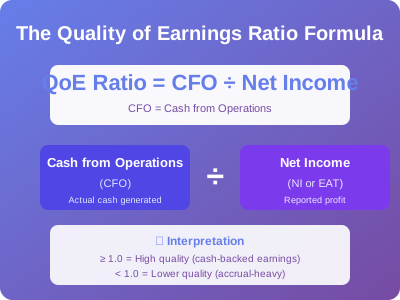
QoE Ratio = Cash from Operations ÷ Net Income
The Quality of Earnings ratio compares cash flow from operations (actual cash generated) to net income (reported profit). A ratio ≥ 1.0 means earnings are backed by cash. A ratio < 1.0 signals that profits might be inflated through accounting accruals rather than real cash generation.
Understanding the Quality of Earnings Formula
Let me break down the formula piece by piece so you understand exactly what you're measuring.
The Formula Explained
The Quality of Earnings (QoE) ratio is deceptively simple, but it reveals something profound about a company's financial health.
QoE Ratio = Cash from Operations (CFO) ÷ Net Income
Cash from Operations (CFO) represents the actual cash generated from the company's core business operations. It's found on the cash flow statement and measures real cash inflows and outflows.
Net Income is the accounting profit reported on the income statement. It includes non-cash items like depreciation, accruals, and estimates.
The ratio tells you: "For every dollar of reported profit, how many dollars of actual cash did the company generate?"
How to Calculate the Quality of Earnings Ratio
I'll walk you through the calculation process step by step.

Step-by-Step Process
Step 1: Find Net Income
Look at the income statement and find the bottom line: Net Income (also called Net Profit or Net Earnings). This is after all expenses, taxes, and interest.
You can also use Earnings Before Tax (EBT) if you want to pre-tax comparisons.
Step 2: Find Cash from Operations
Go to the cash flow statement and find "Cash Flow from Operating Activities" or "Cash from Operations" (CFO). This is the first section of the cash flow statement.
CFO = Net Income + Non-Cash Expenses ± Changes in Working Capital
Step 3: Divide
Simply divide Cash from Operations by Net Income. That's your Quality of Earnings ratio.
QoE Ratio = CFO ÷ Net Income
Interpreting the Quality of Earnings Ratio
Understanding what the ratio tells you about earnings quality.
What the Ratio Means
The Quality of Earnings ratio reveals how much of a company's reported profit is supported by actual cash flow. Here's how to interpret different ranges:
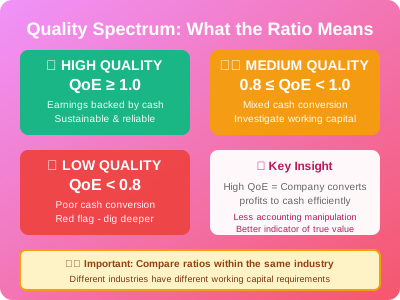
QoE Ratio ≥ 1.0: High Quality
Excellent! The company generates more cash than reported profit. This typically means:
- Non-cash expenses (depreciation, amortization) are significant
- Working capital is improving (collecting receivables faster, managing inventory well)
- Earnings are sustainable and backed by real cash
- Lower risk of accounting manipulation
0.8 ≤ QoE Ratio < 1.0: Medium Quality
Caution warranted. The company generates less cash than profit. This could indicate:
- Growing working capital needs (funding receivables or inventory growth)
- Some accrual accounting adjustments
- Need to investigate the underlying drivers
- Not necessarily bad, but requires deeper analysis
QoE Ratio < 0.8: Low Quality
Red flag! The company reports profits but isn't converting them to cash. Potential issues:
- Aggressive revenue recognition (booking sales before cash collection)
- Deteriorating working capital (slower collections, inventory buildup)
- Potential accounting manipulation or earnings management
- Higher risk of earnings restatements or cash flow problems
Real-World Calculation Example
Let me walk you through a detailed example using actual numbers.
TechCorp Inc. - Quality of Earnings Analysis
Financial Statement Data
INCOME STATEMENT
Revenue: $500 million
Operating Expenses: $350 million
Depreciation & Amortization: $50 million
Net Income: $100 million
CASH FLOW STATEMENT
Net Income: $100 million
+ Depreciation & Amortization: $50 million
− Increase in Accounts Receivable: $20 million
− Increase in Inventory: $10 million
Cash from Operations: $120 million
Calculation
QoE Ratio = $120M ÷ $100M = 1.20
✅ Interpretation: High Quality Earnings
TechCorp's QoE ratio of 1.20 indicates excellent earnings quality. The company generates $1.20 in cash flow for every $1 of reported profit. This is driven by significant non-cash depreciation expenses ($50M) that don't require cash outlays. Investors can have confidence that the earnings are sustainable and backed by real cash generation.
⚠️ What If QoE Was Lower?
If TechCorp had aggressive revenue recognition or poor working capital management, the calculation might look different:
Scenario: Cash from Operations = $70M (due to $50M working capital drain)
QoE Ratio = $70M ÷ $100M = 0.70
This would signal that despite $100M in reported profits, the company only generated $70M in cash. The $30M gap suggests aggressive accounting (booking sales before collecting cash) or deteriorating working capital (customers paying slower, inventory piling up). This would be a major red flag requiring deeper investigation.
Analyze Earnings Quality with My Free Tools
Don't calculate Quality of Earnings manually. Use my free calculators to analyze company financials instantly.
Why I Created This Guide
After years of analyzing financial statements, I've learned that not all profits are created equal. Some companies report impressive earnings that exist only on paper—driven by accounting accruals, aggressive revenue recognition, or working capital games. Others report modest earnings but generate mountains of cash.
The Quality of Earnings ratio is my go-to metric for separating the two. It cuts through accounting noise and reveals the true cash-generating power of a business. Whether you're an investor, analyst, or business owner, understanding this formula will protect you from accounting tricks and help you find genuinely sustainable businesses.
The Accounting Behind the Ratio
To really understand the Quality of Earnings ratio, you need to understand the difference between accrual accounting and cash accounting.
Accrual Accounting (Net Income)
Companies record revenue when earned and expenses when incurred, regardless of when cash changes hands. This creates timing differences. You can book a sale today (increasing net income) but not collect cash for 90 days (no cash flow yet).
Cash Accounting (CFO)
Cash flow statement tracks actual cash movements. It adjusts net income for non-cash items (like depreciation) and changes in working capital (receivables, payables, inventory). This is the reality check.
The Quality of Earnings ratio measures the gap between these two. If accrual accounting inflates earnings beyond what cash supports, the ratio drops below 1.0. If non-cash expenses or working capital improvements create excess cash, the ratio rises above 1.0.
Factors That Affect the Quality of Earnings Ratio
Several factors can push the QoE ratio above or below 1.0. Understanding these helps you interpret the ratio correctly.
✅ Factors That INCREASE QoE Ratio (Above 1.0)
- High depreciation & amortization: These are non-cash expenses that reduce net income but don't consume cash. Capital-intensive companies (manufacturing, utilities) often have QoE > 1.0 for this reason.
- Improving working capital: Collecting receivables faster, reducing inventory, or stretching payables improves cash flow relative to earnings.
- Deferred tax benefits: Tax timing differences can create cash flow that doesn't hit net income immediately.
- Stock-based compensation: Often a non-cash expense that reduces net income but not cash flow.
❌ Factors That DECREASE QoE Ratio (Below 1.0)
- Aggressive revenue recognition: Booking revenue before cash collection (recognizing long-term contracts upfront, bill-and-hold arrangements). This inflates net income without immediate cash flow.
- Deteriorating working capital: Customers paying slower, inventory building up, or paying suppliers faster drains cash relative to earnings.
- Rapid growth: Growing businesses often front cash for inventory and receivables before collecting from customers, temporarily depressing QoE.
- One-time working capital hits: Large inventory purchases or strategic supplier payments can temporarily reduce cash flow.
💡 Key Insight: Context Matters
A QoE ratio below 1.0 isn't always bad. A fast-growing SaaS company might have QoE = 0.85 because it's investing in growth (hiring salespeople, building infrastructure) before collecting subscription revenue. This is investment, not manipulation. The key is to understand why the ratio deviates from 1.0 and whether it's sustainable.
Quality of Earnings vs. Other Earnings Quality Metrics
The Quality of Earnings ratio isn't the only way to assess earnings quality. Here's how it compares to other metrics I use.
| Metric | Formula | What It Measures | Best For |
|---|---|---|---|
| Quality of Earnings Ratio | CFO ÷ Net Income | Cash conversion of earnings | Overall earnings quality assessment |
| Accrual Ratio | (Net Income − CFO) ÷ Total Assets | Level of accruals in earnings | Detecting earnings management |
| Free Cash Flow Margin | FCF ÷ Revenue | Cash generation efficiency | Comparing cash efficiency across companies |
| Operating Cash Flow Margin | CFO ÷ Revenue | Core operations cash generation | Business model cash efficiency |
Pro Tip: I use the Quality of Earnings ratio as my first screen, then dive deeper with accrual analysis and working capital trends if something looks off. No single metric tells the whole story.
Industry Considerations
Different industries have different typical Quality of Earnings ratios. Comparing a software company to a manufacturer is like comparing apples to oranges.
Capital-Intensive Industries
Typical QoE: 1.2 - 1.5+
Manufacturing, utilities, telecom have heavy depreciation (non-cash) that reduces net income but not cash flow. These industries naturally have higher QoE ratios.
Service & Software Industries
Typical QoE: 0.9 - 1.1
Less depreciation means QoE closer to 1.0. Fast-growing SaaS might have lower QoE due to growth-related working capital needs.
Retail & Consumer
Typical QoE: 0.95 - 1.1
Inventory-heavy businesses may have variable QoE depending on inventory management and seasonal patterns.
Financial Services
Typical QoE: 0.85 - 1.0
Banks and insurance companies have unique cash flow structures. QoE interpretation differs significantly.
⚠️ Important: Always compare a company's QoE ratio to industry peers and its own historical trend. A ratio of 0.9 might be excellent for a fast-growing software company but terrible for a mature utility.
Practical Tools for Earnings Quality Analysis
Calculating Quality of Earnings manually is valuable for learning, but for real analysis, you'll want efficient tools. Here's what I recommend:
📊 Stock Valuation Calculator
My free Stock Valuation Calculator helps you analyze a company's intrinsic value while considering earnings quality. High-quality earnings justify higher valuations.
Calculate Stock Value →💰 DCF Calculator
Discounted Cash Flow analysis focuses on cash flow, not accounting earnings. This is the ultimate earnings quality check—value the business based on cash, not paper profits.
Calculate DCF Value →🏢 Business Valuation Calculator
When buying or selling a business, earnings quality matters immensely. Use this calculator to value businesses while assessing the sustainability of reported profits.
Value a Business →Frequently Asked Questions
What is the quality of earnings ratio formula?
The Quality of Earnings ratio formula is: QoE Ratio = Cash from Operations (CFO) ÷ Net Income. It measures how much of a company's reported net income is supported by actual cash flow from operations. A ratio of 1.0 means the company generates $1 in cash for every $1 of reported profit. Above 1.0 indicates cash flow exceeds reported earnings (often due to non-cash expenses like depreciation), while below 1.0 suggests earnings aren't fully backed by cash (potentially due to working capital drains or aggressive revenue recognition).
How do you calculate quality of earnings ratio?
To calculate the Quality of Earnings ratio: (1) Find Net Income from the income statement (the bottom-line profit), (2) Find Cash from Operations from the cash flow statement (the first section showing cash generated from core business activities), (3) Divide Cash from Operations by Net Income. For example, if a company has Net Income of $100M and Cash from Operations of $120M, the QoE Ratio = $120M ÷ $100M = 1.20. This indicates high-quality earnings backed by strong cash flow.
What is a good quality of earnings ratio?
A Quality of Earnings ratio of 1.0 or higher is generally considered good, indicating earnings are fully backed by cash flow. Ratios above 1.0 (typically 1.1-1.5) suggest excellent earnings quality, often due to non-cash depreciation expenses. Ratios between 0.8-1.0 are moderate and warrant investigation—common in fast-growing companies investing in working capital. Ratios below 0.8 signal poor earnings quality and are red flags, potentially indicating aggressive revenue recognition, deteriorating working capital, or accounting manipulation. However, always compare to industry peers as norms vary significantly.
What does it mean when quality of earnings is less than 1?
When the Quality of Earnings ratio is less than 1, it means the company's reported net income exceeds its actual cash flow from operations. For example, a QoE of 0.80 means the company only generated $0.80 in cash for every $1 of reported profit. This can happen due to: (1) Aggressive revenue recognition (booking sales before collecting cash), (2) Deteriorating working capital (customers paying slower, inventory building up), (3) Rapid growth requiring upfront cash investment, (4) One-time working capital drains. While not always bad, a QoE below 1 warrants investigation to understand whether it's due to growth investment or accounting issues.
What is the difference between quality of earnings and quality of income ratio?
These terms are often used interchangeably, but technically: Quality of Earnings ratio typically refers to CFO ÷ Net Income (comprehensive measure). Quality of Income ratio specifically compares operating cash flow to operating income, focusing on core operations rather than net income. In practice, both measure the same concept—cash conversion of earnings—and the formula is essentially identical (CFO divided by an earnings metric). Most analysts use them synonymously, and the interpretation is identical.
How does depreciation affect quality of earnings ratio?
Depreciation increases the Quality of Earnings ratio because it's a non-cash expense that reduces net income but doesn't consume cash. For example, a manufacturing company might have $50M in depreciation expense. This reduces Net Income by $50M, but when calculating Cash from Operations, depreciation is added back (no actual cash outflow). This creates a higher CFO relative to Net Income, pushing QoE above 1.0. This is why capital-intensive industries (manufacturing, utilities, telecom) typically have QoE ratios of 1.2-1.5+. This isn't manipulation—it's a legitimate effect of the accounting model.
Why is quality of earnings important for investors?
Quality of Earnings is crucial because accounting earnings can be manipulated or distorted, while cash flow is harder to fake. A high QoE ratio indicates: (1) Earnings are sustainable and backed by real cash generation, (2) Lower risk of accounting manipulation or earnings restatements, (3) Better ability to fund operations, pay dividends, and invest in growth without external financing, (4) Management's conservative accounting practices. Low QoE signals potential red flags—aggressive revenue recognition, deteriorating fundamentals, or unsustainable growth. For value investors, high QoE provides confidence that earnings are real and will continue.
How does working capital affect quality of earnings ratio?
Working capital changes (receivables, inventory, payables) directly impact Cash from Operations and thus the QoE ratio. When receivables increase (customers owe more money), CFO decreases because sales were booked but cash wasn't collected—this lowers QoE. When inventory increases (cash tied up in unsold goods), CFO decreases—this also lowers Qe. When payables increase (delaying payments to suppliers), CFO increases—this boosts QoE. Rapidly growing companies often have lower QoE because they're investing in receivables and inventory before collecting from customers. This is growth investment, not manipulation, but it temporarily depresses the ratio.
What is the accruals component of quality of earnings?
The accruals component represents the difference between net income and cash flow from operations. Accruals = Net Income − CFO. High positive accruals (Net Income > CFO) indicate earnings are ahead of cash flow—potentially aggressive. High negative accruals (CFO > Net Income) indicate conservative earnings or significant non-cash expenses. The Quality of Earnings ratio is essentially accruals expressed as a ratio: QoE = 1 − (Accruals ÷ Net Income). Companies with low or negative accruals tend to have higher future stock returns, while high-accrual companies often see earnings disappointments. This is why QoE is such a powerful screen.
Can quality of earnings ratio be negative?
Technically no—the Quality of Earnings ratio cannot be negative because both Cash from Operations and Net Income can be negative, but the ratio itself is positive. However, if Net Income is positive but CFO is negative (the company is profitable but burning cash), the ratio would be negative, though this is rarely expressed that way. More commonly, if Net Income is negative (loss), the QoE ratio becomes meaningless or is expressed as absolute value. In practice, QoE is only calculated for profitable companies. For unprofitable companies, analysts focus on burn rate and cash flow directly rather than earnings quality metrics.
How do you interpret quality of earnings ratio for different industries?
Industry context is critical for interpreting QoE ratios. Capital-intensive industries (manufacturing, utilities, telecom) typically have QoE of 1.2-1.5+ due to heavy non-cash depreciation. Technology and software companies often have QoE of 0.9-1.1 due to lower depreciation and potential working capital growth. Retail and consumer companies vary from 0.95-1.1 depending on inventory management. Financial services have unique structures and often lower QoE (0.85-1.0). Always compare to industry peers and historical company trends. A declining Qe trend is more concerning than a single low reading, and an improving trend is a positive signal even if the absolute ratio is below 1.0.
What are the limitations of the quality of earnings ratio?
The Quality of Earnings ratio has several limitations: (1) It doesn't distinguish between 'bad' low QoE (aggressive accounting) and 'good' low QoE (growth investment), (2) Capital-intensive companies artificially have higher QoE due to depreciation, (3) One-time events (major asset sales, litigation payments) can distort the ratio temporarily, (4) It's a snapshot in time—trends matter more than single readings, (5) Doesn't work for unprofitable companies (negative Net Income), (6) Different industries have different norms, making cross-industry comparison difficult. Use QoE as a screening tool, then investigate the underlying drivers of significant deviations from 1.0.
How does revenue recognition affect quality of earnings ratio?
Revenue recognition policy significantly impacts QoE ratio. Companies that recognize revenue conservatively (when cash is collected or milestones achieved) tend to have higher QoE (cash flow matches or exceeds earnings). Companies with aggressive revenue recognition (booking long-term contracts upfront, recognizing revenue before cash collection, bill-and-hold arrangements) report higher Net Income relative to CFO, depressing QoE. For example, a software company booking a 3-year contract immediately recognizes all revenue (boosting Net Income) but collects cash over time (lowering CFO relative to earnings), creating low QoE. This is why SaaS companies often have QoE below 1.0—it's not manipulation, it's the business model and revenue recognition policy.
What is a good quality of earnings ratio for a SaaS company?
For SaaS companies, a Quality of Earnings ratio of 0.85-1.1 is typical and acceptable, unlike traditional industries where 1.0+ is expected. This is because: (1) SaaS companies have minimal depreciation (no heavy equipment), so less 'artificial boost' to QoE, (2) Fast-growing SaaS invests heavily in sales and marketing upfront, hiring staff and incurring expenses before recognizing subscription revenue, (3) Customers pay annually or multi-year, but revenue is recognized monthly—this timing difference creates working capital pressure, (4) Deferred revenue (cash collected upfront but not recognized as revenue) can cause temporary mismatches. A SaaS company with QoE of 0.9 might be excellent if it's growing 50%+ annually. Focus on trend stability, not absolute ratio.
How can I improve my company's quality of earnings ratio?
To improve Quality of Earnings ratio: (1) Accelerate receivables collection—offer early payment discounts, improve invoicing processes, tighten credit policies, (2) Optimize inventory—reduce carrying costs, implement just-in-time systems, clear slow-moving stock, (3) Extend payables (within supplier relationships)—negotiate better terms, strategic payment timing, (4) Recognize revenue more conservatively—align recognition with cash collection when possible, (5) Manage growth strategically—don't grow working capital faster than revenue growth supports, (6) Monitor the ratio monthly—identify and address deteriorating trends early. However, don't sacrifice growth or customer relationships just to boost QoE. Sustainable improvements come from operational excellence, not accounting tricks.
What is the relationship between quality of earnings and stock performance?
Research consistently shows that companies with high Quality of Earnings ratios (CFO ≥ Net Income) tend to outperform the market, while low QoE companies underperform. This is because: (1) High QoE indicates sustainable, cash-backed earnings that are less likely to be restated or disappoint, (2) Low QoE often signals aggressive accounting or deteriorating fundamentals that precede earnings declines, (3) Investors eventually discount low-quality earnings, leading to valuation compression, (4) High accruals (low QoE) predict negative future earnings surprises and stock returns. The 'accrual anomaly' is one of the most persistent market inefficiencies—portfolios sorted on QoE or accruals generate significant abnormal returns. For long-term investors, QoE is a powerful factor to incorporate into stock selection.
Related Tools & Guides
Stock Valuation Calculator
Analyze earnings quality alongside intrinsic value calculations.
DCF Calculator
Value companies based on cash flow, not accounting earnings.
Business Valuation Calculator
Value businesses while assessing earnings quality.
EBITDA Calculator
Calculate EBITDA and analyze operating performance.
Ready to Analyze Earnings Quality?
Use my free calculators to assess company financials and distinguish high-quality earnings from accounting gimmicks.
Start Analyzing Now