Post Money Valuation Calculator
I built this tool to help founders understand what their startup is really worth after investment—and how much they're giving up to get there. No more surprises.
Post Money Valuation Calculator
Calculate Your Startup's Valuation After Investment
Your startup's worth BEFORE this investment.
Amount the investor is contributing.
Optional: For calculating price per share and dilution.
Investment: $1,000,000
Post-Money Valuation
Your startup's worth AFTER investment
Valuation Breakdown
Ownership Structure
Post Money Valuation Calculator in 3 Simple Steps
I've made this dead simple. You don't need an MBA or an investment banker. Just follow these three steps and you'll understand your startup's valuation in minutes.
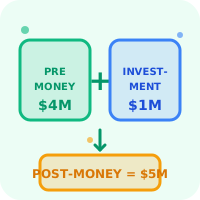
1. Enter Your Pre-Money Valuation
This is what investors say your company is worth BEFORE they invest. You might negotiate this number, or it might be based on comparable companies. Put it in the calculator.
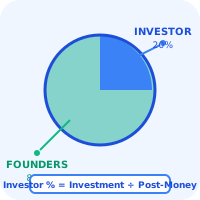
2. Add the Investment Amount
How much is the investor putting in? This could be $500K from an angel, $5M from a VC, or anywhere in between. The calculator instantly shows you your post-money valuation.
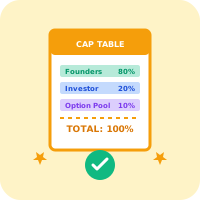
3. Understand Your Dilution
Boom. Now you can see exactly what your startup is worth after investment, how much equity the investor gets, and how much your ownership is diluted. Knowledge is power.
Why I Built This Calculator
I've watched too many founders get screwed in fundraising because they didn't understand post-money valuation. They'd celebrate raising $2M at a "$10M valuation" without realizing they just gave up 20% of their company—and that's before the option pool shuffle.
Here's the thing: pre-money vs. post-money valuation isn't rocket science, but it's confusing when you're in the middle of fundraising and stressed out of your mind. I built this calculator to give you clarity in seconds.
You plug in two numbers—pre-money valuation and investment amount—and I show you everything: post-money valuation, investor ownership, your dilution, price per share, new shares issued. No surprises. No getting blindsided.
Understanding Post-Money Valuation
The Basic Formula (It's Simpler Than You Think)
Post-Money Valuation = Pre-Money Valuation + Investment Amount
That's it. Really. If your startup is worth $4M before investment and you raise $1M, your post-money valuation is $5M. Simple addition.
But here's where it gets interesting—and where a lot of founders get confused. The investor's ownership percentage is calculated using post-money valuation, not pre-money:
Investor Ownership % = Investment Amount ÷ Post-Money Valuation
So in our example, the investor gets $1M ÷ $5M = 20% of your company. Not $1M ÷ $4M = 25%. This small detail makes a huge difference in how much equity you give up.
Pre-Money vs. Post-Money: The Critical Difference
Let me give you a real example from my experience. A founder I know was raising her Series A. An investor offered: "$5M investment at a $15M valuation." Sounds great, right?
But she didn't ask the right question: Is that $15M pre-money or post-money? It matters. A lot.
If $15M is Pre-Money:
- • Pre-Money: $15M
- • Investment: $5M
- • Post-Money: $20M
- • Investor gets: 25%
- • Founder keeps: 75%
If $15M is Post-Money:
- • Post-Money: $15M
- • Investment: $5M
- • Pre-Money: $10M
- • Investor gets: 33.3%
- • Founder keeps: 66.7%
That's an 8.3% difference in ownership—which could be worth millions when you exit. Always clarify which number they're talking about.
Price Per Share: How It All Connects
Now let's add another layer: shares. Post-money valuation determines the price per share, which then determines how many new shares you issue to the investor.
The Share Math:
- Price Per Share: Pre-Money Valuation ÷ Existing Shares Outstanding
- New Shares Issued: Investment Amount ÷ Price Per Share
- Total Shares (Post-Investment): Existing Shares + New Shares Issued
Here's how it plays out in practice: Let's say you have 10M shares outstanding and a $4M pre-money valuation. Your price per share is $0.40. If an investor puts in $1M, they get 2.5M new shares ($1M ÷ $0.40). After the investment, there are 12.5M total shares outstanding, and the investor owns 20% (2.5M ÷ 12.5M).
This is why understanding post-money valuation matters. It affects everything: your ownership percentage, your cap table, your dilution, and ultimately how much money you make when you sell your company.
Understanding Dilution: What Happens to Your Equity
The Dilution Math Nobody Teaches You
Dilution sucks. There's no way around it. Every time you raise money, your ownership percentage goes down. But here's the thing most founders miss: dilution isn't necessarily bad if the pie is growing.
Let me give you an example. You own 100% of a company worth $1M. That's great, but $1M isn't life-changing money. Now you raise $2M at a $8M post-money valuation, giving up 25% of your company. You now own 75% instead of 100%. You got diluted.
But wait. Your 75% is now worth $6M (75% × $8M). That's 6x more than the $1M you started with. So even though you own a smaller percentage, you're worth way more. This is why dilution is the price of growth.
⚠️ The Hidden Dilution Trap: Option Pools
Here's something that screws over founders constantly: investors often require you to create an option pool BEFORE they invest, and that pool comes out of YOUR portion, not theirs.
Let's say you raise $2M at a $8M post-money valuation. Simple math says the investor gets 25% and you keep 75%. But the investor says, "We need a 20% option pool for future hires." If that pool is created pre-money, here's what actually happens:
- • Pre-money valuation: $6M
- • Investment: $2M
- • Post-money valuation: $8M
- • Investor gets: 25% ($2M ÷ $8M)
- • Option pool: 20% (comes out of YOUR 75%)
- • You're left with: 55% (not 75%!)
That 20% option pool just cost you an additional 20% of the company. Always negotiate whether the option pool is pre-money or post-money. It makes a massive difference.
How Much Dilution Is Too Much?
There's no hard rule, but here are the typical ranges I see at each stage:
| Stage | Typical Dilution | Pre-Money Valuation |
|---|---|---|
| Pre-Seed | 10-25% | $500K - $2M |
| Seed | 15-30% | $2M - $8M |
| Series A | 20-35% | $8M - $20M |
| Series B | 15-25% | $20M - $50M |
| Series C+ | 10-20% | $50M+ |
If you're giving up more than 35-40% in a single round, alarm bells should be ringing. That's aggressive dilution and suggests either (a) you're desperate, (b) the investor knows you're in a weak position, or (c) the investor is predatory. None of those are great scenarios.
Post-Money Valuations by Funding Stage
Every funding round has different valuation expectations. Here's what I typically see in the market right now:
Pre-Seed: $1M - $3M Post-Money
You're just getting started. Maybe you have a prototype or early traction. Investors are betting on you, not the business. You'll raise $250K-$750K and give up 15-25%.
Seed: $3M - $15M Post-Money
You have some traction—revenue, users, or a strong team. This is often the first "institutional" money from VCs. You'll raise $500K-$3M and give up 15-30%. Location matters: SF startups are worth 2-3x what Midwest startups are worth.
Series A: $15M - $40M Post-Money
You have product-market fit and meaningful revenue (usually $1M-$5M ARR). This is about scaling what works. You'll raise $5M-$15M and give up 20-35%. Metrics matter here: growth rate, churn, unit economics.
Series B: $40M - $100M Post-Money
You're scaling aggressively. Revenue is usually $5M-$20M ARR. This round is about expansion—new markets, products, or segments. You'll raise $10M-$30M and give up 15-25%. The valuation is based on revenue multiples (usually 10x-20x ARR).
Series C+: $100M+ Post-Money
Late-stage. You're a market leader or on your way there. Revenue is $20M+ ARR. These rounds are about dominating the market or preparing for IPO. You'll raise $30M-$100M+ and give up 10-20%. Valuation is based on revenue multiples or public market comparables.
💡 Pro Tip: Geography and Industry Matter
A SaaS company in San Francisco raising a seed round might get a $12M post-money valuation. The exact same company in Atlanta might get $6M. Unfair? Maybe. But it's reality. Similarly, a SaaS startup is worth more than a consumer app with the same revenue because SaaS has predictable, recurring revenue. Know what's typical for your industry and location.
More Tools for Founders
Fundraising is about more than just valuation. Here are other calculators I've built to help you navigate the journey:
🚀 Pre Money Valuation Calculator
Calculate your startup's pre-money valuation from the investor's perspective. Understand what your company is worth before investment.
🏢 Business Valuation Calculator
Not a startup? Use this tool to value small businesses using SDE/EBITDA multiples.
📈 Discounted Cash Flow Calculator
Want to justify your valuation to investors? Use DCF to show them the math behind your number.
Frequently Asked Questions
What's the difference between pre-money and post-money valuation?
Pre-money valuation is what your company is worth BEFORE investment. Post-money valuation is what it's worth AFTER investment. The formula is simple: Post-Money = Pre-Money + Investment. Think of it this way: pre-money is the value of your existing shares, post-money is the value of all shares (existing + new). This distinction matters because investor ownership is calculated using post-money valuation, not pre-money.
How do I calculate investor ownership percentage?
Investor Ownership % = Investment Amount ÷ Post-Money Valuation. For example, if an investor puts in $2M and your post-money valuation is $10M, they get 20% ownership ($2M ÷ $10M = 20%). This is why pre-money vs. post-money matters so much—if the $10M in my example was pre-money instead of post-money, the investor would own 16.7% instead of 20%.
What is a good post-money valuation for my startup?
It depends on your stage, industry, location, and traction. Pre-seed startups typically see $1M-$3M post-money valuations. Seed rounds are usually $3M-$15M. Series A is $15M-$40M. Series B is $40M-$100M. Series C+ is $100M+. That said, these are rough ranges. A SaaS company in SF might get 3x the valuation of a consumer app in the Midwest. The best way to know your range is to look at comparable companies that recently raised in your industry and location.
How does post-money valuation affect my ownership percentage?
Your ownership gets diluted every time you raise money. Here's the math: If you own 100% and raise money at a $4M pre-money valuation, then raise $1M (25% dilution), you now own 75%. If you then raise another $5M at a $15M post-money valuation (33% dilution), you own 50% (75% × 67%). The key is understanding that dilution is the price of growth—you own a smaller percentage, but of a much more valuable company.
What is price per share and how is it calculated?
Price Per Share = Pre-Money Valuation ÷ Existing Shares Outstanding. For example, if your pre-money valuation is $4M and you have 10M shares outstanding, your price per share is $0.40. The investor then buys new shares at this price. If they invest $1M, they get 2.5M new shares ($1M ÷ $0.40). After the investment, there are 12.5M total shares (10M existing + 2.5M new), and the investor owns 20% (2.5M ÷ 12.5M).
Should I accept a higher valuation from a risky investor?
Be careful. Inflated valuations from predatory investors can backfire. If you raise at a $20M post-money when your company is really worth $10M, you set unrealistic expectations. Next round, if you can't justify a higher valuation, you'll face a 'down round' (raising at a lower valuation than your previous round), which is terrible for morale and can trigger anti-dilution provisions that hurt you even more. I'd rather take a slightly lower valuation from a reputable investor than an inflated valuation from a risky one.
How does an option pool affect post-money valuation?
This is where many founders get screwed. Investors often require you to create an option pool (usually 10-20%) BEFORE they invest, and that pool typically comes out of YOUR ownership, not theirs. If you raise $2M at a $8M post-money valuation and need a 20% option pool, you might think you keep 75% (100% - 25% investor). But if the pool is pre-money, here's what happens: investor gets 25%, option pool gets 20%, and you're left with 55%. Always negotiate whether the option pool is pre-money or post-money.
What is dilution and how much is too much?
Dilution is the reduction in your ownership percentage when you issue new shares to investors. Typical dilution per round: Pre-seed (10-25%), Seed (15-30%), Series A (20-35%), Series B (15-25%), Series C+ (10-20%). If you're giving up more than 35-40% in a single round, that's aggressive and suggests either desperation or a predatory investor. That said, dilution isn't inherently bad—better to own 20% of a $100M company than 100% of a $1M company.
How do I negotiate a higher post-money valuation?
Negotiate pre-money, not post-money. Remember: Post-Money = Pre-Money + Investment. If you want a higher post-money valuation, you need to negotiate a higher pre-money valuation. How? Create competitive tension (multiple investors), show strong metrics (growth, revenue, retention), demonstrate momentum (press, customers, partnerships), and have a compelling story about the future. Also, know your BATNA (Best Alternative to a Negotiated Agreement)—if you have other options, you have more leverage.
Can post-money valuation go down between rounds?
Yes, and it's called a 'down round.' This happens when you raise at a lower valuation than your previous round. For example, if you raised at a $20M post-money last year and raise at a $15M post-money this year, that's a down round. Down rounds are painful—they crush morale, make employees' options underwater, and can trigger anti-dilution provisions that further dilute founders. They're also not the end of the world—many successful companies (including Facebook) had down rounds. But they're something to avoid if possible.
Ready to Calculate Your Post-Money Valuation?
Don't fly blind during fundraising. Use my free calculator to understand exactly what you're giving up—and what you're getting in return.
Calculate Post-Money Valuation Now