How to Determine Fair Market Value
After 15+ years of valuing businesses and assets, I've learned that determining fair market value is both an art and a science. Whether you're selling a business, buying real estate, or navigating tax compliance, I'll show you exactly how professionals determine fair market value in 2026.
Why Determining Fair Market Value Matters
Early in my career, I watched a business owner accept $2M for his company—only to discover later that its fair market value was closer to $3.5M. He left $1.5M on the table because he didn't understand how to properly determine fair market value. That mistake drove me to master valuation, and now I want to help you avoid the same costly error.
Fair market value isn't just a theoretical concept—it's the foundation of countless financial decisions. Whether you're buying or selling a business, valuing real estate, dealing with tax compliance (like 409A valuations for startups), or navigating legal proceedings, knowing how to determine fair market value accurately can save (or make) you thousands or even millions of dollars.
In this comprehensive guide, I'll walk you through the three professional approaches to determining fair market value, explain when to use each method, share real-world examples from my experience, and point you to free tools that can help you calculate fair market value yourself. Let's dive in.
📌 What You'll Learn
- ✓The exact definition of fair market value and why it differs from other value concepts
- ✓Three professional valuation approaches: Asset, Market, and Income methods
- ✓Step-by-step calculations with real-world examples and numbers
- ✓When to use each method based on your asset type and situation
- ✓Free professional tools to calculate fair market value instantly
- ✓Common mistakes that lead to inaccurate valuations (and how to avoid them)
Understanding Fair Market Value: The Basics
Before we dive into the methods, let's make sure we're on the same page about what fair market value actually means—and what it doesn't mean.
📖 The Official Definition
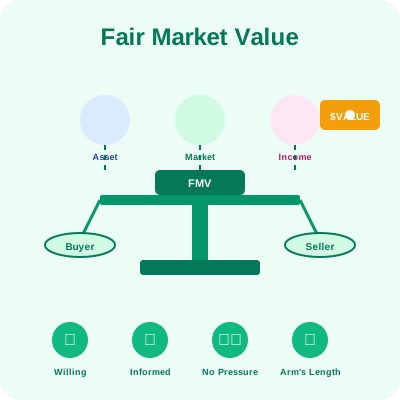
Fair Market Value (FMV) is the estimated price that an asset would sell for under the following conditions:
- 1.Willing Buyer & Seller: Both parties are motivated to complete the transaction
- 2.Reasonable Knowledge: Both parties have reasonable knowledge of the relevant facts
- 3.No Compulsion: Neither party is under duress or pressure to act
- 4.Arm's Length: The transaction is at arm's length (no special relationship)
✅ What Fair Market Value IS
- • An objective, unbiased estimate of value
- • Based on current market conditions
- • Determined using accepted valuation methods
- • Used in legal, tax, and financial contexts
- • The price a "typical" buyer would pay
- • Defensible with proper methodology
❌ What Fair Market Value is NOT
- • The highest price you could possibly get
- • What a specific strategic buyer would pay
- • The price in a forced sale or fire sale
- • Your subjective opinion of worth
- • Book value or accounting value
- • The same as "investment value" for particular buyers
Key Value Concepts You Should Know
Fair Market Value vs. Market Value
While often used interchangeably, fair market value is a legal construct used in specific contexts like tax valuations and litigation, whereas market value is more commonly used in investment analysis and can fluctuate more based on current supply and demand. Fair market value adds a layer of "fairness" and considers hypothetical willing parties under ideal conditions.
Fair Market Value vs. Fair Value (Accounting)
Fair value in accounting (ASC 820/IFRS 13) is different from fair market value. Fair value considers the perspective of market participants and uses a "highest and best use" concept, while fair market value focuses on a hypothetical transaction between willing parties. Accounting fair value is used for financial reporting, while fair market value is used for tax and legal purposes.
Fair Market Value vs. Investment Value
Investment value is what a specific buyer would pay based on their unique circumstances (synergies, strategic fit, etc.). Fair market value assumes a generic, typical buyer without special advantages. A strategic buyer might pay 2-3x investment value compared to fair market value if there are significant synergies.
⚠️ Why This Matters for You
Understanding these distinctions isn't just academic—it has real financial implications. For example, if you're selling your business and rely on "market value" without understanding "fair market value," you might set unrealistic expectations based on outlier transactions or strategic buyer premiums. Or in tax situations, using the wrong valuation standard could trigger IRS scrutiny or penalties. Always use the right value concept for your specific situation.
Three Professional Approaches to Determine Fair Market Value
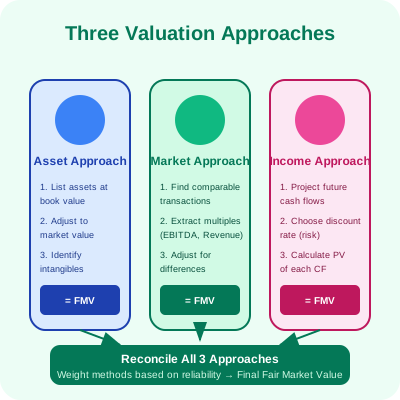
Professional appraisers and business valuation experts use three fundamental approaches. Here's how each one works, when to use it, and real examples from my experience.
1. Asset-Based Approach (Cost Approach)
Best for: Asset-heavy businesses, real estate, holding companies, distressed businesses
How It Works:
Determine the fair market value of all assets (tangible and intangible) minus all liabilities. This approach asks: "What would it cost to recreate this business or asset?" The most common method is the Adjusted Book Value Method, which starts with accounting book values and adjusts them to current market values.
Step-by-Step Calculation:
📊 Real Example: Manufacturing Company
I valued a small manufacturer last year. Here's the adjusted book value calculation:
Pros & Cons:
✓ Pros:
- • Objective and verifiable
- • Works well for asset-heavy businesses
- • Simple to understand
- • Good for distressed companies
✗ Cons:
- • Ignores earning power
- • Misses intangible value
- • Can undervalue service businesses
- • Market values can be hard to determine
2. Market Approach (Comparative Approach)
Best for: Businesses with comparable transactions, public companies, real estate, franchises
How It Works:
Compare your asset to similar assets that have recently sold. Look at the pricing multiples (like EBITDA multiples, revenue multiples, P/E ratios) from comparable transactions and apply them to your asset. This approach asks: "What are others paying for similar assets?"
Common Market Approach Methods:
Guideline Public Company Method
Compare to public companies in same industry. Adjust for size, liquidity, and other factors.
Comparable Transactions Method
Use actual M&A transaction multiples from similar private company sales.
Previous Transactions
Use past transactions in the same company's stock as evidence of FMV.
Rules of Thumb
Industry-specific multiples (e.g., "1.5x revenue for SaaS"). Use with caution.
📊 Real Example: SaaS Business Valuation
I valued a SaaS company with $2M ARR. Found 3 comparable transactions:
Our target: 50% growth, 22% margin → Apply 7x multiple
FMV = $2M × 7 = $14,000,000
Pros & Cons:
✓ Pros:
- • Based on real market data
- • Reflects current market conditions
- • Easy to understand and explain
- • Widely accepted by courts/IRS
✗ Cons:
- • Requires good comparable data
- • True comparables may not exist
- • Each situation is unique
- • Market can be irrational at times
3. Income Approach
Best for: Operating businesses, companies with predictable cash flows, service businesses, startups
How It Works:
Value the asset based on its expected future economic benefits (income, cash flow, or earnings). The most common methods are Discounted Cash Flow (DCF) and Capitalization of Earnings. This approach asks: "What are the future cash flows worth today?"
Common Income Approach Methods:
Discounted Cash Flow (DCF)
Project future cash flows and discount them to present value using a discount rate that reflects risk.
PV = Σ(CF₁/(1+r)¹ + CF₂/(1+r)² + ... + CFₙ/(1+r)ⁿ) + Terminal Value
Capitalization of Earnings (Cap Method)
For stable businesses, divide normalized earnings by a capitalization rate.
Value = Earnings ÷ Cap Rate
Multi-Period Excess Earnings Method (MPEEM)
Used for valuing intangible assets by isolating cash flows attributable to the intangible.
📊 Real Example: Service Business DCF
Valued a consulting firm with $500K EBITDA, growing 10% annually:
5-Year PV: $2,192K + Terminal Value: $2,847K
FMV = $5,039,000
Pros & Cons:
✓ Pros:
- • Captures future earning potential
- • Ideal for service/tech businesses
- • Flexible and sophisticated
- • Focuses on cash flow, not assets
✗ Cons:
- • Requires projections (uncertain)
- • Sensitive to discount rate
- • Complex calculations
- • Garbage in, garbage out
🎯 Which Approach Should You Use?
Professional appraisers typically use multiple approaches and reconcile the results. Here's my framework for choosing methods based on situation:
Asset-Based Best For:
- • Holding companies
- • Real estate
- • Asset-heavy manufacturers
- • Distressed businesses
- • Loss-making companies
Market Approach Best For:
- • Businesses with comps
- • Franchises
- • Real estate
- • Mature industries
- • 409A valuations
Income Approach Best For:
- • Service businesses
- • Tech/SaaS companies
- • Startups with projections
- • Cash-flow-positive businesses
- • Intangible asset valuations
Free Tools to Calculate Fair Market Value
You don't need to hire an expensive appraiser to get started. I've built these free professional tools based on the exact methods I've used throughout my career.
Business Valuation Calculator
SDE & EBITDA Multiple Method
Calculate fair market value using the market approach. Enter your SDE or EBITDA, choose industry multiples, and get instant business valuation estimates. Perfect for small businesses, restaurants, and service companies.
When to use it: You own a profitable business with $50K-$5M in annual earnings and want to know what it's worth based on market comparables.
Discounted Cash Flow Calculator
Income Approach Method
Calculate fair market value using DCF analysis. Project future cash flows, choose your discount rate, and calculate present value. Ideal for businesses with predictable cash flows and growth projections.
When to use it: You have a business with steady cash flows and growth projections, or you need a DCF for investor presentations or internal planning.
Goodwill Calculator
Purchase Price Allocation
Calculate goodwill (intangible value) when determining fair market value in M&A transactions. Enter purchase price and net asset values to see the goodwill component.
When to use it: You're buying or selling a business and need to understand the intangible value beyond tangible assets. Essential for purchase price allocation.
EBITDA Calculator
Earnings Metric for Valuation
Calculate EBITDA from net income, operating income, or revenue. EBITDA is the most common earnings metric used in fair market value calculations for businesses.
When to use it: You need to calculate EBITDA as a starting point for business valuation, or you want to understand EBITDA margins and apply industry multiples.
💡 Pro Tip: Use Multiple Tools
Just like professional appraisers, I recommend using multiple approaches. Calculate value using the market approach (Business Valuation Calculator) and the income approach (DCF Calculator), then compare the results. If they're within 10-20% of each other, you can be confident in your fair market value estimate. If they diverge significantly, investigate why—there may be something unique about your business that one method captures better than the other.
Advanced Topics: Beyond the Basics
Common Fair Market Value Mistakes (And How to Avoid Them)
❌ Mistake #1: Using Only One Valuation Method
Relying on a single method is risky. I've seen businesses undervalued by 50% because the seller only considered asset value (missing substantial goodwill), and others overvalued by 100% because they only looked at revenue multiples without considering profitability.
✅ Solution: Always use at least 2-3 methods and reconcile the results
❌ Mistake #2: Using Outdated or Irrelevant Comparables
Market conditions change rapidly. Using 2021 transaction multiples in 2026 could lead to wildly inaccurate valuations. Also, ensure comparables are truly similar—industry, size, geography, and growth rate all matter.
✅ Solution: Use recent (6-12 months) transactions and adjust for differences
❌ Mistake #3: Ignoring Risk in the Income Approach
Using a 10% discount rate for a high-risk startup or a 25% rate for a stable utility company will produce meaningless results. The discount rate must reflect the actual risk of the cash flows.
✅ Solution: Carefully consider business risk, size, industry, and market position when selecting discount rates
❌ Mistake #4: Double-Counting Assets
I've seen valuations add excess cash to an EBITDA multiple valuation, effectively counting the same value twice. If you're using an earnings multiple, that already includes the operating assets needed to generate those earnings.
✅ Solution: Be explicit about what's included in your valuation and avoid double-counting
❌ Mistake #5: Overadjusting Earnings ("Hockey Stick" Projections)
Adding back every personal expense and projecting unrealistic growth will destroy your credibility with buyers, investors, or the IRS. Aggressive adjustments are a major red flag.
✅ Solution: Only add back legitimate, one-time, non-recurring expenses and use conservative, defensible projections
Special Situations That Affect Fair Market Value
🏢 409A Valuations for Startups
Startups need independent 409A valuations to set strike prices for employee stock options. These valuations must determine FMV following IRS guidelines and typically use a combination of all three approaches.
Common method: Backsolve from recent preferred stock financing, adjusted for lack of marketability and special features.
⚖️ Litigation and Divorce
In legal disputes, FMV determinations must withstand scrutiny from opposing experts and judges. Documentation, methodology, and expert credentials matter immensely.
Key consideration: Fair market value vs. fair value (legal standard) can vary by jurisdiction.
💰 ESOP Valuations
Employee Stock Ownership Plans require annual valuations by independent valuation experts. ERISA imposes strict requirements on methodology and independence.
Critical: Must consider all three approaches and provide detailed documentation.
🏠 Real Estate FMV
Real estate FMV heavily relies on the market approach (comparable sales) but also considers income approach (rental properties) and cost approach (special-purpose properties).
Pro tip: Professional appraisals are standard—DIY valuations rarely accepted by lenders.
How to Document and Defend Your Fair Market Value
Whether for tax purposes, litigation, or a transaction, your FMV determination must be well-documented and defensible. Here's the framework I use:
State the Purpose and Standard of Value
Document why you're determining FMV (tax, transaction, litigation) and confirm it's the appropriate standard.
Describe the Asset/Business Thoroughly
Include history, operations, financials, management, market position, and risk factors.
Explain Economic and Industry Conditions
Document the market environment, industry trends, competitive landscape, and economic outlook.
Apply Multiple Valuation Approaches
Use at least 2-3 methods. Explain why you chose each and how you weighted them in reconciliation.
Document All Sources and Assumptions
Cite data sources (comps, financial statements), explain assumptions, and show all calculations.
Reconcile to Final Conclusion
Explain how you weighed different approaches and arrived at final FMV with a clear, logical rationale.
Remember: If your FMV determination can't withstand scrutiny from a qualified opposing expert, it's not worth the paper it's written on. Invest in proper documentation from the start.
Frequently Asked Questions
What is the difference between fair market value and fair value?
Fair market value (FMV) is the price an asset would sell for between willing, knowledgeable parties under no compulsion. It's used primarily in tax, legal, and regulatory contexts. Fair value (in accounting, per ASC 820/IFRS 13) is the price that would be received to sell an asset in an orderly transaction between market participants. Key differences: (1) FMV assumes hypothetical willing parties, while fair value considers the perspective of market participants; (2) FMV is used for tax/legal purposes, while fair value is used for financial reporting; (3) Fair value often uses a 'highest and best use' concept, while FMV considers the asset's current use. In practice, they often yield similar numbers, but the conceptual differences matter in specific contexts like tax compliance vs. financial statements.
How do I calculate fair market value of a small business?
For small businesses (typically under $5M revenue), use this process: (1) Calculate SDE (Seller's Discretionary Earnings) or EBITDA—normalize earnings by adding back one-time expenses and excess owner compensation; (2) Research industry multiples—for small businesses, SDE multiples typically range 1.5-3x, EBITDA multiples 2-5x depending on industry; (3) Apply market approach: Value = Normalized Earnings × Industry Multiple; (4) Adjust for asset value: Add net working capital and fixed assets, subtract excess liabilities; (5) Consider income approach: If the business has strong growth projections, run a DCF analysis; (6) Reconcile: Use multiple methods and weight them based on reliability. For a typical small business with $200K SDE, at a 2.5x multiple, FMV ≈ $500K plus net assets. Use our free Business Valuation Calculator to run these calculations instantly.
What is the formula for fair market value?
There's no single formula—fair market value depends on the asset type and valuation approach. However, here are the most common formulas: (1) Market Approach: FMV = Earnings × Multiple (e.g., FMV = EBITDA × 5x or FMV = Revenue × 1.5x); (2) Income Approach (DCF): FMV = Σ[CFₜ/(1+r)ᵗ] + Terminal Value, where CF = cash flow, r = discount rate, t = time period; (3) Asset Approach: FMV = Fair Value of Assets - Fair Value of Liabilities; (4) Capitalized Earnings: FMV = Normalized Earnings ÷ Capitalization Rate; (5) Real estate (direct cap): FMV = Net Operating Income ÷ Cap Rate. The right formula depends on your situation: earnings multiples for operating businesses, DCF for growth companies, asset value for holding companies or real estate. Professional appraisers typically use multiple formulas and reconcile the results.
How often should fair market value be determined?
The frequency depends on the purpose and context: (1) For 409A valuations (startup stock options)—annually or sooner if there's a material event (new funding round, major pivot, significant change in financials); (2) For ESOPs—annually by IRS requirement; (3) For financial reporting (ASC 820)—at each reporting period (quarterly/annually) or when impairment indicators exist; (4) For tax purposes (gift/estate tax)—as of the date of gift or death; (5) For transaction planning—6-12 months before anticipated sale, and updated closer to transaction; (6) For internal management—annually or when major business changes occur. Remember that FMV changes over time as market conditions, business performance, and economic factors change. A valuation from 12 months ago may no longer be accurate today.
What factors affect fair market value?
Fair market value is influenced by dozens of factors across three categories: (1) Company-Specific Factors: Financial performance (revenue, profit margins, growth rate), customer base (concentration, retention, LTV), competitive advantages (IP, brand, technology), management team quality, operational efficiency, debt load and capital structure, asset quality, and historical trends. (2) Industry Factors: Growth prospects, competitive landscape, regulatory environment, technological disruption, cyclicality, and consolidation trends. (3) Economic/Market Factors: Interest rates, economic outlook, availability of capital, buyer demand, M&A activity levels, comparable transactions, and market sentiment. For example, a SaaS company with high growth, low churn, and strong margins will command a much higher FMV in 2026 than a declining legacy manufacturing business with high debt and weak margins. The more positive the factors across all three categories, the higher the FMV.
Can I determine fair market value myself, or do I need a professional appraiser?
You can absolutely determine fair market value yourself for internal planning, preliminary sale preparation, or basic understanding. Use our free calculators to get started quickly. However, there are situations where a professional appraiser is required or strongly recommended: (1) Required: 409A valuations for startups (IRS requirement), ESOP valuations (ERISA requirement), financial reporting for public companies (GAAP requirement), litigation/expert witness testimony, tax audits or disputes; (2) Highly Recommended: Major transactions (selling a business >$1M), estate/gift tax returns with substantial assets, divorce proceedings, partnership buyouts, regulatory compliance. Professional appraisers bring independence, credentials, defensible methodology, and courtroom credibility. Cost typically ranges from $5K-$50K depending on complexity. For internal purposes or small transactions, start with DIY tools; for anything with legal/tax implications, invest in a professional.
What is a 409A valuation and how does it determine fair market value?
A 409A valuation is an independent appraisal of a startup's fair market value for the purpose of setting the strike price for employee stock options. Required under IRS Section 409A, it ensures companies don't set artificially low strike prices (which would be taxable compensation). The 409A valuation determines FMV using the three valuation approaches: (1) Backsolve Method (most common): Start with the price per share paid in recent preferred stock financing, then adjust for lack of marketability and special rights (liquidation preference, participation, etc.) to derive common stock FMV; (2) Market Approach: Compare to similar public companies or recent M&A transactions, applying multiples and adjusting for size, stage, and risk; (3) Income Approach: DCF analysis of projected future cash flows (less common for early-stage). The 409A report documents methodology, assumptions, data sources, and concludes with a specific FMV per share. Startups need a new 409A annually or after material events (new funding round, pivot, major change in financials).
How does fair market value apply to real estate?
Real estate FMV follows the same three approaches used for business valuation: (1) Market Approach (most common for real estate): Appraisers find 3-6 comparable properties that sold recently in the same area, adjust for differences (size, condition, amenities, location), and derive a price per square foot or total value. This is the 'sales comparison' method. (2) Income Approach: For rental properties, FMV = Net Operating Income ÷ Capitalization Rate. Cap rates vary by property type and location (e.g., 4-6% for multifamily in major metros, 7-10% for retail). (3) Cost Approach: Calculate the cost to replace the structure (minus depreciation) plus land value. Used for special-purpose properties or new construction. Professional real estate appraisals weigh all three methods, with market approach typically most heavily weighted. Residential appraisals cost $400-$800; commercial appraisals $3K-$15K depending on complexity. For mortgage purposes, lenders require professional appraisals—they won't accept DIY valuations.
What is the difference between fair market value and book value?
Book value is an accounting concept based on historical costs recorded on the balance sheet. Fair market value is the current market price based on supply and demand. Key differences: (1) Basis: Book value = historical cost minus accumulated depreciation; FMV = current market value; (2) Timing: Book value is backward-looking (what you paid); FMV is current (what it's worth now); (3) Adjustments: Book value follows accounting rules (GAAP); FMV considers market conditions, appraisals, and intangible value; (4) Intangibles: Book value typically excludes intangible assets like brand, customer relationships, IP (unless separately acquired); FMV includes all intangibles; (5) Use case: Book value is used for financial reporting and some debt covenants; FMV is used for transactions, tax, and legal matters. Example: A software company might have a book value of $1M (assets minus liabilities) but a fair market value of $10M due to strong customer relationships, technology, and growth potential. Conversely, an old manufacturing plant might have a book value of $5M but FMV of only $2M due to outdated equipment and declining markets.
How do you determine fair market value of intangible assets?
Intangible assets (patents, trademarks, customer lists, software, goodwill) require specialized valuation approaches: (1) Income Approach (most common): Use the Multi-Period Excess Earnings Method (MPEEM). Project cash flows attributable specifically to the intangible, discount to present value. Example: For a patent, calculate incremental profits from the patented technology vs. non-patented alternatives over the patent's remaining life, discount at a rate reflecting the patent's risk. (2) Market Approach: Find comparable licenses, sales, or royalty agreements. If similar patents licensed for 3% royalty, apply that to the asset's revenue. (3) Cost Approach: Calculate the cost to recreate the intangible (R&D expenses, legal fees, marketing costs). Less common because cost doesn't equal value. (4) Relief from Royalty: Calculate what you'd pay to license the asset if you didn't own it (Market Approach variation). (5) With-and-Without: Compare business value with and without the intangible. Intangible value = (Value with asset) - (Value without asset). Challenges: Intangibles are harder to value than tangibles due to lack of market data and uncertainty about future benefits. Professional valuation is often necessary.
What documentation is needed to support a fair market value determination?
To create a defensible FMV determination, you need comprehensive documentation: (1) Business/Asset Description: Detailed overview, history, operations, products/services, management team, facilities, competitive advantages; (2) Financial Statements: 3-5 years of balance sheets, income statements, cash flow statements, plus current YTD financials; (3) Tax Returns: 3-5 years of business tax returns (provide credibility); (4) Industry and Market Data: Market research, industry reports, competitor analysis, growth trends; (5) Comparable Transactions: Details on similar businesses/assets sold (prices, multiples, terms); (6) Asset Detail: Equipment lists, real estate appraisals, inventory detail, depreciation schedules; (7) Projections (if using income approach): 3-5 year forecasts with supporting assumptions; (8) Adjustments: Explanation of all normalized earnings adjustments with supporting documentation; (9) Methodology Explanation: Detailed description of valuation approaches used, why chosen, calculations performed; (10) Reconciliation: How different methods were weighted and final FMV determined. The more thorough your documentation, the more defensible your FMV will be under scrutiny.
How does debt affect fair market value of a business?
Debt affects fair market value differently depending on the valuation method and context: (1) Asset Approach: FMV of Equity = (FMV of Assets) - (FMV of Liabilities including debt). Higher debt = lower equity FMV. (2) Market Approach: Multiples (EBITDA, revenue) typically value the business at the enterprise value level, which is pre-debt. To get equity value: Equity Value = Enterprise Value - Debt + Cash. (3) Income Approach: Debt is accounted for in the discount rate (WACC includes cost of debt) and/or in net cash flows. Higher debt usually increases risk (higher discount rate) but also provides tax shield (interest is tax-deductible). Example: Business with $1M EBITDA, 5x multiple → $5M enterprise value. If business has $2M debt and $500K cash: Equity FMV = $5M - $2M + $500K = $3.5M. Key distinction: Enterprise value (EV) is the value of operations independent of capital structure. Equity value accounts for debt. Most transactions are priced on an equity value basis (what the seller walks away with after paying off debt). Always clarify whether a stated FMV includes or excludes debt.
What role does risk play in determining fair market value?
Risk is the single biggest factor affecting fair market value. Higher risk = lower FMV, all else equal. Risk manifests in several ways: (1) Income Approach: Higher discount rates directly reduce present value. A stable utility might have a 7% discount rate; a high-growth tech startup might have 25-40%. The difference dramatically affects valuation. (2) Market Approach: Riskier businesses trade at lower multiples. A SaaS company with 120% churn might get 3x revenue, while one with 5% churn gets 10x. (3) Key Risk Factors: Customer concentration (one customer = 30%+ revenue = high risk), technology obsolescence, competitive threats, regulatory risk, management dependence, financial leverage, cyclical revenue, commodity price sensitivity, litigation risk, key person risk. (4) How to Mitigate Risk Impact: Diversify customer base, document recurring revenue, secure long-term contracts, build strong management team, maintain clean financials, create defensible market position, invest in technology/IP. Buyers pay premium for lower risk—often 20-50% more than similar businesses with higher risk profiles. Documenting risk reduction strategies can significantly increase FMV.
How do changes in economic conditions affect fair market value?
Economic conditions have a profound impact on FMV, often more than business-specific factors: (1) Interest Rates: Higher rates = higher discount rates (DCF) = lower valuations. Higher rates also reduce buyer purchasing power (less debt financing available). Example: A business worth $5M at 5% interest rates might be worth only $3.5M at 8% rates. (2) Economic Growth: In strong economies, buyer confidence high, competition for deals high, multiples expand. In recessions, buyers retreat, deal flow slows, multiples contract. (3) Industry Cycles: Some industries highly cyclical (construction, energy). FMV can swing 50%+ based on where you are in the cycle. (4) Inflation: High inflation squeezes margins (if can't pass through costs), increases capex costs, increases working capital needs—all reducing FMV. But some businesses (pricing power) benefit. (5) Access to Capital: When credit is loose, more buyers can afford higher prices, increasing FMV. When credit tightens, buyer pool shrinks, FMV declines. (6) Market Sentiment: Optimism/pessimism affects buyer willingness to pay. Tech valuations in 2021 vs. 2023 illustrate this dramatically. Best practice: Time valuations close to transactions and be aware of economic context.
What is the role of synergies in fair market value?
This is a critical distinction: Fair market value <strong>excludes</strong> synergies that specific buyers might realize. FMV assumes a hypothetical 'financial' buyer who wouldn't realize operational synergies. <strong>Investment value</strong> or <strong>strategic value</strong> includes synergies. Example: A competitor buyer might eliminate duplicate costs (one HQ instead of two, combined purchasing power), cross-sell to both customer bases, and realize technology integration benefits. These synergies might justify paying 2x the FMV. But FMV determination must ignore these specific synergies and value the business on a standalone basis. Confusion between FMV and strategic value is common. I've seen sellers reject FMV-based offers because they've heard of strategic multiples that include synergies their business won't realize for most buyers. Conversely, strategic buyers sometimes try to justify low offers citing FMV when they should pay strategic value. Key point: If you're a strategic buyer with genuine synergies, you can justify paying above FMV. If you're a financial buyer (PE, individual), FMV is the right benchmark.
How do you value a startup with no revenue for fair market value?
Valuing pre-revenue startups requires specialized approaches since traditional earnings-based methods don't work: (1) Cost Approach: FMV ≈ capital invested to date. If you've raised $2M and have tangible IP developed, FMV is at least $2M. (2) Backsolve Method: If recent financing occurred, use that price per share adjusted for differences in rights/preferences between investor shares and common shares. (3) Berkus Method: Assign value to key progress milestones (sound idea = $0-500K, prototype = $0-500K, quality team = $0-500K, strategic relationships = $0-500K, product rollout/sales = $0-500K). Max ~$2-2.5M. (4) Scorecard Method: Compare to regional averages for similar startups, adjust for team, market, product, traction. (5) Venture Capital Method: Project exit value in 5-7 years, apply desired ROI multiple to back into current valuation. (6) Comparable Transactions: Look at what similar pre-revenue startups raised at recently. Key challenge: Pre-revenue startups are highly uncertain, valuations vary wildly. The 409A valuation is critical for establishing defensible FMV for employee options. Expect wide ranges—a pre-revenue startup might be worth anywhere from $500K to $5M depending on team, market, and traction.
What happens if fair market value is disputed?
FMV disputes are common in tax audits, litigation, divorce, and partnership disputes. Here's what happens: (1) IRS Audits: If IRS disagrees with your FMV (e.g., for estate/gift tax), they'll propose their own valuation and additional tax. You can contest by hiring a qualified appraiser and presenting a rebuttal valuation. Many cases settle; some go to Tax Court. (2) Litigation: In shareholder oppression, divorce, partnership dissolution, each side hires expert appraisers. They present methodologies, depositions, and testimony. The judge or jury decides which FMV to accept. (3) Buy-Sell Disagreements: If partners disagree on value, the buy-sell agreement typically specifies a process (one appraiser, each side picks appraiser then they agree on a third, 'shotgun' clause). (4) How to avoid disputes: Use independent, qualified appraisers; follow accepted valuation standards (USPAP, ASA); document everything; get multiple appraisals for significant transactions; involve all parties early in the process; include dispute resolution mechanisms in agreements. (5) Cost: Defending FMV in litigation can cost $50K-$200K+ in expert fees. It's usually cheaper to get it right upfront with a professional appraisal than to defend a DIY valuation later.
Related Tools & Guides
🏢 Business Valuation Calculator
Calculate business value using SDE/EBITDA multiples. Fast, accurate, free.
Calculate Business Value →📊 DCF Calculator
Discounted Cash Flow valuation for detailed income approach analysis.
Calculate DCF →💼 How to Determine Business Value
Complete guide covering DCF, comparables, precedent transactions, and asset valuation.
Read Guide →🏛️ Goodwill Calculator
Calculate intangible value and goodwill in business transactions.
Calculate Goodwill →💵 EBITDA Calculator
Calculate EBITDA, EBITDA margin, and business value instantly.
Calculate EBITDA →🔍 How to Value a Company for Purchase
M&A valuation guide for buyers covering due diligence and deal structures.
Read Guide →Ready to Determine Your Fair Market Value?
Don't guess your fair market value—calculate it with confidence using our free professional tools. Whether you're valuing a business, real estate, or any asset, start with proven methods used by experts.
All calculators are free. No signup required. Get instant results based on professional valuation methods.