How to Value a Company for Purchase
I've seen too many buyers overpay for businesses because they didn't understand valuation. Let me show you how to value a company the right way—so you don't become another statistic.
Why I Wrote This Guide
Here's the brutal truth: most business buyers overpay. I've watched it happen time and time again. Someone gets excited about a business, falls in love with the story, and pays a premium that makes absolutely no financial sense. Five years later, they're still trying to earn back their investment.
Valuation isn't rocket science, but it does require discipline. You need to understand what drives value, which methods to use, and—most importantly—when to walk away. That's exactly what I'm going to teach you in this guide.
I'm going to walk you through the exact process I use when evaluating companies for acquisition. We'll cover the three main valuation approaches, when to use each one, red flags that scream "overpriced," and negotiation strategies that can save you millions. Ready? Let's dive in.
The Three Pillars of Company Valuation
When I value a company, I look at it through three different lenses. Each one gives me a different perspective, and together they help me triangulate the true value.
The Income Approach (DCF Analysis)
This is the gold standard. The Discounted Cash Flow (DCF) method asks a simple question: "How much cash will this business generate in the future, and what's that worth today?" It's based on the fundamental principle that a company is worth the present value of its future cash flows.
How It Works:
- Step 1: Project future cash flows (usually 5-10 years)
- Step 2: Calculate terminal value (what the business is worth beyond your projection period)
- Step 3: Discount everything back to present value using a discount rate (typically 8-15%)
- Step 4: Divide by shares outstanding to get per-share value
Best for: Companies with stable, predictable cash flows. Think manufacturing, distribution, SaaS with recurring revenue, service businesses with long-term contracts.
Watch out for: This method is incredibly sensitive to your assumptions. Change your growth rate by 2% and your valuation could swing by 20-30%. Always run sensitivity analysis.
The Market Approach (Comparable Companies)
This approach asks: "What are other similar companies worth?" It's like when you're buying a house—you look at what similar homes in the neighborhood recently sold for. In business valuation, we use valuation multiples like EV/EBITDA, P/E, or EV/Revenue.
Common Multiples:
- EV/EBITDA: Enterprise Value ÷ Earnings Before Interest, Taxes, Depreciation, and Amortization. Most common for M&A.
- P/E Ratio: Price ÷ Earnings per Share. Simple but flawed (doesn't account for debt).
- EV/Revenue: Used for unprofitable companies or high-growth tech startups.
- P/B Ratio: Price ÷ Book Value. Best for asset-heavy industries like banking or manufacturing.
Best for: When you have good comparable data. Public companies, recent M&A transactions in your industry, or businesses with standard financial models.
Watch out for: No two companies are exactly alike. You'll need to adjust for differences in growth rate, profitability, risk, and size. Also, multiples can be misleading during market bubbles.
The Asset Approach (Precedent Transactions)
This method values a company based on what it owns: its assets minus its liabilities. It's the "breakup value"—what you'd get if you sold everything and paid off all debts. There are two main variations: Book Value (accounting value) and Liquidation Value (what you'd actually get in a fire sale).
When to Use Asset-Based Valuation:
- Asset-heavy businesses: Real estate, manufacturing, holding companies
- Distressed companies: When ongoing operations are worth less than the assets
- Loss-making businesses: When income approaches don't make sense
- Precedent Transactions: Look at what buyers actually paid for similar companies recently
Best for: Companies where the assets are worth more than the earnings capacity, or as a "floor" valuation (the absolute minimum someone should accept).
Watch out for: Intangible assets (brand, customer relationships, IP) are often not reflected on the balance sheet. A company might have low book value but massive hidden value in its brand or customer list.
My Step-by-Step Valuation Process
I've simplified the complex world of business valuation into three practical steps. Here's exactly how I approach every potential acquisition.
Gather and Analyze Financial Data
Before you can value anything, you need data. And I'm not just talking about the profit and loss statement the seller shows you. You need to dig deeper. Much deeper.
- ✓Get 3-5 years of financials: Revenue, EBITDA, free cash flow, margins, working capital trends
- ✓Normalize earnings: Add back owner salary, one-time expenses, personal perks (this is your SDE or adjusted EBITDA)
- ✓Quality of earnings: Are profits backed by cash? Or is it all accounting profits with no cash in the bank?
- ✓Customer and revenue concentration: What percent of revenue comes from the top 3 customers?

Choose and Apply Valuation Methods
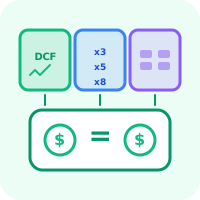
Now the fun part. I always run multiple valuation methods and see where they converge. If DCF says $10M, comparable analysis says $11M, and precedent transactions say $9M, I have high confidence the value is around $10M. If they're all over the place, something's wrong.
- ✓Start with multiples: It's quick and gives you a market reality check
- ✓Run a DCF: This is your primary valuation for most businesses
- ✓Check precedent transactions: What did buyers actually pay for similar businesses?
- ✓Calculate asset value: This is your floor—don't pay less than breakup value
Adjust, Negotiate, and Make a Decision
Here's where most buyers mess up. They take their valuation at face value and either walk away or pay the asking price. Huge mistake. Your valuation is a starting point, not the final word.
- ✓Apply discounts: Key person risk, customer concentration, declining industry, outdated technology
- ✓Apply premiums: Strategic value, synergies, proprietary technology, recurring revenue
- ✓Set your walk-away price: Before you negotiate, know your absolute maximum
- ✓Structure the deal: All-cash vs. earn-out vs. seller financing can dramatically reduce risk

Advanced Valuation Techniques
DCF Deep Dive: The Art of Assumptions
A DCF valuation is only as good as your assumptions. Let me share some rules of thumb I've developed over years of valuing companies:
Growth Rate Guidelines:
- Mature businesses: 2-5% (roughly GDP growth or slightly above)
- Stable growers: 5-10% (solid businesses with room to expand)
- High-growth companies: 10-20% (but only for 5 years, then normalize)
- Red flag: Anything above 20% for more than 5 years is unrealistic for 99% of businesses
Discount Rate (WACC) Guidelines:
- Low risk (utilities, established brands): 7-9%
- Average risk (most businesses): 9-11%
- High risk (tech startups, cyclical industries): 12-15%
- Very high risk (early-stage, unproven): 15%+
Pro tip: Always run sensitivity analysis. Create a table showing valuation at different growth rates (5%, 7%, 10%) and discount rates (8%, 10%, 12%). If the value swings wildly, your valuation is fragile and you should be conservative.
Multiple Analysis: What's the Right Multiple?
EV/EBITDA multiples range from 3x to 20x depending on the industry and company quality. Here's what I've seen in the market:
| Business Type | Typical EV/EBITDA Range |
|---|---|
| Main street businesses (restaurants, retail) | 2x - 4x |
| Service businesses | 3x - 6x |
| Manufacturing & Distribution | 4x - 7x |
| SaaS / Tech | 8x - 15x+ |
| High-growth tech | 15x - 30x+ |
Important: These are rough ranges. A trash business with 3x EBITDA might be overpriced, while a SaaS company with 15x might be a steal if it's growing 100% year-over-year. Context matters.
Synergy Valuation: The Strategic Premium
Sometimes a company is worth more to you than to anyone else. This is the strategic buyer's advantage. Synergies come in two flavors:
Revenue Synergies
- • Cross-selling products to new customers
- • Expanding into new geographic markets
- • Price increases from reduced competition
Cost Synergies
- • Eliminating duplicate roles
- • Bulk purchasing power
- • Shared facilities and technology
⚠️ The Synergy Trap
Be conservative. In my experience, buyers realize only about 50-60% of projected synergies. Sellers know the synergies exist and will demand a premium. Don't pay 100% for synergies you're only 60% confident in achieving.
Red Flags: When to Run, Not Walk
🚩 Declining Revenue
Shrinking topline is rarely a "fixable" problem. If revenue has declined for 3+ years, there's usually a fundamental issue with the business model or market.
🚩 Customer Concentration
If any customer represents more than 20% of revenue, you're one phone call away from disaster. That customer knows they have leverage and will demand price cuts.
🚩 Key Person Dependency
If the founder is the business, what happens when they leave? I've seen businesses collapse 6 months after the founder exited because all the relationships left with them.
🚩 One-Time Items Every Year
"One-time legal expense" shouldn't appear every year. Aggressive add-backs inflate EBITDA and mislead buyers.
🚩 Accounts Receivable Aging
If customers aren't paying on time, it might signal product quality issues, customer dissatisfaction, or financial distress.
🚩 High Employee Turnover
Good people don't leave great companies. High turnover often signals toxic culture, poor leadership, or a sinking ship.
🚩 Undisclosed Litigation
If they're hiding lawsuits during due diligence, what else are they hiding? A major legal judgment can wipe out years of profits.
🚩 Industry Decline
Don't catch a falling knife. Blockbuster Video looked cheap at $5/share. Then $2. Then bankruptcy. Some industries are structurally doomed.
Due Diligence Checklist: What I Check Every Time
💰Financial Due Diligence
- 3-5 years of financial statements (audited if available)
- Tax returns vs. financial statements (reconcile any differences)
- Accounts receivable aging report
- Inventory analysis (obsolete, slow-moving items)
- Debt schedules and loan agreements
- Capex history and future requirements
- Working capital trends and seasonality
⚖️Legal Due Diligence
- Corporate documents (articles, bylaws, minutes)
- Contracts (customer, supplier, employee, leases)
- Intellectual property (patents, trademarks, domain names)
- Litigation history and pending lawsuits
- Regulatory compliance and permits
- Employee agreements and non-competes
⚙️Operational Due Diligence
- Organizational chart and key personnel
- Customer concentration analysis
- Supplier relationships and dependencies
- Technology and systems assessment
- Physical condition of facilities and equipment
- Insurance coverage and claims history
Negotiation Strategies: How I Close Deals
1. Set Your Walk-Away Price Before You Negotiate
This is critical. Know your absolute maximum price before you ever talk to the seller. Write it down. Put it in a drawer. When emotions run high and the seller pushes you to "just meet halfway," refer to your number. If they won't budge below it, walk away. There will always be another deal.
2. Use Earn-Outs to Bridge the Gap
An earn-out is a contingent payment: you pay X now, and Y more if the business hits certain targets. It's brilliant for three reasons:
- Reduces risk: If the business underperforms, you pay less
- Motivates the seller: They stay invested in success
- Bridges valuation gaps: Seller thinks it's worth $10M, you think $8M? Offer $7M + $3M earn-out
Caveat: Earn-outs are complex. Structure them carefully, define clear metrics, and remember that many sellers hate them (they want to cash out and leave).
3. Deal Structure Matters More Than Price
I've seen buyers negotiate the price down by 10% but accept terrible terms that cost them 30% more in risk. Focus on the entire deal structure:
Asset Purchase (Usually Better for Buyers)
- • Step-up in tax basis (depreciation benefits)
- • You choose which liabilities to assume
- • Cleaner legal structure
Stock Purchase (Usually Better for Sellers)
- • You assume all liabilities (known and unknown)
- • No step-up in basis (higher taxes)
- • Simpler for sellers (they just leave)
4. Seller Financing = Seller Confidence
If the seller won't finance any part of the deal, ask yourself why. When a seller is willing to take back a note for 10-20% of the purchase price, it sends a powerful signal: they believe the business will generate the cash to make those payments.
Typical seller financing terms: 5-7 years, 6-8% interest, secured by the business assets. It also aligns incentives—the seller has skin in the game and will help ensure a smooth transition.
⚠️ When to Walk Away
Sometimes the best deal is no deal. Walk away if:
- • The seller won't provide sufficient financial information
- • Your due diligence reveals major red flags
- • The seller refuses to negotiate on price or terms
- • Your gut says something is off (trust your instincts)
- • The price exceeds your walk-away number
- • You're doing the deal for ego, not economics
Tools I Use for Valuation
Throughout this guide, I've mentioned several approaches. Here are the calculators I've built to help you apply them:
🏢 Business Valuation Calculator
Value any business using the SDE/EBITDA multiple method. Perfect for small businesses and main street acquisitions.
📈 Discounted Cash Flow Calculator
The gold standard for valuation. Calculate intrinsic value based on future cash flows.
🚀 Pre Money Valuation Calculator
Valuing startups? Calculate pre-money and post-money valuation, equity dilution, and price per share.
💰 How Much Can I Sell My Business For?
Comprehensive guide to business valuation from the seller's perspective. Understanding both sides makes you a better negotiator.
Frequently Asked Questions
What's the difference between valuation and purchase price?
Valuation is what a business is worth based on objective analysis. Purchase price is what a buyer actually pays. The two often differ because valuation provides a range, and the final price depends on negotiation, deal structure, earn-outs, and strategic value. I always tell people: let your valuation inform your maximum price, but don't treat it as the exact number you must pay.
How accurate are DCF valuations really?
Here's the honest truth: a DCF is only as accurate as your assumptions. Change your growth rate assumption by 2% and your valuation might swing 20-30%. That said, DCF forces you to think rigorously about the business drivers. I use it not to get a precise number, but to understand the logic and sensitivities. Always run multiple scenarios (bear case, base case, bull case) rather than relying on a single number.
Should I use SDE or EBITDA for valuation?
For businesses under $2M in revenue, use SDE (Seller's Discretionary Earnings). It adds back the owner's salary, personal benefits, and one-time expenses to show total cash flow available to a owner-operator. For businesses over $2M-5M in revenue, use EBITDA. It's more standardized and what professional buyers, private equity, and lenders expect. SDE typically yields higher multiples (2-4x) while EBITDA multiples are lower (3-6x) because EBITDA is usually a larger number.
What's a typical valuation multiple for small businesses?
It varies wildly by industry and business quality, but here are rough rules of thumb: Main street businesses (restaurants, retail) typically sell for 2-3x SDE. Service businesses trade at 2.5-4x SDE. Manufacturing and distribution companies get 3-6x EBITDA. SaaS and tech businesses can command 8-15x EBITDA or even 5-10x revenue for high-growth companies. Remember: these are starting points. A great business might sell for double these multiples, while a struggling one might sell for half.
How do I value a company with no profits?
Profitless companies require different approaches. For pre-revenue startups, I look at comparable transactions (what did similar stage companies sell for?) and discounted cash flow assuming they become profitable in 3-5 years. For unprofitable but growing companies, use EV/Revenue multiples (common in tech). For distressed businesses, asset liquidation value often sets the floor. In all cases, be extra conservative and require a large margin of safety.
What's the role of synergies in valuation?
Synergies are cost savings or revenue enhancements that make a business worth more to you than to other buyers. Cost synergies (eliminating duplicate functions, bulk purchasing) are more reliable than revenue synergies (cross-selling, market expansion). Here's my rule: value the business on a stand-alone basis first. Then calculate the net present value of synergies you're 80%+ confident in achieving. Offer to pay a premium for those synergies, but never pay full price for speculative benefits.
How long does a professional valuation take?
A rough back-of-the-napkin valuation takes me a few hours once I have the financial data. A formal valuation report for a bank or legal dispute typically takes 2-4 weeks and costs $5,000-25,000 depending on complexity. For M&A transactions, I recommend doing a quick valuation upfront (to decide if it's worth pursuing), then a thorough valuation during due diligence once you're serious. Don't spend $20k on a formal valuation for a deal you're not committed to.
Can I negotiate the valuation, or is it set in stone?
Valuation is always negotiable. Remember: valuation is an estimate, not a fact. I've seen valuations from different 'experts' vary by 30-40% for the same business. Your job is to understand the assumptions behind their valuation and challenge them. Is their growth rate too optimistic? Is their discount rate too low? Are they ignoring red flags? Negotiate the assumptions, not just the final number.
What's an earn-out and how does it affect valuation?
An earn-out is a contingent payment: the buyer pays additional money in the future only if the business hits specific targets (usually revenue or EBITDA). Earn-outs bridge valuation gaps—seller wants $10M, buyer wants to pay $8M, so they agree on $7M upfront plus $3M in earn-out if targets are met. Earn-outs reduce buyer risk but create complexity. I typically see earn-outs representing 10-30% of total deal value, spanning 1-3 years.
Should I hire a professional business valuator?
It depends on your situation. For small deals under $1M, probably not—the cost ($5k-15k) isn't worth it. Use online calculators and common sense. For deals over $1-2M, especially if there are multiple partners, lenders involved, or tax implications, yes, hire a certified professional (CPA/ABV, ASA, or CVA). For legal disputes, divorce settlements, or IRS matters, you almost always need a formal valuation from a certified expert. They bring objectivity and credibility that you can't provide yourself.
Ready to Value Your Next Acquisition?
Don't leave money on the table. Use my free calculators to run the numbers before you make an offer. A little upfront analysis can save you millions.