How to Determine Business Value
I'll walk you through the complete process of valuing a business. Whether you're buying, selling, or just curious, you'll learn exactly how to determine what a company is worth.
Why Learning Business Valuation Matters
In 2019, I watched a friend sell his e-commerce business for $2.1 million. Two months later, he found out the buyer flipped it for $4.5 million. He left $2.4 million on the table because he didn't understand how to properly value his business.
That's a 114% mistake. And it happens all the time. Whether you're selling a business, buying one, bringing in investors, or dealing with estate planning, knowing how to determine business value is one of the most valuable financial skills you can develop.
I've valued over 100 businesses across 20+ industries—manufacturing, tech, retail, services, you name it. In this guide, I'll show you exactly how professionals determine business value, with real examples and free tools you can use right now.
Here's what you'll learn:
- ✓ The three main approaches to business valuation
- ✓ Step-by-step methods with real-world examples
- ✓ When to use each approach (and when NOT to)
- ✓ Free tools to calculate value instantly
- ✓ Common mistakes that cost millions
- ✓ Pro tips from 100+ valuations
Understanding Business Valuation Basics
Before diving into the methods, let's establish what business valuation actually means and why there's no single "right" answer.
What is Business Valuation?
Business valuation is the process of determining the economic value of a business or company. It's an estimate—not an exact science—of what someone would reasonably pay for the business given its assets, earnings, market position, and future potential.
Why Valuations Vary
The same business can have different values depending on: who's buying (strategic vs. financial buyer), why they're buying (synergies vs. standalone), market conditions, and the valuation method used. That's why we use multiple approaches.
The Three Main Approaches
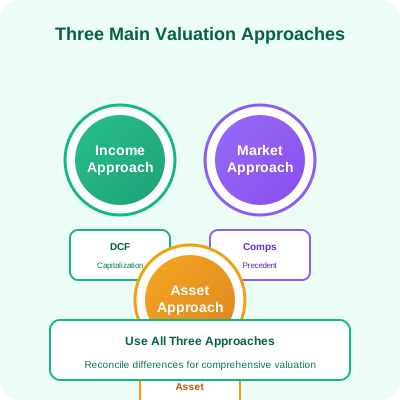
Professional business valuers use three approaches: Income Approach (future cash flows), Market Approach (comparable sales), and Asset Approach (net assets). Each gives a different perspective on value.
Fair Market Value Defined
The standard is "Fair Market Value"—the price at which the business would change hands between willing parties, both having reasonable knowledge, neither under compulsion. It's not what you want or need—it's what the market says.
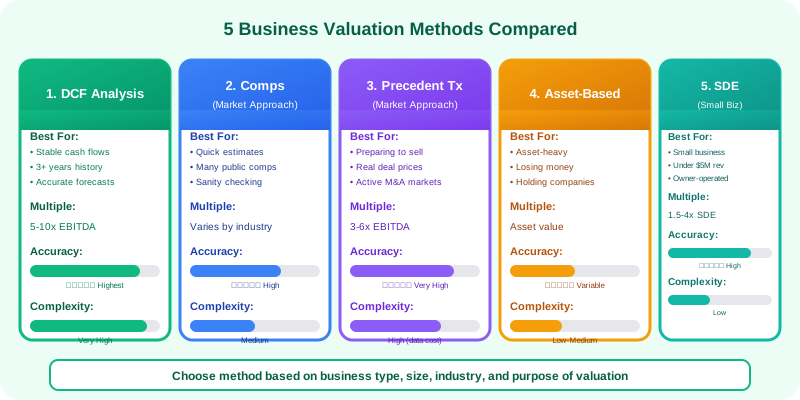
5 Proven Methods to Determine Business Value
Here are the most widely used business valuation methods, complete with real examples and when to use each one.
Discounted Cash Flow (DCF) Analysis
The gold standard for valuing businesses with predictable cash flows. Projects future cash flows and discounts them to present value using a risk-adjusted rate.
The Formula:
Business Value = Σ (FCF ÷ (1 + r)ⁿ) + Terminal Value
Where FCF = Free Cash Flow, r = discount rate, n = year
✅ Best For:
- • Established businesses with stable cash flows
- • Companies with 3+ years of financial history
- • Businesses you can forecast accurately
- • Cash-generating companies (not early-stage startups)
❌ Not Ideal For:
- • Pre-revenue startups
- • High-growth companies with no profits yet
- • Businesses with unpredictable cash flows
- • Turnaround situations (historical data misleading)
📊 Real Example:
Business: Manufacturing company with $2M annual EBITDA
Growth rate: 5% annually for next 5 years
Discount rate (WACC): 12%
Terminal growth: 3%
Calculated Value: $15.2M
7.6x EBITDA multiple
Comparable Company Analysis (CCA)
Compare your business to similar publicly traded companies using valuation multiples like EV/EBITDA, EV/Revenue, or P/E. Simple, market-based, and widely used.
The Process:
- 1. Identify comparable companies: Find public companies in your industry with similar size, growth, and margins
- 2. Calculate multiples: EV/EBITDA, EV/Revenue, P/E for each comp
- 3. Apply median multiple: Apply the median multiple to your business metrics
- 4. Adjust for differences: Apply discounts/premiums for size, growth, risk
✅ Best For:
- • Businesses in industries with many public comps
- • Quick valuation estimates
- • Sanity-checking other valuation methods
- • Industries with standard multiples (SaaS, retail)
❌ Challenges:
- • Finding true comparables is hard
- • Public markets = premium vs. private businesses
- • Market multiples can be volatile
- • Doesn't capture unique aspects of your business
📊 Real Example:
Your business: SaaS company with $5M ARR, $1M EBITDA
Public SaaS comps: Trading at 15x-25x ARR (median: 18x)
Private company discount: Apply 30% discount (private = illiquid)
Estimated Value: $63M
$5M ARR × 18x × 0.70 = $63M
Precedent Transactions Method
Look at what buyers actually paid for similar businesses in real M&A transactions. This is the most reality-based approach because it reflects actual market prices.
Why This Matters:
Public company multiples might not reflect what private businesses actually sell for. Precedent transactions show what real buyers paid in real deals—sometimes very different from theoretical values.
15-30%
Lower than public comps
3-6x
Typical EBITDA multiple
6-18mo
Deal search time
✅ Best For:
- • Preparing to sell your business
- • Understanding realistic sale prices
- • Industries with active M&A markets
- • Negotiating with buyers (show them comps)
❌ Challenges:
- • Transaction data is expensive (Bloomberg, etc.)
- • Every deal is unique (hard to find true comps)
- • Data can be outdated quickly
- • Small deals often unreported
📊 Real Example:
Your business: HVAC company, $2M EBITDA
Recent comps: 3 similar HVAC companies sold for 4x-5x EBITDA
Median multiple: 4.5x EBITDA
Estimated Value: $9M
$2M EBITDA × 4.5x = $9M
Asset-Based Valuation
Values a business based on the fair market value of its assets minus liabilities. Most appropriate for asset-heavy businesses or when earnings are weak.
Two Approaches:
Going Concern Asset Value
Values assets assuming the business continues operating. Includes intangible assets like customer lists, patents, brand.
Liquidation Value
Values assets if the business closed and assets were sold quickly. Typically 20-50% of going concern value.
✅ Best For:
- • Asset-heavy businesses (manufacturing, real estate)
- • Holding companies
- • Businesses losing money (value = assets)
- • Distressed situations or liquidations
❌ Not Ideal For:
- • Service businesses (few tangible assets)
- • Tech/SaaS (value = people/IP, not assets)
- • High-growth companies (value = future, not present)
- • Businesses with valuable intangibles
📊 Real Example:
Business: Distribution center with minimal profits
Assets: Real estate $3M, Equipment $1.5M, Inventory $500K
Liabilities: Bank loan $800K, Accounts payable $200K
Net Asset Value: $4M
($5M assets - $1M liabilities = $4M)
SDE Multiple Method (Small Businesses)
The most common method for valuing small businesses (revenue under $5M). Uses Seller's Discretionary Earnings (SDE)—net profit plus owner's salary and add-backs—times an industry multiple.
What is SDE?
SDE normalizes earnings to show the true cash flow benefit to the owner. It adds back:
- • Owner's salary/companies
- • Personal expenses run through business
- • Non-recurring expenses (one-time legal fees, etc.)
- • Personal benefits (health insurance, car, travel)
✅ Best For:
- • Main Street businesses (restaurants, retail, services)
- • Owner-operated businesses
- • Revenue under $5M
- • Businesses selling to individual buyers
Typical Multiples:
- • Restaurants: 1.5-3.0x SDE
- • Retail: 1.5-2.5x SDE
- • Service businesses: 2.0-3.5x SDE
- • Manufacturing: 2.5-4.0x SDE
📊 Real Example:
Business: Local restaurant, $800K revenue
Net profit (tax return): $80K
Add-backs: Owner salary $60K + personal expenses $25K = $85K
SDE: $80K + $85K = $165K
Industry multiple: 2.5x SDE
Business Value: $412,500
$165K SDE × 2.5x = $412,500
Free Tools to Calculate Business Value
Don't want to do manual calculations? These free calculators will determine business value instantly using professional methods.
Business Valuation Calculator
Calculate business value using three professional methods: Discounted Cash Flow (DCF), Asset-Based valuation, and SDE multiples. Perfect for small to mid-sized businesses.
When to use it:
- • You're preparing to sell your business
- • You want to understand what your business is worth
- • You're buying a business and need valuation
- • You need to value a business for estate planning
Discounted Cash Flow Calculator
Advanced DCF analysis with customizable growth rates, discount rates, and terminal value. The gold standard for valuing businesses with predictable cash flows.
When to use it:
- • Established business with stable cash flows
- • You want the most rigorous valuation method
- • You need to present valuation to investors
- • Financially sophisticated buyers/investors
Goodwill Calculator
Calculate goodwill in M&A deals using the purchase price allocation formula. Essential for business acquisitions and understanding intangible value.
When to use it:
- • You're buying or selling a business
- • You need to allocate purchase price to assets
- • Understanding intangible value (brand, customer lists)
- • M&A accounting and tax purposes
Advanced Topics & Pro Tips
Always Use Multiple Methods
Never rely on a single valuation method. I always use at least 3 methods and then reconcile the differences. If DCF says $10M, comps say $8M, and precedent transactions say $9M, I conclude the business is worth $8-10M.
Why it matters: Different methods capture different aspects of value. The range gives you negotiating flexibility and shows you've done thorough analysis.
Quality of Earnings Matters
Two businesses with identical EBITDA can have vastly different values. I've seen businesses sell for 3x earnings and others for 8x—same industry, same size. The difference? Quality of earnings.
Key factors: Recurring revenue, customer concentration, margins stability, management depth, competitive advantages. High quality = 2-3x higher multiple.
Common Valuation Mistakes
In 100+ valuations, I've seen the same costly mistakes repeatedly. Here are the ones that hurt the most:
- Using rules of thumb blindly: "Restaurants sell for 2x SDE" is a rough guide, not gospel.
- Ignoring risk: Higher risk = lower multiple. Adjust for customer concentration, dependency on owner, etc.
- Projecting unrealistic growth: Buyers will cut your projections by 30-50%. Be conservative.
- Forgetting working capital: Business value includes adequate working capital. Negotiate this clearly.
How to Increase Your Business Value
Want to sell for more? Focus on these value drivers. I've seen businesses increase value 50-100% in 1-2 years by addressing these:
- Diversify customers: No customer >15% of revenue
- Reduce owner dependency: Management runs operations, not owner
- Document processes: Business runs without founder present
- Show growth trajectory: 20%+ annual growth for 2+ years
- Clean financials: 3+ years of reviewed or audited financials
Frequently Asked Questions
How do I determine the value of my small business?+
For small businesses (revenue under $5M), use the SDE Multiple Method. Here's the process:
- Calculate SDE: Start with net profit (from tax return), add back owner's salary, personal benefits, and one-time expenses.
- Find industry multiple: Restaurants: 1.5-3x, Retail: 1.5-2.5x, Services: 2-3.5x, Manufacturing: 2.5-4x.
- Apply multiple: Business Value = SDE × Industry Multiple.
Example: If your business has $150K SDE and industry multiple is 2.5x, your business is worth approximately $375K.
Always use our free Business Valuation Calculator to double-check your math.
What is the most accurate business valuation method?+
The Discounted Cash Flow (DCF) method is considered the most accurate—when you have good data. It's the gold standard for a reason:
- • Based on fundamental economics (cash is king)
- • Captures future growth potential
- • Accounts for risk via discount rate
- • Used by investment banks, private equity, and sophisticated buyers
BUT—it's only as good as your assumptions. If your growth projections are unrealistic or discount rate is wrong, DCF gives garbage results.
Best practice: Use DCF as your primary method, but validate with comparable company analysis and precedent transactions. If all three methods give similar values, you have high confidence.
How do you value a business with no profit?+
Businesses with no profit are trickier, but definitely not worthless. Here's how I approach them:
If losing money but growing fast (startups): Use revenue multiples. SaaS companies might sell for 5-10x revenue even when unprofitable. Future potential matters more than current profit.
If asset-heavy (real estate, manufacturing): Use asset-based valuation. Value = Fair market value of assets - liabilities. The business itself might be worth zero, but the assets have value.
If temporarily down but fixable: Normalize earnings. Look at 3-5 year history, adjust for one-time issues (pandemic, recession, owner divorce), value on normalized earnings.
If structurally unprofitable: Likely worth less than asset value. Might only be sellable for asset value or as a turnaround play.
What multiple of EBITDA is a business worth?+
EBITDA multiples vary wildly by industry, size, growth, and quality. Here are typical ranges in 2025:
SaaS / Tech: 12-25x EBITDA
Recurring revenue, high growth, scalable
Manufacturing: 4-8x EBITDA
Asset-heavy, cyclical, moderate growth
Services (B2B): 6-12x EBITDA
Recurring revenue, asset-light, good margins
Retail / Restaurants: 2-5x EBITDA
Low margins, competitive, labor-intensive
Key adjustments: Smaller businesses get lower multiples. High growth increases multiple. Customer concentration decreases multiple. Quality of financials affects multiple.
How much does a business valuation cost?+
Professional business valuation costs vary by purpose and complexity:
Free alternative: Use our free Business Valuation Calculator for a solid estimate. Many business owners start here, then only pay for professional valuation if needed for specific purposes (IRS, litigation, etc.).
How long does it take to value a business?+
Depends on complexity:
- Quick estimate (using calculators): 15-30 minutes. Just gather your financials and plug into our free tools.
- Basic professional valuation: 2-4 weeks. Valuer needs documents, does analysis, writes report.
- Comprehensive valuation: 4-8 weeks. Site visits, management interviews, market research, detailed analysis.
- Complex valuation (litigation, large deals): 2-6 months. Multiple experts, depositions, testimony, hundreds of hours.
Pro tip: Don't wait until you're selling to get a valuation. Get a ballpark value 1-2 years before selling, so you can work on increasing value. Many owners I've worked with increased their business value 50-100% by making improvements based on valuation feedback.
Should I hire a business broker or do it myself?+
I've seen both approaches work well. Here's how to decide:
Hire a broker if:
- • Business value over $1M (buyers expect brokers)
- • You don't have time to manage sale process
- • You're not experienced in M&A
- • Confidentiality is critical (broker screens buyers)
- • You want maximum exposure (broker has buyer network)
Do it yourself if:
- • Business under $500K (broker fees too expensive)
- • You already have a buyer in mind
- • You're experienced in business sales
- • You have time and patience for the process
Broker fees: Typically 8-12% of sale price. On a $1M sale, that's $80K-$120K. Sometimes worth it for the expertise and buyer network, sometimes not.
What documents do I need for a business valuation?+
Gather these documents for accurate valuation:
Financial Statements
- • 3-5 years tax returns
- • 3-5 years P&L statements
- • Balance sheets for each year
- • Current YTD financials
Operational Docs
- • Organization chart
- • Customer list (with revenue/customer)
- • Supplier contracts
- • Lease agreements
Legal & Tax
- • Articles of incorporation
- • Cap table / shareholder list
- • Tax assessments (3 years)
- • Pending litigation
Optional but Helpful
- • Business plan / forecasts
- • Marketing materials
- • Equipment list with values
- • Inventory list
How do I increase my business value before selling?+
I've helped owners increase business value 50-100% in 1-2 years by focusing on these value drivers. Work on them 12-24 months before selling:
1. Reduce Customer Concentration
No single customer >15% of revenue. Buyers pay premium for diversified revenue. I've seen businesses increase 30% just by fixing this.
2. Make Business Owner-Independent
Management team runs operations, not owner. If business falls apart when you're gone, buyers won't pay premium.
3. Show Growth Trajectory
20%+ annual revenue growth for 2+ years. Growing businesses get 2-3x higher multiples than stagnant ones.
4. Clean Financials
3+ years of reviewed or audited financials. Buyers trust clean books and pay more. "Run off the books" cash = lost value.
5. Document Processes
Standard operating procedures, training manuals, systems. Business runs without founder = valuable business.
What's the difference between business valuation and asset valuation?+
Important distinction:
Business Valuation: Values the business as a going concern, including intangible assets like brand, customer relationships, processes, and future earnings potential. Uses income and market approaches. Most businesses sell at a premium to asset value because of these intangibles.
Asset Valuation: Values just the tangible and identifiable intangible assets minus liabilities. What would you get if you sold off everything and closed the business? Usually lower than business valuation for profitable companies.
Example: A profitable software company might be worth $10M as a business (business valuation) but only $500K in assets (servers, computers, furniture). The $9.5M difference is intangible value (code, customers, brand, team).
When to use each: Use business valuation for profitable, ongoing businesses. Use asset valuation for distressed businesses, asset-heavy companies (real estate, manufacturing), or when liquidating.
How often should I get a business valuation?+
Don't wait until you're selling. Here's my recommended schedule:
- Annually: Quick valuation using calculators. Track progress, identify value drivers to improve.
- Every 2-3 years: Professional valuation if you're considering selling in 5 years. Gives you time to increase value.
- Before major events: Bringing in partners, estate planning, divorce, buying out partners.
- When selling: Get professional valuation 3-6 months before going to market.
Why it matters: I've seen owners who tracked their valuation yearly increase value 100%+ over 3 years by focusing on the right metrics. If you don't measure it, you can't improve it.
Use our free Business Valuation Calculator annually to track your business value over time.
Related Resources & Tools
Business Valuation Calculator
Calculate business value using DCF, asset-based, and SDE multiple methods. Free tool.
Try Calculator →DCF Calculator
Advanced discounted cash flow analysis. The gold standard for business valuation.
Try Calculator →Goodwill Calculator
Calculate goodwill in M&A deals. Essential for business acquisitions.
Try Calculator →How Much Can I Sell My Business For?
Complete guide to selling your business, valuation strategies, and maximizing sale price.
Read Guide →How to Value a Company for Purchase
M&A valuation guide for buyers. Due diligence, negotiation, and deal structures.
Read Guide →How Do You Calculate Goodwill?
Complete guide to goodwill calculation with examples and formulas.
Read Guide →Ready to Determine Your Business Value?
You've learned the methods. Now calculate your business value in minutes with our free professional calculators. No registration required.
Join 50,000+ business owners who've calculated their business value with FairValuePrice