Peter Lynch Fair Value Calculator
Use the legendary investor's PEG ratio method to find undervalued growth stocks. I'll show you exactly how Peter Lynch identified his "ten-baggers" using this simple but powerful formula.
Calculate Fair Value NowPeter Lynch Fair Value Calculator
Current market price per share
Trailing twelve months (TTM)
Expected EPS growth rate (typically 8-25%)
Auto-calculated: 10.00
Peter Lynch Fair Value
Based on PEG ratio of 1.0
$75.00
per share
PEG Ratio
Price/Earnings to Growth
0.67
Current Market Price
$50.00
Margin of Safety
+33.3%
💡 Interpretation
Good news! The PEG ratio is below 1.0, suggesting this stock may be undervalued relative to its growth rate. Peter Lynch looked for stocks with PEG ratios under 1.0.
Remember: This is just one metric. Always consider the company's fundamentals, competitive advantages, management quality, and industry trends before making investment decisions.
Peter Lynch Fair Value Calculator in 3 Simple Steps
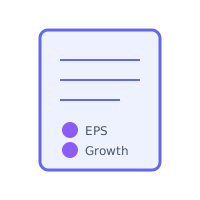
Step 1: Gather Your Data
Find the company's current stock price, earnings per share (EPS), and expected annual growth rate. I get this data from Yahoo Finance, Seeking Alpha, or the company's investor relations page.
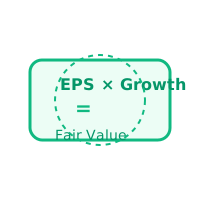
Step 2: Calculate Fair Value
Multiply the EPS by the growth rate. That's it! Peter Lynch's formula assumes a stock is fairly valued when its P/E ratio equals its growth rate (PEG = 1).
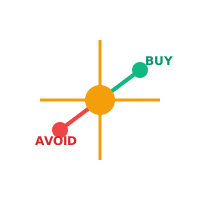
Step 3: Interpret the Results
Compare the fair value to the current price. If the PEG ratio is below 1.0, the stock might be undervalued. Above 1.0? It could be overpriced. Simple as that!
What is the Peter Lynch Fair Value Method?
Let me tell you about one of my favorite investment approaches. Peter Lynch, who managed the Fidelity Magellan Fund from 1977 to 1990, achieved an incredible 29.2% annual return. His secret? A beautifully simple formula based on the PEG ratio (Price/Earnings to Growth).
Here's Lynch's core insight: a fairly valued stock should have a P/E ratio equal to its growth rate. If a company is growing earnings at 20% per year, it deserves a P/E ratio of about 20. That means a PEG ratio of 1.0 indicates fair value.
The beauty of this method is its simplicity. While DCF models require dozens of assumptions about future cash flows, discount rates, and terminal values, Peter Lynch's approach boils down to one question: "Am I paying a reasonable price for this company's growth?"
Lynch famously looked for PEG ratios under 1.0—stocks trading below their fair value. These were his "ten-baggers," stocks that could potentially increase 10-fold. And he found them not through complex financial models, but by understanding businesses and paying attention to this simple metric.
Understanding the PEG Ratio
The Formula
PEG Ratio = (P/E Ratio) / (Annual EPS Growth Rate)
Fair Value = EPS × Growth Rate (when PEG = 1)
The PEG ratio puts the P/E ratio in context. A stock with a P/E of 30 might seem expensive—until you learn it's growing earnings at 35% per year. That gives it a PEG ratio of 0.86, suggesting it's actually undervalued!
Conversely, a stock with a "cheap" P/E of 12 might be overvalued if it's only growing at 5% per year. That's a PEG ratio of 2.4—you're paying too much for too little growth.
PEG \u003c 1.0: Potentially Undervalued
This is what Peter Lynch hunted for. When you're paying less for growth than the growth rate itself, you've found a potential bargain. A PEG of 0.5? Even better—that's a stock growing twice as fast as its P/E ratio suggests it should.
PEG ≈ 1.0: Fairly Valued
The stock is priced appropriately for its growth. Not a screaming buy, but not overpriced either. Whether you invest depends on your confidence in the company and what else is available.
PEG \u003e 1.5: Likely Overvalued
You're paying a premium for growth. This might be justified for exceptional companies with durable competitive advantages, but proceed with caution. Lynch generally avoided stocks with PEG ratios above 1.5.
Peter Lynch's Core Investment Principles
📊 "Invest in What You Know"
Lynch famously discovered great investments in everyday life—Dunkin' Donuts, The Gap, Volvo. He believed regular people have an edge over Wall Street because we encounter great businesses before analysts do. If you love a product or service, investigate the company behind it.
🎯 Focus on Growth at a Reasonable Price (GARP)
Lynch didn't want slow-growing value stocks, nor did he want to overpay for high-flyers. He wanted the sweet spot: companies growing 15-25% per year, trading at reasonable valuations. The PEG ratio is the perfect tool for finding this balance.
🔍 Do Your Homework
The PEG ratio is a starting point, not the finish line. Lynch spent hours researching companies—reading annual reports, visiting stores, talking to management. He wanted to understand the business, not just the numbers. A low PEG ratio means nothing if the company's competitive position is eroding.
⏰ Think Long-Term
Lynch held stocks for years, not months. He understood that great companies take time to compound their value. If you've found a quality business with a PEG ratio under 1.0, be patient. The market will eventually recognize what you've discovered.
💪 Ignore the Noise
Lynch famously said, "The key to making money in stocks is not to get scared out of them." Market volatility is normal. If your analysis is sound and the PEG ratio is attractive, temporary price drops are buying opportunities, not reasons to panic.
When to Use the Peter Lynch Method
✅ Best For:
- • Growth stocks with consistent earnings
- • Companies growing 8-25% annually
- • Established businesses with track records
- • Retail, consumer goods, technology companies
- • Quick screening of investment ideas
- • Comparing similar companies in the same industry
❌ Not Suitable For:
- • Startups with no earnings yet
- • Highly cyclical businesses (oil, mining)
- • Financial companies (banks, insurance)
- • Companies with negative or erratic earnings
- • Turnaround situations
- • Dividend-focused value stocks
⚠️ Important Limitations
Growth rate estimates are subjective. The PEG ratio is only as good as your growth assumptions. Be conservative—it's better to underestimate growth and be pleasantly surprised.
It ignores debt and cash. Two companies with identical PEG ratios might have vastly different balance sheets. Always check debt levels and cash positions separately.
It doesn't account for quality. A company with a PEG of 0.8 and deteriorating margins is less attractive than one with a PEG of 1.2 and a strong competitive moat. Quality matters.
How to Find the Inputs
Current Stock Price
This is the easy part! Check any financial website—Yahoo Finance, Google Finance, Bloomberg, or your brokerage account. Use the current market price, not the day's high or low.
Pro tip: I like to calculate fair value and then set price alerts. When the stock drops to my target price, I get notified automatically.
Earnings Per Share (EPS)
Use the trailing twelve months (TTM) EPS, which you'll find on any financial website under "Key Statistics" or "Financials." This is the actual earnings over the past year, not forward estimates.
Pro tip: Make sure you're using diluted EPS, not basic EPS. Diluted EPS accounts for stock options and convertible securities, giving you a more conservative number.
Expected Annual Growth Rate
This is the trickiest input. I use a combination of:
- Historical growth: Look at the past 3-5 years of EPS growth
- Analyst estimates: Check consensus estimates on Yahoo Finance or Seeking Alpha
- Industry trends: Consider the company's market and competitive position
- Management guidance: What does the company project for future growth?
Pro tip: When in doubt, be conservative. I usually take the lower end of analyst estimates or use historical growth minus 2-3%. It's better to underestimate and find a bargain than overestimate and overpay.
P/E Ratio (Optional)
The calculator can auto-calculate this by dividing the current price by EPS. But if you want to input it manually, use the trailing P/E ratio, not the forward P/E.
Pro tip: Compare the company's current P/E to its historical average P/E. If it's trading well below its historical average AND has a low PEG ratio, that's a double signal of potential undervaluation.
Real-World Example
Let's Value a Hypothetical Growth Stock
Current Stock Price
$75.00
Earnings Per Share (TTM)
$4.50
Expected Annual Growth Rate
18%
Step 1: Calculate Fair Value
Fair Value = EPS × Growth Rate
Fair Value = $4.50 × 18 = $81.00
Step 2: Calculate PEG Ratio
P/E Ratio = $75.00 / $4.50 = 16.67
PEG Ratio = 16.67 / 18 = 0.93
✅ The Verdict
This stock is potentially undervalued! With a PEG ratio of 0.93 (below 1.0) and trading at $75 versus a fair value of $81, it offers an 8% margin of safety.
Peter Lynch would likely be interested in this stock. The next step? Research the company's competitive advantages, management quality, and industry trends to confirm this is a solid investment opportunity.
Frequently Asked Questions
Q: What's the difference between Peter Lynch's method and DCF?
DCF (Discounted Cash Flow) projects all future cash flows and discounts them to present value—it's comprehensive but complex. Peter Lynch's PEG method is much simpler: it just asks if you're paying a reasonable price for growth. DCF is better for detailed analysis; PEG is better for quick screening. I use both—PEG to find candidates, DCF to validate my top picks.
Q: Can I use this for dividend stocks?
Not really. The PEG ratio is designed for growth stocks. For dividend stocks, you're better off using the Dividend Discount Model (DDM) or looking at dividend yield and payout ratios. Peter Lynch himself focused on growth, not income.
Q: What if the company has no earnings or negative earnings?
Then you can't use the PEG ratio—it requires positive earnings and a positive growth rate. For startups or turnaround situations, you'll need different valuation methods like price-to-sales ratios, comparable company analysis, or venture capital-style valuation approaches.
Q: Is a PEG ratio of 0.5 always better than 0.8?
Not necessarily! A very low PEG ratio might signal that the market knows something you don't—maybe the growth rate is about to collapse, or there's a major risk you're missing. Always ask WHY a stock is cheap. Sometimes it's a bargain; sometimes it's a value trap.
Q: Should I use historical growth or projected growth?
I use projected growth, but I sanity-check it against historical growth. If a company has historically grown at 10% but analysts project 25%, I'm skeptical. Conversely, if historical growth is 20% and projections are 8%, I want to understand what changed. The key is being realistic and conservative.
Q: How often should I recalculate the PEG ratio?
I recalculate quarterly when new earnings are released. The stock price changes daily, but that's just noise. What matters is whether the fundamentals—earnings and growth prospects—have changed. If they haven't, temporary price fluctuations are opportunities, not problems.
Q: Did Peter Lynch only use the PEG ratio?
No! Lynch used the PEG ratio as a screening tool, but he also looked at debt levels, competitive advantages, management quality, industry trends, and dozens of other factors. The PEG ratio tells you if a stock deserves further research—it doesn't tell you to buy. Always do your homework.
Q: What growth rate range is ideal for this method?
Peter Lynch preferred companies growing 15-25% annually. Below 10% is too slow (you're essentially buying a value stock). Above 30% is often unsustainable—very few companies can maintain that pace for years. The sweet spot is steady, predictable growth in the mid-teens to low-twenties.
Q: Can I use this for international stocks?
Absolutely! The PEG ratio works for any stock with positive earnings and growth. Just make sure you're using consistent currency (don't mix USD prices with EUR earnings) and be aware that accounting standards vary by country. I tend to add a small premium to my required PEG ratio for international stocks to account for additional risks.
Q: What if the PEG ratio keeps changing as the stock price moves?
That's normal! The PEG ratio will fluctuate with the stock price. What you're looking for is when the PEG drops below 1.0 due to price declines, not deteriorating fundamentals. If earnings and growth expectations remain solid but the price has fallen, that's your buying opportunity. Set price alerts at your target PEG ratio.
More Valuation Calculators
🧠 Benjamin Graham Formula Calculator
Use the "father of value investing's" formula to find defensive stocks with a margin of safety. Perfect complement to Peter Lynch's growth-focused approach.
Calculate Graham Number →📈 Discounted Cash Flow (DCF) Calculator
The gold standard for stock valuation. Use DCF to validate your Peter Lynch picks with comprehensive cash flow analysis.
Start DCF Calculation →🧮 Stock Valuation Calculator
Compare multiple valuation methods side-by-side. See how Peter Lynch's PEG approach stacks up against other metrics.
Compare Methods →💰 Dividend Discount Model Calculator
Value dividend-paying stocks using the Gordon Growth Model. Ideal for income investors looking beyond pure growth plays.
Calculate DDM Value →Ready to Find Your Next Ten-Bagger?
Use Peter Lynch's proven PEG ratio method to identify undervalued growth stocks today.
Calculate Fair Value Now