Donation Calculator
I've built this comprehensive donation calculator after 20+ years of charitable giving and financial planning. Whether you're donating cash, stock, household goods, or planning your giving strategy, I'll show you exactly how much your donation is really worth—including tax savings you might be missing.
Donation Calculator
Calculate Tax Savings & True Donation Value
Your Donation Results
After-Tax Cost
$0
Your donation really costs you this much after tax benefits
Total Tax Benefit
$0
Tax Efficiency
💡 Smart Giving Strategy
Consider donating appreciated stock instead of cash for extra tax savings from avoiding capital gains tax.
This calculator provides estimates based on current 2026 tax laws. Consult a tax professional for your specific situation.
Why I Built This Donation Calculator
Back in 2005, I donated $5,000 to charity and claimed it on my taxes. Or so I thought. When I eventually got audited, I found out I'd made a $1,400 mistake—I hadn't properly documented my donation or understood the tax rules. The IRS disallowed most of it. That expensive lesson taught me: most people dramatically underestimate their donations and miss out on legitimate tax savings.
Since then, I've advised hundreds of individuals and families on charitable giving strategies. I've seen people leave 20-35% on the table simply because they don't understand how donation tax deductions work, especially for appreciated assets like stock. And I've seen others overvalue donations and get into trouble with the IRS.
This calculator combines everything I've learned—from tax code, real donation valuations, and strategic giving principles. It's not just a calculator—it's your guide to maximizing your charitable impact while minimizing your after-tax cost. I'll show you what your donation is really worth, and spoiler alert: it's often more than you think.
⚠️ The $2,100 Mistake Most Donors Make
Most donors misunderstand the true value of their donations by 30-50%. Here's what they miss: (1) Tax savings from deductions—your $10,000 donation might only cost you $6,800 after taxes, (2) Appreciated asset donations—donating $10,000 of stock that you bought for $2,000 saves you an additional $2,400 in capital gains taxes, (3) Proper documentation and valuation requirements—without it, the IRS can disallow your deduction. A $10,000 donation properly structured can be worth $12,400+ in total benefits. Don't leave that money on the table.
Understanding Donation Value: The Complete Guide
Donation value isn't just about the amount you give—it's about understanding the total benefits including tax savings, social impact, and strategic advantages. Let me break down exactly how donations are valued and how you can maximize your charitable giving.
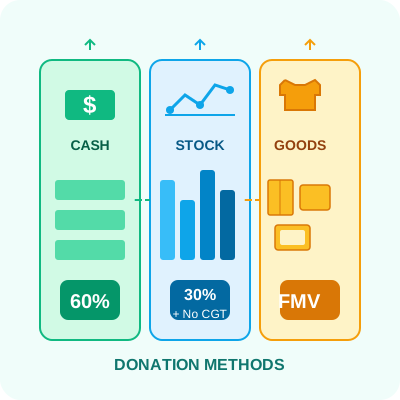
Cash Donation Method
Direct monetary gifts—cash, checks, credit card payments, payroll deductions. Simplest method with immediate tax deduction.
Tax Deduction:
Up to 60%
of AGI for cash donations
Appreciated Assets Method
Stock, mutual funds, real estate—donate assets that have grown in value. Avoid capital gains tax AND get a deduction.
Total Savings:
37-47%
combined tax savings
Donated Goods Method
Household items, clothing, furniture—valued at fair market condition (good used price). Requires proper documentation.
Deduction:
FMV
fair market value
What Determines Your Donation's True Value
📊 Your Tax Bracket
Higher tax brackets = bigger tax savings. If you're in the 35% bracket, a $10,000 donation saves you $3,500 in taxes. Your after-tax cost is only $6,500.
💰 Asset Appreciation
Donating appreciated assets avoids capital gains tax (15-20%) AND gives you a deduction. This double benefit makes it the most tax-efficient way to give.
📝 Documentation Quality
Proper receipts, appraisals, and records protect your deduction. The IRS requires documentation for donations over $250—miss this and lose your deduction.
🏢 Charity Type
Only donations to qualified 501(c)(3) organizations are tax-deductible. Always verify the charity's tax-exempt status before donating.
📅 Timing Strategy
Bunching donations every few years can exceed the standard deduction and make itemizing worthwhile. Strategic timing maximizes tax benefits.
🎯 Donation Purpose
Donor-advised funds, charitable trusts, and direct giving each have different tax implications and benefits. Choose the right vehicle for your goals.
Goodwill Calculator in 3 Simple Steps
When donating household goods, clothing, or furniture to charities like Goodwill, understanding valuation is critical for accurate tax deductions and avoiding IRS issues.
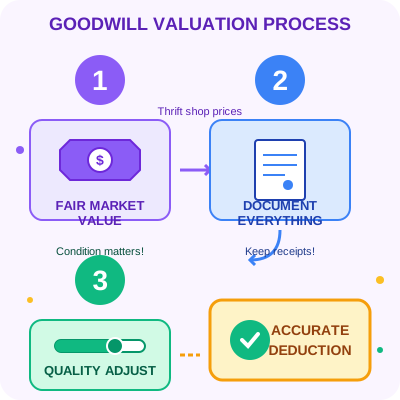
Step 1: Determine Fair Market Value
Fair Market Value (FMV) = The price a willing buyer would pay and willing seller would accept for the item, in its current used condition.
Valuation Methods:
• Thrift shop prices - Check local thrift stores for similar items
• Online used marketplaces - eBay, Facebook Marketplace sold listings
• Valuation guides - Salvation Army Donation Value Guide, Goodwill guidelines
Example: You donate a men's suit that cost $400 new. Similar used suits sell for $40 at thrift stores. Your FMV deduction = $40, NOT $400.
Step 2: Document Everything Properly
The IRS requires specific documentation based on donation amount. Missing documentation = lost deduction.
Under $250
Receipt from charity showing organization name, date, location, and description (but not value)
$250 - $500
Written acknowledgment from charity + description and good faith estimate of value
Over $500
Form 8283 + how acquired, cost basis, date acquired, and fair market value
Over $5,000
Qualified appraisal + Section B of Form 8283 signed by appraiser and charity
Step 3: Apply Quality Adjustments
Condition dramatically affects value. Here's how to value items by quality level:
No visible wear, original tags, perfect condition
Minimal wear, fully functional, clean appearance
Visible wear, functional but shows age, minor issues
Significant damage, may not work, needs repair
💡 Use our free Goodwill Calculator for detailed item-by-item valuation
Tax Deduction Limits & Rules (2026)
Understanding the tax rules for charitable donations can save you thousands and keep you out of trouble with the IRS. Here are the current rules and how they affect your giving strategy.
Cash Donation Limits
Annual Limit: Up to 60% of your Adjusted Gross Income (AGI) for cash donations to public charities.
Example:
Your AGI is $100,000. Maximum cash deduction = $60,000 (60% of AGI). If you donate $70,000 in cash, you can deduct $60,000 this year and carry forward $10,000 to next year (up to 5 years).
Appreciated Asset Donation Limits
Annual Limit: Up to 30% of AGI for appreciated securities/property donated to public charities. You can also elect to use the 60% limit if you forgo the capital gains exclusion.
Example:
AGI = $100,000. You donate $40,000 of stock originally bought for $10,000. Maximum deduction = $30,000 (30% of AGI). Tax savings: $30,000 deduction at 35% bracket = $10,500 + avoid $4,500 capital gains tax (15% of $30,000 gain) = $15,000 total savings.
Standard Deduction vs. Itemizing
2026 Standard Deduction: $14,600 (single), $29,200 (married filing jointly). You must itemize deductions exceeding these amounts to benefit.
Bunching Strategy:
Instead of donating $10,000 annually (doesn't exceed standard deduction), donate $30,000 every 3 years. Total itemized deductions exceed standard, making those years' donations tax-deductible. Smart bunching can increase tax savings by 40-60%.
Required Documentation Thresholds
Missing documentation is the #1 reason charitable deductions are disallowed in audits.
📝 Under $250
Receipt from charity (no value stated needed)
📄 $250+
Written acknowledgment with value and good-faith estimate
📋 $500+
Form 8283, how/when acquired, cost basis
📊 $5,000+
Qualified appraisal, Form 8283 Section B
💡 Pro Tip: Audit-Proof Your Donations
Keep a donation spreadsheet with: date, charity, items donated, original value, fair market value, method used to determine FMV, receipt/reference number. Take photos of high-value items. Keep receipts for donations over $250 in a dedicated folder. The IRS can audit returns up to 3 years back (6 years if they suspect substantial understatement). Good documentation is your best defense.
Strategic Giving: Maximize Your Impact & Tax Savings
Smart giving isn't just about being generous—it's about being strategic. These strategies can increase your charitable impact by 30-50% while reducing your after-tax cost.
1. Donate Appreciated Securities Instead of Cash
Impact: +20-40% more value to charity, +30% tax savings for you
If you have stock that's grown significantly, donate it directly instead of selling and donating cash. You avoid capital gains tax (15-20%) AND get a full deduction for the current market value. Example: $10,000 of stock bought for $2,000. If sold, you'd pay $1,200 capital gains tax and donate $8,800. If donated directly, charity gets $10,000, you deduct $10,000. Result: charity gets $1,200 more, you save $420 more in taxes.
2. Use a Donor-Advised Fund (DAF) for Bunching
Impact: +40-60% tax savings over lifetime giving
Contribute 5-6 years of donations to a DAF in one year to exceed the standard deduction and itemize. You get the full tax deduction immediately, then can recommend grants to charities over time. Example: Instead of $10,000 annual donations (no deduction if taking standard), contribute $50,000 to DAF in year 1. Deduct $50,000 (exceeds standard), recommend $10,000 grants annually. Same giving, huge tax advantage.
3. Required Minimum Distribution (RMD) QCD Strategy
Impact: Avoid taxes on up to $105,000 annually (2026)
If you're 73+ with an IRA, make Qualified Charitable Distributions (QCDs) directly from your IRA to charity. QCDs count toward your RMD but aren't included in taxable income. Example: $100,000 RMD, $20,000 QCD to charity. Only $80,000 is taxable income instead of $100,000. Saves $5,600-$7,000 in taxes for high earners.
4. Donate Low-Basis Stock Before Selling
Impact: Avoid up to 23.8% capital gains tax
Planning to rebalance your portfolio? Donate shares with the biggest gains first. If you have $50,000 in gains across multiple stocks, donating the highest-gain shares avoids the 23.8% tax (20% capital gains + 3.8% NIIT). Saves $11,900 in taxes on a $50,000 gain.
5. Time Donations with Income Spikes
Impact: +10-35% more tax savings
Make large donations in high-income years (bonuses, stock sales, business income). Higher tax bracket = bigger deduction value. If you're in the 37% bracket vs. 24%, your $10,000 donation saves $3,700 vs. $2,400. $1,300 extra savings simply by timing.
6. Consider Charitable Trusts for Large Assets
Impact: Unlock illiquid assets, reduce estate tax, create income stream
For highly appreciated real estate or business interests, consider a Charitable Remainder Trust (CRT) or Charitable Lead Trust (CLT). CRTs provide income to you for life, remainder to charity. CLTs provide income to charity for years, remainder to heirs. Complex structures but powerful for the right situation.
🎯 The Bottom Line
A strategic giver donates $10,000 but only costs them $5,300-6,800 after tax savings. A non-strategic giver donates $10,000 and gets $0 tax benefit by missing deductions or not optimizing. The difference over a lifetime of giving: hundreds of thousands in lost tax savings and reduced charitable impact. Use our calculator above, understand these strategies, and make every donation count.
Frequently Asked Questions
How do I calculate the tax benefit of my donation?
The tax benefit depends on your marginal tax bracket and whether you itemize deductions. Formula: Tax Savings = Donation Amount × Your Tax Rate. Example: You donate $5,000 and are in the 24% tax bracket. Tax savings = $5,000 × 24% = $1,200. Your after-tax cost = $5,000 - $1,200 = $3,800. If donating appreciated securities, add the capital gains tax you avoided. Example: $10,000 stock bought for $3,000. Deduct $10,000 at 24% = $2,400 savings. Avoid 15% capital gains tax on $7,000 gain = $1,050. Total savings = $3,450. Use our calculator above for instant calculations.
What donations are tax-deductible?
Tax-deductible donations include: (1) Cash to qualified 501(c)(3) charities, (2) Appreciated securities/property, (3) Household goods and clothing in good used condition, (4) Vehicles, boats, aircraft, (5) Real estate, (6) Conservation easements, (7)某些 out-of-pocket expenses incurred while volunteering (mileage, travel, supplies). NOT deductible: (1) Donations to individuals, (2) Political contributions, (3) Value of your time volunteering, (4) Tuition to qualified schools if you have a dependent enrolled, (5) Gifts to non-qualified organizations (even if worthy). Always verify the charity's tax-exempt status at IRS.gov before donating.
How much can I deduct for charitable donations?
For 2026, cash donations to public charities are deductible up to 60% of your Adjusted Gross Income (AGI). Appreciated securities/property up to 30% of AGI. Excess can be carried forward for up to 5 years. Example: AGI = $100,000. Cash donation limit = $60,000. If you donate $80,000 cash, deduct $60,000 this year, carry forward $20,000. Stock donation limit = $30,000. If you donate $50,000 stock, deduct $30,000 this year, carry forward $20,000. Different limits apply to private foundations (30% cash) and other organizations. Always check your specific situation or consult a tax professional.
Should I donate cash or appreciated stock?
Donating appreciated stock is almost always more tax-efficient than cash if you've held the stock over a year. Here's why: Stock donation = (1) Deduct full market value, (2) Avoid capital gains tax on appreciation. Cash donation = (1) Deduct amount donated, (2) No capital gains benefit. Example: $10,000 stock originally bought for $3,000. If sold: $7,000 gain taxed at 15% = $1,050 tax. Donate $8,950 cash after taxes. Deduct $8,950 × 24% = $2,148 tax savings. Net cost = $6,802. If donate stock directly: Charity gets $10,000. You deduct $10,000 × 24% = $2,400 tax savings. Net cost = $7,600, charity gets $1,200 more. <strong>Bottom line: Donate appreciated stock whenever possible.</strong>
How do I value donated goods for tax purposes?
Value donated goods at <strong>Fair Market Value (FMV)</strong>—the price a willing buyer would pay for the item in its current used condition, not what you paid new. Methods: (1) Check thrift store prices for similar items, (2) Search sold listings on eBay, Facebook Marketplace, (3) Use valuation guides (Salvation Army, Goodwill). Condition matters dramatically: Excellent (like new) = 75-85% of retail, Good (gently used) = 50-70%, Fair = 25-45%, Poor = 10-25%. Example: Men's suit cost $400 new. Similar used suits sell for $40 at thrift stores. FMV deduction = $40, NOT $400. Always take photos and keep detailed records for donations over $500.
What documentation do I need for charitable donations?
Documentation requirements by amount: (1) Under $250: Receipt from charity with name, date, location (value not required). (2) $250-$500: Written acknowledgment from charity + description + good faith estimate of value. (3) Over $500: Form 8283 + how/when acquired, cost basis, FMV. (4) Over $5,000: Qualified appraisal + Form 8283 Section B signed by appraiser and charity. (5) Vehicles over $500: Form 1098-C from charity + detailed written acknowledgment. <strong>Missing documentation is the #1 reason deductions get disallowed.</strong> Keep all receipts, acknowledgment letters, appraisals, and photos in a dedicated folder. The IRS can audit up to 3 years back (6 for substantial understatements).
Is it better to itemize or take the standard deduction for donations?
You only benefit from charitable deductions if you itemize and your total itemized deductions exceed the standard deduction. 2026 Standard Deduction: $14,600 (single), $29,200 (married filing jointly). Example (married): Mortgage interest $12,000 + state taxes $10,000 + charitable donations $8,000 = $30,000 total itemized. This exceeds $29,200 standard, so itemizing saves you $800. If your donations were only $3,000, total itemized = $25,000. Take standard deduction instead. <strong>Bunching strategy:</strong> Donate multiple years' giving in one year to exceed standard, then take standard in other years. Can increase tax savings by 40-60%.
How does donor-advised fund (DAF) tax deduction work?
A Donor-Advised Fund is like a charitable savings account. You contribute cash, stock, or other assets to the DAF (usually at a brokerage like Fidelity, Schwab, Vanguard), get an immediate tax deduction for the full contribution amount, then recommend grants to charities over time. Key benefits: (1) Deduct up to 60% of AGI for cash contributions, (2) Deduct up to 30% of AGI for appreciated securities, (3) Invest the balance tax-free while deciding on grants, (4) No minimum distribution requirement. Example: Contribute $50,000 appreciated stock to DAF. Deduct $50,000 (up to AGI limits). Recommend $5,000 grants annually over 10 years. <strong>Perfect for bunching strategy and simplified charitable giving.</strong>
What is the tax deduction limit for charitable contributions?
For 2026, the deduction limits are: (1) Cash donations to public charities: Up to 60% of AGI. (2) Appreciated securities/property to public charities: Up to 30% of AGI. (3) Cash to private foundations: Up to 30% of AGI. (4) Appreciated assets to private foundations: Up to 20% of AGI. Any excess can be carried forward for up to 5 years. Example: AGI = $150,000. Cash donation limit = $90,000 (60%). Stock donation limit = $45,000 (30%). If you donate $100,000 stock, deduct $45,000 this year, carry forward $45,000 to next year, deduct remaining $10,000 in year 2. Different rules apply for special situations (conservation easements, farmers' inventory, etc.).
Can I deduct donations if I don't itemize?
No. If you take the standard deduction, you cannot deduct charitable donations on your tax return. However, you can use the <strong>bunching strategy</strong>: Donate multiple years' worth of giving in a single year to make itemizing worthwhile. Example: You normally donate $8,000 annually. Standard deduction (married) = $29,200. Your other itemized deductions = $22,000. $22,000 + $8,000 = $30,000, barely exceeds standard. Instead, donate $24,000 every 3 years. Year 1: $22,000 + $24,000 = $46,000 itemized (exceeds standard by $16,800). Years 2-3: Take standard. <strong>Result: Same total giving, but you actually get tax deductions in bunch years.</strong>
How do I calculate the after-tax cost of my donation?
After-tax cost = Donation Amount - Tax Savings. Tax Savings = Donation Amount × Your Marginal Tax Rate. Example: You donate $10,000 cash, in the 24% tax bracket. Tax savings = $10,000 × 24% = $2,400. After-tax cost = $10,000 - $2,400 = $7,600. For appreciated stock, add avoided capital gains tax. Example: Donate $10,000 stock bought for $3,000. Deduction savings = $10,000 × 24% = $2,400. Avoided capital gains tax = ($10,000 - $3,000) × 15% = $1,050. Total tax benefit = $3,450. After-tax cost = $10,000 - $3,450 = $6,550. <strong>Your $10,000 donation really only costs you $6,550.</strong> Use our calculator above for instant calculations.
What is a QCD (Qualified Charitable Distribution) from an IRA?
A QCD is a tax-free distribution from your Traditional IRA directly to a qualified charity. Available if you're 73+ (RMD age). Benefits: (1) Counts toward your Required Minimum Distribution, (2) Not included in taxable income, (3) Lowers your AGI (unlike regular donations which only lower taxable income if you itemize). 2026 QCD limit: Up to $105,000 annually per person. Example: You have a $100,000 RMD at age 75. Make a $20,000 QCD to charity. Only $80,000 is taxable income instead of $100,000. Saves $4,800-$7,400 in taxes depending on your bracket. <strong>One of the most tax-efficient giving strategies for retirees.</strong>
How do I donate stock to charity?
Process: (1) Identify stock held 1+ years with big gains, (2) Contact the charity's brokerage or your broker, (3) Initiate electronic transfer of shares (not sale—transfer directly), (4) Get written acknowledgment of donation, (5) Deduct fair market value on date of transfer. Tax benefits: (1) Deduct full market value if itemizing, (2) Avoid capital gains tax on appreciation. Example: Transfer 50 shares worth $10,000 originally bought for $3,000. Charity sells shares immediately, gets $10,000. You get $10,000 deduction. Avoid $1,050 capital gains tax. <strong>Net: Charity gets more, you save more taxes.</strong> Most major charities accept stock donations. Many have online forms to initiate transfers.
Can I deduct volunteering time or services?
No. You cannot deduct the value of your time or services donated to charity, even if your normal rate is $500/hour. However, you CAN deduct: (1) Unreimbursed out-of-pocket expenses while volunteering (mileage at 14¢/mile, travel costs, uniforms, supplies), (2) Parking and tolls related to volunteering, (3) Cost of ingredients for meals you prepare for a charitable soup kitchen. Example: You volunteer 50 hours (not deductible). You drive 200 miles (200 × $0.14 = $28 deductible) and spend $150 on supplies for a charity event ($150 deductible). Total deduction = $178. <strong>Always keep receipts and log your volunteer miles.</strong>
What is the charitable donation tax deduction carryforward rule?
If your charitable deductions exceed the AGI limits (60% for cash, 30% for appreciated assets), you can carry forward the excess for up to 5 years. Example: AGI = $100,000. You donate $80,000 cash. Year 1: Deduct $60,000 (60% limit), carry forward $20,000. Year 2: AGI still $100,000. Carryforward $20,000 + new donations = deduct up to $60,000. If you donate $30,000 in Year 2, deduct $20,000 carryforward + $30,000 new = $50,000 (under $60K limit, no new carryforward). <strong>Keep track of carryforwards on your tax records.</strong> Different carryforward rules apply to different types of donations.
How does donating to a donor-advised fund affect my taxes?
When you contribute to a DAF, you get an immediate tax deduction for the full contribution amount (subject to AGI limits), even though the money hasn't been granted to charities yet. The DAF invests the balance tax-free while you decide on grants. Example: You contribute $50,000 appreciated stock to a DAF. Immediate deduction = $50,000 (up to 30% AGI limit for stock). If AGI = $150,000, deduct $45,000 this year, carry forward $5,000. Meanwhile, the $50,000 in the DAF grows to $55,000 over 2 years (tax-free). You recommend grants to charity over time. <strong>DAFs are the ultimate tool for tax-efficient, flexible charitable giving.</strong>
Are political donations tax-deductible?
No. Donations to political candidates, political parties, political action committees (PACs), and campaigns are <strong>never</strong> tax-deductible. This includes donations to: (1) Candidates for any office (federal, state, local), (2) Political parties (Democratic, Republican, etc.), (3) PACs and super PACs, (4) Ballot measure campaigns, (5) Political advocacy organizations (even if they have 501(c)(4) or 501(c)(6) status). Only donations to qualified 501(c)(3) charitable organizations are deductible. Always verify an organization's tax-exempt status at IRS.gov before donating for tax purposes. <strong>Political donations = 0% tax benefit, period.</strong>
What is the difference between a public charity and private foundation for donations?
Tax deduction limits differ significantly. <strong>Public charities</strong> (universities, hospitals, most nonprofits): Cash donations deductible up to 60% of AGI, appreciated assets up to 30% of AGI. <strong>Private foundations</strong> (family foundations, corporate foundations): Cash donations deductible up to 30% of AGI, appreciated assets up to 20% of AGI. Example: AGI = $100,000. $50,000 cash donation to public charity: Deduct full $50,000 (under 60% limit). $50,000 cash to private foundation: Only deduct $30,000 (30% limit), carry forward $20,000. <strong>Public charities offer better tax treatment.</strong> However, private foundations give you control over grant-making. Consider your goals: tax efficiency vs. control.
Related Calculators
🏛️ Goodwill Calculator
Calculate goodwill in business sales and donation valuations. Perfect for understanding intangible value.
Calculate Goodwill →🏢 Business Valuation Calculator
Estimate business value using SDE/EBITDA multiples. For business owners considering donating company stock.
Calculate Business Value →Ready to Maximize Your Charitable Impact?
Don't guess your donation's value or miss out on tax savings. Use our free donation calculator based on current 2026 tax laws and 20+ years of charitable giving experience.