Stock Valuation Calculator
I built this tool to help you answer the most important question in investing: "What is this stock actually worth?"
Fair Value Calculator (DCF Method)
Input Parameters
The company's most recent annual free cash flow
Expected annual FCF growth rate during projection period
Perpetual growth rate after projection period (typically 2-3%)
Weighted Average Cost of Capital (WACC)
Number of years to project (typically 5-10 years)
Total number of outstanding shares
Results
Enter your parameters and click "Calculate Fair Value" to see results
Stock Valuation Calculator in 3 Simple Steps
1. Input Data
Enter the stock's ticker symbol and key financial metrics like Free Cash Flow and Growth Rate.

2. Calculate
My calculator uses the Discounted Cash Flow (DCF) model to crunch the numbers instantly.
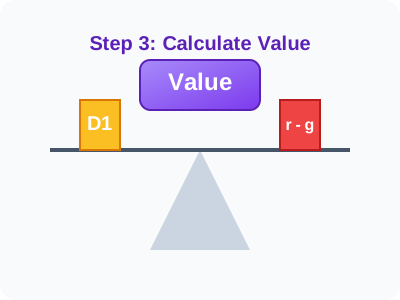
3. Interpret
See the intrinsic value vs. current price. Is it undervalued? That's your potential buy signal.
Why I Use a Stock Valuation Calculator
I've been investing for years, and if there's one thing I've learned, it's that price is what you pay, but value is what you get. The market is emotional. It overreacts to bad news and gets overly excited about good news. That's why I rely on math, not feelings.
A stock valuation calculator cuts through the noise. It tells me, "Based on the cash this business generates, here is what it's worth right now." If the market price is lower than that number, I get interested. If it's higher, I stay away. It's that simple.
How My Calculator Works (The DCF Method)
I designed this calculator based on the Discounted Cash Flow (DCF) method. In my opinion, this is the gold standard for valuation. Here's the logic:
- Cash is King: A company is worth the sum of all the cash it will generate in the future.
- Time Value of Money: A dollar I get 10 years from now is worth less than a dollar I get today. So, we "discount" those future cash flows back to today's value.
When you use the calculator above, you're essentially predicting the company's future bank account balance and translating that into a per-share price today.
Other Valuation Metrics I Watch
While DCF is my favorite, I don't ignore other tools. Here are a few other metrics I check to confirm my findings:
P/E Ratio (Price-to-Earnings)
This tells me how much I'm paying for every $1 of earnings. I compare this to the company's historical average and its competitors. If it's historically low, that's a good sign.
PEG Ratio
The P/E ratio doesn't account for growth. The PEG ratio does. I look for a PEG ratio under 1.0—that usually signals a stock is undervalued relative to its growth.
P/B Ratio (Price-to-Book)
Great for banks and asset-heavy companies. It compares the price to the net value of the company's assets.
Dividend Yield
For income stocks, I want to see if the yield is attractive compared to bonds or other safe investments.
My "Margin of Safety" Rule
Here is my #1 rule for using this calculator: Never pay the full fair value price.
I always demand a "margin of safety." If the calculator says a stock is worth $100, I typically won't buy it unless it's trading at $70 or $80. Why? Because I might be wrong. My growth assumptions might be too high. The economy might tank.
Buying at a discount gives me a cushion. If I'm right, I make a huge return. If I'm slightly wrong, I still probably won't lose money. This is the secret to sleeping well at night as an investor.
More Popular Calculators
Check out these other powerful tools to help you find the fair value of stocks.
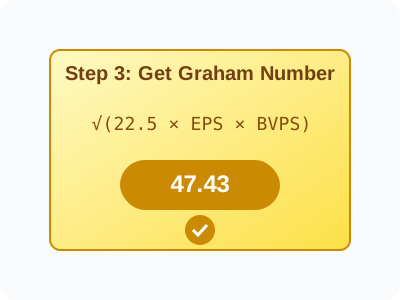
Benjamin Graham Formula
The classic formula from the "Dean of Wall Street". Perfect for defensive investors.
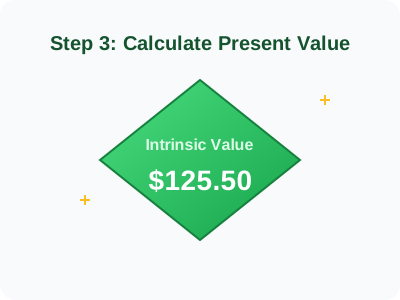
Discounted Cash Flow (DCF)
The gold standard for valuation. Estimate intrinsic value based on future free cash flows.
Dividend Discount Model (DDM)
Value dividend-paying stocks instantly using the Gordon Growth Model.
Frequently Asked Questions
How accurate is this stock valuation calculator?
It's mathematically precise, but the output is only as good as the inputs. If you put in unrealistic growth rates (like assuming a company will grow 50% forever), you'll get an unrealistic value. I recommend being conservative with your estimates.
Can I use this for any stock?
It works best for companies with predictable cash flows and earnings. It's less effective for early-stage startups that are losing money, or for banks and insurance companies where "free cash flow" is defined differently.
What discount rate should I use?
I typically use 10% as a baseline. If a company is very risky (small cap, volatile), I might bump it up to 12% or 15%. If it's a rock-solid blue chip like Johnson & Johnson, I might go down to 8%.
Why is the intrinsic value different from the market price?
Because the market is often irrational! It swings between fear and greed. The intrinsic value is what the business is worth based on math; the market price is what people are willing to pay based on emotion. The difference is your opportunity.
Is a lower P/E ratio always better?
Not always. A low P/E might mean the company is in trouble or its earnings are expected to crash. You have to look at the context. That's why I prefer the DCF model—it forces you to look at the future, not just the past.
Ready to Find Your Next Investment?
Stop guessing and start calculating. Use the tool above to find undervalued stocks today.
Go to Calculator