Profitability Index Calculator
I'll help you evaluate investment projects using the Profitability Index (PI) method. Discover which projects create the most value per dollar invested—perfect for capital budgeting and prioritizing multiple opportunities.
Calculate PI NowProfitability Index Calculator
Total upfront investment required
Required rate of return (WACC or hurdle rate)
Project duration
Expected cash inflows for each year
Profitability Index (PI)
Value created per dollar invested
1.137
📊 Calculation Breakdown
Present Value of Cash Flows:
Total Present Value:
$113,723.6
Initial Investment:
$100,000
Profitability Index:
1.137
PI = $113,723.6 / $100,000
💡 Value Created: $13,723.6
This project creates $13.7¢ of value for every dollar invested.
💡 Interpretation
Accept this project! The PI of 1.137 means the present value of future cash flows exceeds the initial investment. This project creates value and should be considered for funding, especially if you have limited capital and need to prioritize among multiple projects.
Remember: PI is especially useful when you have capital constraints and need to rank multiple projects. Higher PI values indicate better returns per dollar invested. Always verify your cash flow assumptions and discount rate before making final investment decisions.
Profitability Index Calculator in 3 Simple Steps
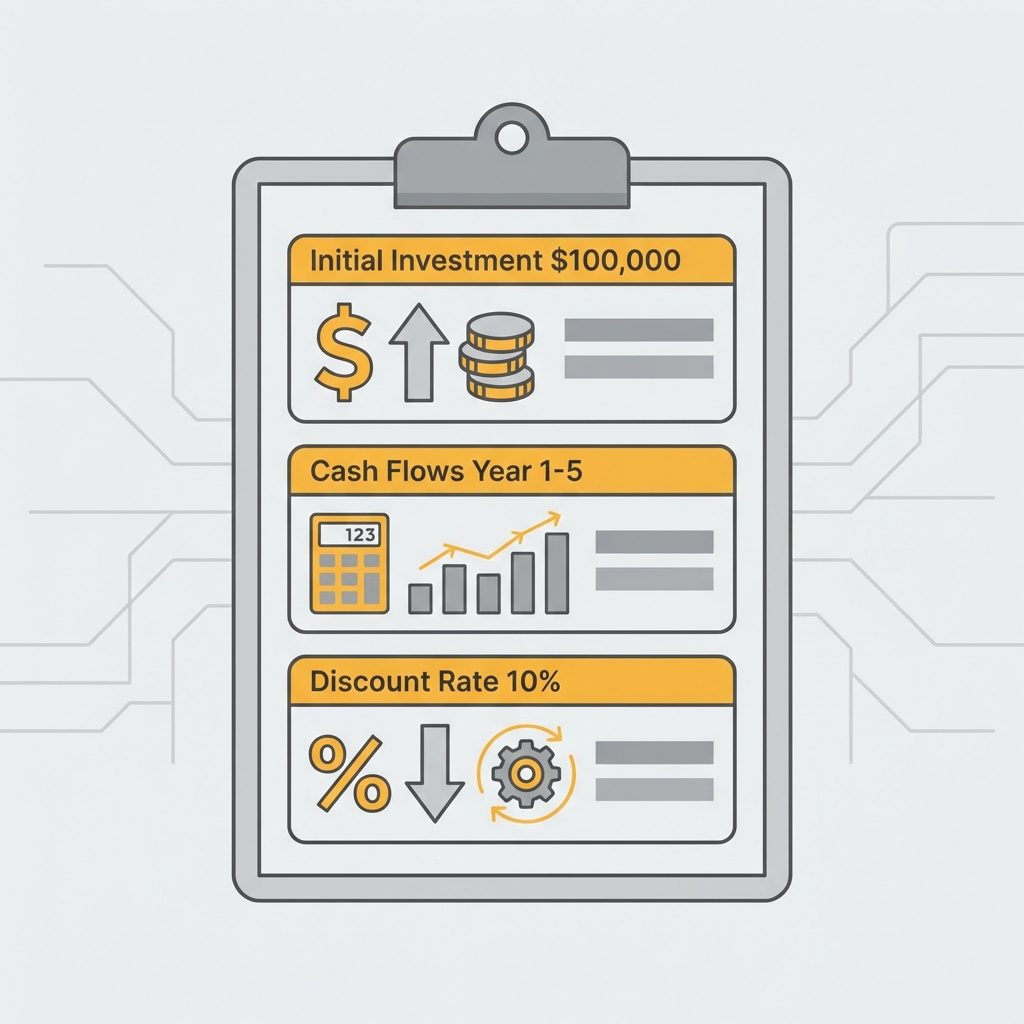
Step 1: Gather Your Data
Collect three key pieces of information: the initial investment required, your expected annual cash flows for each year, and your discount rate (usually your cost of capital or hurdle rate). This is the foundation of your PI calculation.
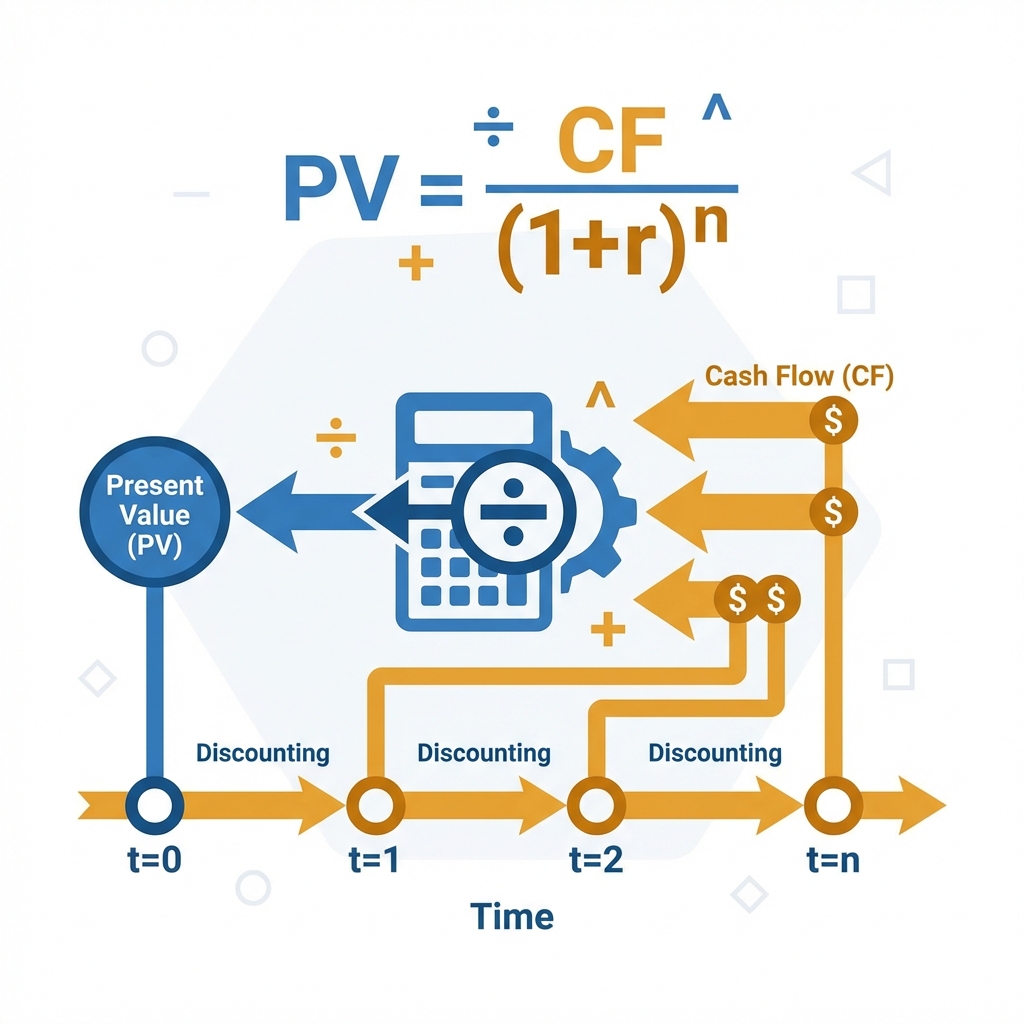
Step 2: Calculate Present Value
Discount each future cash flow back to present value using the formula PV = CF / (1+r)^n. The calculator does this automatically for you, showing how much those future cash flows are worth in today's dollars.
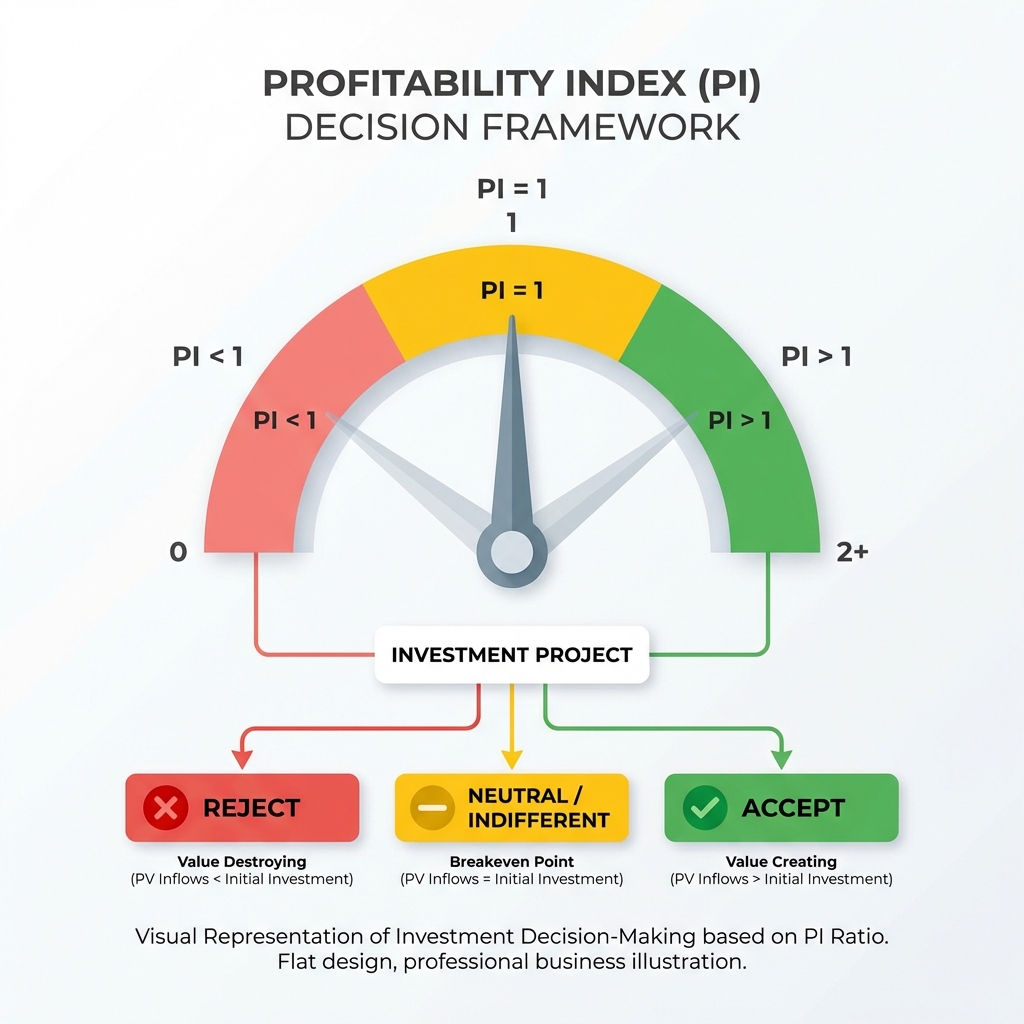
Step 3: Interpret & Decide
Divide the total present value by your initial investment to get the PI. If PI > 1.0, accept the project—it creates value! If PI < 1.0, reject it. The higher the PI, the better the return per dollar invested.
What is the Profitability Index?
The Profitability Index (PI), also called the Profit Investment Ratio or Value Investment Ratio, is one of my favorite capital budgeting tools. It tells you how much value you're creating for every dollar you invest in a project. Think of it as a bang-for-your-buck metric for investments.
Here's what makes PI special: unlike Net Present Value (NPV), which gives you an absolute dollar amount, PI gives you a ratio. This makes it incredibly useful when you're comparing projects of different sizes or when you have limited capital and need to prioritize. A project with a PI of 1.5 creates 50 cents of value for every dollar invested—that's powerful information.
The formula is beautifully simple: PI = Present Value of Future Cash Flows / Initial Investment. If the result is greater than 1.0, your project is creating value. If it's less than 1.0, you're destroying value. At exactly 1.0, you're breaking even—the project returns exactly your required rate of return, nothing more, nothing less.
I love using PI because it accounts for both the magnitude of returns AND the efficiency of capital use. A $1 million project with a PI of 1.3 might be more attractive than a $10 million project with a PI of 1.1, especially if you have capital constraints. It's all about maximizing value creation with the resources you have.
How to Calculate Profitability Index
The Formula Explained
Step 1: Calculate Present Value of Each Cash Flow
For each year's expected cash flow, discount it back to present value using:
PV = Cash Flow / (1 + Discount Rate)^Year
Step 2: Sum All Present Values
Add up all the individual present values to get the total PV of future cash flows. This represents what all those future cash flows are worth in today's dollars.
Step 3: Calculate the Profitability Index
Divide the total present value by the initial investment:
PI = Total PV of Cash Flows / Initial Investment
Step 4: Interpret the Result
If PI > 1.0, the project creates value and should be accepted. If PI < 1.0, the project destroys value and should be rejected. The higher the PI, the more value created per dollar invested.
How to Interpret PI Results
PI > 1.0: Accept the Project
This is what you're looking for! A PI greater than 1.0 means the present value of cash flows exceeds the initial investment. The project creates value and earns more than your required rate of return. The higher above 1.0, the better—a PI of 1.5 means you're creating $0.50 of value for every dollar invested.
PI = 1.0: Break-Even Point
A PI of exactly 1.0 means you're breaking even. The present value of cash flows equals the initial investment, so you're earning exactly your required rate of return—nothing more, nothing less. The project neither creates nor destroys value. You might accept it for strategic reasons, but financially, you're indifferent.
PI < 1.0: Reject the Project
This is a red flag. A PI less than 1.0 means the present value of cash flows is less than the initial investment. The project destroys value and doesn't earn your required rate of return. Unless there are compelling strategic reasons (market entry, defensive moves, etc.), you should reject this project and look for better opportunities.
💡 Ranking Multiple Projects
When you have multiple projects competing for limited capital, rank them by PI from highest to lowest. Start funding projects at the top of the list and work your way down until you run out of capital. This maximizes the total value created with your available resources. It's like getting the most groceries for your budget—you want the best value per dollar spent.
When to Use Profitability Index
✅ Best Use Cases
- • Capital rationing situations (limited budget)
- • Comparing projects of different sizes
- • Ranking multiple investment opportunities
- • Portfolio optimization decisions
- • Resource allocation across divisions
- • When efficiency matters more than scale
📊 When to Use NPV Instead
- • Mutually exclusive projects of similar size
- • No capital constraints
- • When absolute value creation matters most
- • Single large project evaluation
- • Strategic projects regardless of returns
- • When you want dollar amounts, not ratios
💡 My Recommendation
I always calculate BOTH PI and NPV. NPV tells me the absolute value created, while PI tells me the efficiency of capital use. Together, they give me a complete picture. For example, a project might have a lower NPV but a higher PI—that's valuable information when I'm working with limited capital. Use PI as your primary tool when capital is constrained, and NPV when it's not.
Profitability Index vs NPV vs IRR
| Metric | What It Measures | Best For | Decision Rule |
|---|---|---|---|
| PI | Value created per dollar invested (ratio) | Capital rationing, ranking projects | Accept if PI > 1.0 |
| NPV | Absolute value created (dollars) | No capital constraints, large projects | Accept if NPV > $0 |
| IRR | Rate of return (percentage) | Quick screening, communicating to stakeholders | Accept if IRR > required rate |
Pro Tip: PI and NPV will always agree on accept/reject decisions for individual projects. If NPV is positive, PI will be greater than 1.0, and vice versa. They only differ when ranking multiple projects—PI ranks by efficiency, NPV ranks by absolute value. IRR can sometimes give conflicting signals, especially with unconventional cash flows, so I trust PI and NPV more.
Real-World Example
Manufacturing Equipment Investment
Let's say I'm evaluating a new piece of manufacturing equipment. Here's the scenario:
Initial Investment
$100,000
Discount Rate (WACC)
10%
Expected Annual Cash Flows:
Step 1: Calculate Present Values
Year 1: $30,000 / (1.10)^1 = $27,273
Year 2: $30,000 / (1.10)^2 = $24,793
Year 3: $30,000 / (1.10)^3 = $22,539
Year 4: $30,000 / (1.10)^4 = $20,490
Year 5: $30,000 / (1.10)^5 = $18,627
Step 2: Sum the Present Values
Total PV = $27,273 + $24,793 + $22,539 + $20,490 + $18,627 = $113,722
Step 3: Calculate Profitability Index
PI = $113,722 / $100,000 = 1.137
✅ The Verdict
Accept this project! With a PI of 1.137, this equipment investment creates $0.137 (or 13.7 cents) of value for every dollar invested. The present value of cash flows ($113,722) exceeds the initial investment ($100,000) by $13,722.
If I had multiple equipment options competing for the same budget, I'd rank them by PI and choose the one with the highest ratio. That's how I maximize value creation with limited capital!
Frequently Asked Questions
Q: What's a good profitability index value?
Any PI greater than 1.0 is technically "good" because it means the project creates value. However, I personally look for PI values of at least 1.15-1.20 to provide a margin of safety for estimation errors. The higher the PI, the better—values above 1.5 indicate excellent projects that create substantial value per dollar invested.
Q: How is PI different from NPV?
NPV gives you an absolute dollar amount of value created, while PI gives you a ratio showing value created per dollar invested. They'll always agree on accept/reject decisions for individual projects, but they can rank projects differently. A $1M project with $500K NPV (PI = 1.5) creates less absolute value than a $10M project with $2M NPV (PI = 1.2), but it's more efficient. Use PI when you have capital constraints and need to maximize efficiency.
Q: What discount rate should I use?
Use your company's Weighted Average Cost of Capital (WACC) as the discount rate. This represents your required rate of return and accounts for both debt and equity costs. If you don't know your WACC, a common rule of thumb is 10% for average-risk projects, 8% for low-risk projects, and 12-15% for high-risk projects. The key is consistency—use the same rate when comparing projects.
Q: Can PI be used for mutually exclusive projects?
Yes, but with caution. When projects are mutually exclusive (you can only choose one), PI can sometimes favor smaller, more efficient projects over larger projects that create more absolute value. In these cases, I recommend using NPV as the primary decision criterion and PI as a secondary consideration. PI shines when you're selecting multiple projects from a larger pool with limited capital.
Q: What if my cash flows are uneven or irregular?
No problem! PI works perfectly fine with uneven cash flows—that's actually the norm in real projects. Just discount each year's cash flow individually and sum them up. The calculator handles this automatically. Whether your cash flows are $10K, $50K, $30K, $20K, $40K or any other pattern, the formula remains the same. Just make sure your estimates are realistic.
Q: Should I include the initial investment in the cash flows?
No! This is a common mistake. The initial investment goes in the denominator of the PI formula, not in the cash flows. Only include the future cash inflows (revenues, cost savings, etc.) in your cash flow projections. The initial investment is treated separately as the amount you're dividing by to get the ratio.
Q: How do I handle salvage value or terminal value?
Include salvage value (the resale value of equipment at project end) or terminal value (ongoing value beyond your projection period) as a cash flow in the final year. For example, if you're projecting 5 years and expect to sell equipment for $20K at the end, add that $20K to your Year 5 cash flow. This ensures you capture all the value the project creates.
Q: What are the limitations of profitability index?
PI has a few limitations: (1) It can favor small, efficient projects over large, value-creating ones when used alone. (2) It doesn't tell you the absolute value created—you need NPV for that. (3) It's sensitive to your discount rate assumption—a small change can significantly impact the result. (4) It assumes you can reinvest cash flows at the discount rate, which may not be realistic. That's why I always use PI alongside NPV and IRR for a complete picture.
Q: Can PI be negative?
Technically yes, if your cash flows are negative (the project loses money every year). But this is extremely rare and would be an obviously terrible project. In practice, you'll see PI values ranging from 0 to 2+. Values below 1.0 indicate value destruction, values above 1.0 indicate value creation. I've seen excellent projects with PI values of 2.0 or higher, meaning they double the initial investment in present value terms.
Q: How often should I recalculate PI during a project?
Recalculate PI whenever there's a significant change in assumptions: major cost overruns, revenue shortfalls, changes in discount rate, or shifts in project timeline. I recommend an annual review at minimum for long-term projects. If the PI drops below 1.0 mid-project, you might need to consider abandoning it (though sunk costs complicate this decision). The key is using PI as a living tool, not a one-time calculation.
Q: Is profitability index the same as benefit-cost ratio?
They're very similar! The benefit-cost ratio (BCR) is essentially the same concept—it compares the present value of benefits to the present value of costs. In most cases, PI and BCR will give you the same result. The main difference is terminology: PI is used more in corporate finance and capital budgeting, while BCR is common in public sector and government project evaluation. Both tell you whether benefits exceed costs.
Q: Can I use PI for non-financial projects?
Absolutely! While PI is most common in financial analysis, you can use it for any project where you can quantify benefits and costs in monetary terms. I've seen it used for IT projects (cost savings from automation), marketing campaigns (revenue from customer acquisition), R&D investments (expected product revenues), and even social programs (monetized social benefits). The key is being able to estimate cash flows or cash equivalents.
More Investment Calculators
📈 DCF Calculator
Calculate the intrinsic value of stocks using discounted cash flow analysis. Perfect for equity valuation and stock picking.
Calculate DCF →💼 Business Valuation Calculator
Value entire businesses using earnings multiples and cash flow methods. Great for M&A and business sale decisions.
Value Business →🎲 Expected Value Calculator
Calculate expected values for decisions under uncertainty. Perfect for risk analysis and probabilistic project evaluation.
Calculate EV →💰 Future Value Calculator
See how investments grow over time with compound interest. Great for retirement planning and savings goals.
Calculate FV →Ready to Evaluate Your Investment Projects?
Use the Profitability Index to prioritize projects and maximize value creation with limited capital.
Calculate PI Now