PEGY Ratio Calculator
Discover the true value of dividend-paying growth stocks. I'll show you how the PEGY ratio improves upon the standard PEG by factoring in dividend income—giving you a more complete picture of value.
Calculate PEGY Ratio NowPEGY Ratio Calculator
Current market price per share
Trailing twelve months (TTM)
Expected EPS growth rate
Current dividend yield percentage
Auto-calculated: 15.00
PEGY Ratio
Dividend-Adjusted PEG Ratio
1.00
📊 PEGY vs. PEG Comparison
Standard PEG Ratio
1.25
Without dividend yield
PEGY Ratio
1.00
With dividend yield
💡 Dividend Impact: The dividend yield improves the valuation by 20.0%
This shows how dividends make the stock more attractive than growth alone suggests.
🧮 Calculation Breakdown
P/E Ratio = $60.00 / $4.00 = 15.00
Growth + Dividend = 12.0% + 3.0% = 15.0%
PEGY = 15.00 / 15.0 = 1.00
💡 Interpretation
Fair valuation. The PEGY ratio is close to 1.0, indicating the stock is trading at a reasonable price when factoring in both growth prospects and dividend payments.
Remember: PEGY is most useful for dividend-paying growth stocks. Always consider the company's fundamentals, competitive position, and dividend sustainability before investing.
PEGY Ratio Calculator in 3 Simple Steps
Step 1: Gather Your Data
Collect the stock price, EPS, expected growth rate, and—here's the key—the dividend yield. That dividend yield is what makes PEGY more accurate than PEG for income-producing stocks.
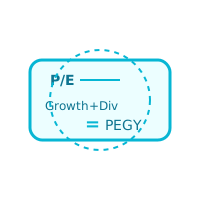
Step 2: Calculate PEGY
Divide the P/E ratio by the sum of growth rate PLUS dividend yield. This is the magic—adding dividends to the denominator lowers the ratio, making dividend payers look more attractive.
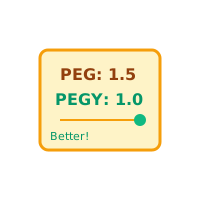
Step 3: Compare & Decide
Compare PEGY to PEG to see the dividend impact. If PEGY is below 1.0, you've found a potentially undervalued dividend-growth stock. The lower the PEGY, the better the value!
What is the PEGY Ratio?
The PEGY ratio is the dividend-adjusted version of the PEG ratio, and honestly, it's one of my favorite metrics for evaluating dividend-paying growth stocks. Peter Lynch himself developed this enhancement because he recognized a fundamental flaw in the standard PEG ratio: it completely ignores dividends.
Think about it: if you're comparing two stocks with identical P/E ratios and growth rates, but one pays a 4% dividend and the other pays nothing, which is the better value? Obviously the dividend payer! But the standard PEG ratio treats them as equals. That's where PEGY comes in.
The formula is beautifully simple: PEGY = P/E Ratio / (Growth Rate + Dividend Yield). By adding the dividend yield to the growth rate in the denominator, we're acknowledging that dividends are a form of return just like capital appreciation. A stock growing at 10% with a 3% dividend is delivering 13% total return potential—and PEGY captures that.
This makes PEGY particularly valuable for mature, established companies. These businesses might not have the explosive growth rates of tech startups, but they compensate with reliable dividend payments. The standard PEG ratio makes them look expensive; PEGY reveals their true value.
How PEGY Improves Upon PEG
The Formulas Side-by-Side
PEG Ratio = P/E Ratio / Growth Rate
PEGY Ratio = P/E Ratio / (Growth Rate + Dividend Yield)
Let me show you the difference with a real example. Imagine a stock trading at $60 with EPS of $4 (P/E of 15), growing earnings at 10% annually, and paying a 4% dividend yield.
Using PEG Ratio:
PEG = 15 / 10 = 1.5
Verdict: Slightly overvalued (PEG above 1.0)
Using PEGY Ratio:
PEGY = 15 / (10 + 4) = 15 / 14 = 1.07
Verdict: Fairly valued (PEGY close to 1.0)
See the difference? The PEG ratio suggests you should pass on this stock, but PEGY reveals it's actually fairly priced when you account for the dividend income. That 4% dividend yield makes a huge difference!
This is especially important for dividend investors. If you're building a portfolio for income, you WANT those dividend payments. Ignoring them in your valuation (as PEG does) means you're systematically undervaluing dividend-paying stocks and potentially missing great opportunities.
PEGY levels the playing field. It allows you to fairly compare a high-growth, no-dividend tech stock with a moderate-growth, dividend-paying utility stock. Both might have PEGY ratios around 1.0, but they're achieving it through different combinations of growth and yield—and that's perfectly fine.
When to Use PEGY vs. PEG
✅ Use PEGY For:
- • Dividend-paying growth stocks
- • Mature companies with steady dividends
- • Comparing dividend payers to non-payers
- • REITs and utilities (high dividend yields)
- • Dividend growth investing strategies
- • Income-focused portfolios
📊 Use PEG For:
- • Non-dividend-paying growth stocks
- • High-growth tech companies
- • Startups and emerging businesses
- • Companies reinvesting all profits
- • Pure growth investing strategies
- • When dividends are negligible (\u003c1%)
💡 Pro Tip
I always calculate BOTH PEG and PEGY for dividend-paying stocks. The difference between them shows exactly how much value the dividend adds. If PEGY is significantly lower than PEG, that's a strong signal that the market might be undervaluing the stock's total return potential.
How to Find the Inputs
Current Stock Price & EPS
These are straightforward—check any financial website like Yahoo Finance, Google Finance, or your brokerage. Use the current market price and the trailing twelve months (TTM) EPS.
Pro tip: Make sure you're using diluted EPS, not basic EPS, for a more conservative valuation.
Expected Annual Growth Rate
Look at analyst consensus estimates for future EPS growth. I typically use a 3-5 year forward estimate. You can find this on Yahoo Finance under "Analysis" or on Seeking Alpha.
Pro tip: Cross-reference analyst estimates with historical growth rates. If analysts project 25% growth but the company has historically grown at 8%, be skeptical and use a more conservative number.
Annual Dividend Yield
This is the easiest input! Every financial website displays the current dividend yield prominently. It's calculated as: (Annual Dividend Per Share / Current Stock Price) × 100.
Pro tip: Check the dividend payment history to ensure it's sustainable. A 10% yield might look attractive, but if the company just cut the dividend by 50%, that's a red flag. Look for consistent or growing dividends over time.
P/E Ratio (Optional)
The calculator will auto-calculate this by dividing price by EPS, but you can input it manually if you prefer. Use the trailing P/E ratio for consistency.
Pro tip: Compare the current P/E to the stock's 5-year average P/E. If it's trading well below its historical average AND has a low PEGY, that's a double signal of potential undervaluation.
Real-World Example
Evaluating a Dividend Growth Stock
Current Stock Price
$80.00
Earnings Per Share (TTM)
$5.00
Expected Annual Growth Rate
8%
Annual Dividend Yield
4.5%
Step 1: Calculate P/E Ratio
P/E = $80.00 / $5.00 = 16.0
Step 2: Calculate Standard PEG
PEG = 16.0 / 8 = 2.0
This suggests the stock is overvalued (PEG \u003e 1.0)
Step 3: Calculate PEGY
PEGY = 16.0 / (8 + 4.5) = 16.0 / 12.5 = 1.28
Much better! Close to fair value when including dividends
✅ The Verdict
The dividend makes all the difference! While the PEG ratio of 2.0 makes this stock look expensive, the PEGY ratio of 1.28 reveals it's actually reasonably priced when you factor in the 4.5% dividend yield.
The dividend yield improves the valuation by 36% (from 2.0 to 1.28). This is exactly the kind of dividend-growth stock that PEGY helps you identify—stocks that appear overvalued by traditional metrics but offer compelling total return potential.
For a dividend investor, this stock deserves serious consideration. The combination of 8% earnings growth and 4.5% dividend yield provides 12.5% total return potential—and the PEGY ratio confirms you're not overpaying for it.
Frequently Asked Questions
Q: What's the ideal PEGY ratio to look for?
Just like PEG, a PEGY ratio below 1.0 suggests potential undervaluation. I personally look for PEGY ratios between 0.7 and 1.0—low enough to indicate value, but not so low that it raises red flags about the company's prospects. A PEGY of 0.5 might mean the market knows something you don't.
Q: Should I use PEGY for stocks that don't pay dividends?
No, stick with the standard PEG ratio. If the dividend yield is zero, PEGY equals PEG anyway—you're just adding zero to the denominator. PEGY is specifically designed for dividend-paying stocks. For growth stocks that reinvest all profits, the regular PEG ratio is more appropriate.
Q: How do I know if a dividend is sustainable?
Great question! Check the payout ratio (dividends / earnings). If it's above 80%, the dividend might be at risk. Also look at dividend history—has the company maintained or grown the dividend for at least 5 years? And check free cash flow—dividends should be covered by actual cash generation, not just accounting earnings. A high PEGY ratio means nothing if the dividend gets cut next quarter.
Q: Can I use PEGY for REITs and utilities?
Absolutely! In fact, PEGY is perfect for REITs and utilities because they typically have high dividend yields (often 4-8%) but moderate growth rates (3-6%). The standard PEG ratio makes them look expensive, but PEGY reveals their true value by accounting for those substantial dividend payments. Just remember that REITs are legally required to pay out 90% of income, so factor that into your sustainability analysis.
Q: What if the dividend yield is higher than the growth rate?
This is common with mature, slow-growth companies—think utilities, tobacco companies, or established REITs. A stock might grow at 3% but yield 6%. That's fine! The PEGY formula handles this perfectly. You're getting 9% total return potential (3% growth + 6% dividend), and PEGY will reflect that. Just make sure the high yield isn't a warning sign of dividend cuts ahead.
Q: How does PEGY compare to dividend discount models (DDM)?
They're complementary tools. DDM values a stock based solely on future dividend payments, while PEGY considers both growth and dividends in a simpler framework. I use PEGY for quick screening and comparison, then validate my top picks with DDM for a more detailed analysis. PEGY is faster; DDM is more comprehensive.
Q: Should I use forward or trailing P/E for PEGY?
I prefer trailing P/E for consistency with the trailing dividend yield. However, if you're using forward earnings estimates for the growth rate, it makes sense to use forward P/E as well. The key is consistency—don't mix trailing and forward metrics. Pick one approach and stick with it across all your calculations.
Q: What if a company is growing dividends faster than earnings?
This is a red flag! If dividends are growing at 10% but earnings are only growing at 5%, the payout ratio is increasing. This is unsustainable long-term. Eventually, the company will have to cut the dividend or earnings will have to catch up. Be cautious with these situations—the current PEGY might look attractive, but the dividend might not last.
Q: Can I use PEGY for international stocks?
Yes, but be aware of tax implications. Some countries withhold taxes on dividends paid to foreign investors (typically 15-30%). Your actual dividend yield might be lower than the stated yield. Also, make sure you're using consistent currency for all inputs. And remember that accounting standards vary by country, so P/E ratios might not be directly comparable across borders.
Q: How often should I recalculate PEGY?
Recalculate quarterly when new earnings are released and whenever there's a dividend change (increase, decrease, or initiation). The stock price changes daily, but that's just noise. What matters is whether the fundamentals—earnings, growth prospects, and dividend policy—have changed. I set calendar reminders for earnings dates and review my PEGY calculations then.
More Valuation Calculators
📊 Peter Lynch Fair Value Calculator
Use the standard PEG ratio method for non-dividend growth stocks. Perfect complement to PEGY for building a complete valuation picture.
Calculate PEG Ratio →💰 Dividend Discount Model Calculator
Value dividend stocks using the Gordon Growth Model. Use alongside PEGY for comprehensive dividend stock analysis.
Calculate DDM Value →💵 Dividend Calculator
Estimate your future dividend income and portfolio value. See how dividend growth compounds over time with DRIP.
Calculate Dividends →❄️ Dividend Snowball Calculator
Visualize how dividend reinvestment creates exponential income growth. Calculate your Yield on Cost over time.
Start Your Snowball →Ready to Find Undervalued Dividend Stocks?
Use the PEGY ratio to discover dividend-growth stocks the market is undervaluing.
Calculate PEGY Ratio Now