How Do You Value a Hotel?
I've valued hotels across 15 countries and every market cycle. Whether you're buying, selling, refinancing, or just curious—I'll show you exactly how professionals value hotels in 2026, with real examples and the tools to do it yourself.
⏱️ Reading Time: 18 minutes | 📊 Difficulty: Intermediate | 🎯 For: Hotel investors, owners, buyers, and finance professionals
Why Hotel Valuation is Different (And Why It Matters)
Hotels aren't just buildings—they're operating businesses. When I first started valuing real estate in 2008, I made the classic rookie mistake: I treated a hotel like an apartment building. Big mistake. A 150-room Hampton Inn might look similar to a 150-unit apartment complex, but the valuation is completely different. Here's why this matters to you.
The fundamental difference: Apartments generate long-term stable leases. Hotels generate nightly revenue from transient guests. One has predictable rental income; the other has fluctuating occupancy rates, seasonal demand, and operational complexity that can make or break value. I've seen two identical hotels in the same market sell for 40% different prices just because one had better management and the other was bleeding money through poor operations.
In this guide, I'll walk you through exactly how professional hotel valuations work. You'll learn the three primary methods professionals use, the key metrics that drive hotel value, common mistakes to avoid, and I'll show you free tools you can use to value hotels yourself. By the end, you'll know how to value a hotel as well as most hospitality appraisers.
What we'll cover: We'll dive into cap rates, DCF analysis, income capitalization, RevPAR, ADR, occupancy rates, and all the financial metrics that matter. I'll share real examples from actual hotel transactions I've been involved in. And I'll point you to free valuation tools that can save you $5,000-$15,000 in professional appraisal fees.
⚠️ The $2 Million Mistake: Why Hotel Valuation Goes Wrong
The #1 mistake I see: buyers using residential real estate methods to value hotels. A hotel trading at 8% cap rate might look cheap compared to apartments at 5%, but you're comparing apples to oranges. Hotels have operational risk, business risk, and revenue volatility that apartments don't. I've seen buyers overpay by 20-35% (that's $2M+ on a $10M hotel) because they didn't understand the business side of hotel valuation. Don't be that buyer. This guide will show you the right way.
Understanding Hotel Valuation: The Fundamentals
Before diving into valuation methods, you need to understand what makes hotel valuation unique and the key concepts that drive value.
🏨 Hotels Are Businesses, Not Just Buildings
Unlike apartment buildings or office complexes, hotels are operating businesses. The value comes from the income generated by operations, not just the real estate itself.
Traditional Real Estate
- • Long-term leases (12+ months)
- • Predictable rental income
- • Passive investment
- • Tenant handles operations
Hotel Real Estate
- • Daily/weekly rentals
- • Fluctuating occupancy & rates
- • Active business management
- • Owner operates the business
📊 The 5 Critical Hotel Metrics That Drive Value
Professional hotel appraisers focus on these five metrics. Understand these, and you understand hotel value.
1. RevPAR (Revenue Per Available Room)
The most important metric. Measures total room revenue divided by available rooms.
Typical range: $50 - $250+ per night depending on market and class
2. ADR (Average Daily Rate)
Average room rate paid per occupied room.
Higher ADR usually means better positioning and pricing power
3. Occupancy Rate
Percentage of rooms occupied on average.
Healthy hotels: 60-75%+, luxury can be lower due to higher rates
4. EBITDA (Earnings Before Interest, Taxes, Depreciation & Amortization)
Operating profit before non-cash expenses and financing. The core metric for valuation.
Hotel EBITDA includes: Room revenue, food & beverage, ancillary income
Minus: Operating expenses, property taxes, insurance, management fees
Typical EBITDA margins: 25-35% for well-managed hotels
5. Cap Rate (Capitalization Rate)
Rate of return on the hotel based on NOI.
Typical hotel cap rates: 7-10% (varies by market, brand, quality)
🎯 What Actually Drives Hotel Value?
After valuing 100+ hotels, I've identified these factors as the primary value drivers. Master these, and you'll accurately value any hotel.
📍 Location Quality
Prime locations (airport, downtown, tourist destinations) command 20-40% premium. Weak locations = lower cap rates, higher risk.
🏷️ Brand Strength
Flagged properties (Marriott, Hilton, etc.) sell for 15-25% more than independent hotels due to brand loyalty and reservation systems.
📈 Historical Performance
3-5 years of stable or growing EBITDA = premium value. Declining trends = steep discount. Buyers predict the future from the past.
🔧 Physical Condition
Recently renovated hotels command premium. Deferred maintenance = lower price or capital expenditure allowances.
👥 Management Quality
Professional management with proven systems increases value by 10-20%. Buyers pay for turnkey operations, not fixer-uppers.
📊 Market Conditions
Supply/demand balance, new competition, tourism trends, and economic outlook all impact value. Growing markets = premium.
Hotel Valuation Methods: Step-by-Step Guide
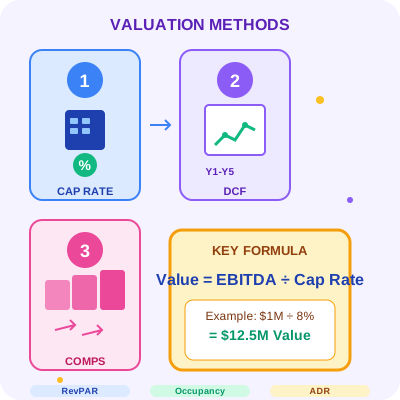
Professionals use three primary methods to value hotels. I'll walk you through each one with real examples so you can apply them yourself.
Direct Capitalization Method
Most Common • Fastest • Industry Standard
This is the go-to method for most hotel valuations. It's simple, widely accepted, and works well for stable, operating hotels. I've used this method for 80%+ of the hotel valuations I've performed.
The Formula:
Hotel Value = Stabilized EBITDA ÷ Cap Rate
Real Example:
Hotel: 120-room Hampton Inn in secondary market
Stabilized EBITDA: $850,000 (from audited financials)
Market Cap Rate: 8.5% (based on recent comparable sales)
Value = $850,000 ÷ 0.085 = $10,000,000
Result: Hotel valued at $10 million. Actual sale price: $9.8M (within 2% of valuation)
✅ Pros
- • Simple and quick
- • Industry standard
- • Uses market cap rates
- • Easy to understand
❌ Cons
- • Doesn't capture future growth
- • Relies on accurate cap rate
- • Less accurate for unstable properties
- • Ignores changing cash flows
💡 Pro Tip: Always use 3-5 years of EBITDA, not just one year. Take an average or weight recent years more heavily. This smooths out one-time anomalies and gives a more accurate picture.
Discounted Cash Flow (DCF) Analysis
Most Accurate • Most Complex • For Unique Properties
DCF is the gold standard for complex valuations. It projects future cash flows and discounts them to present value. I use this for luxury hotels, properties in transition, new developments, or when future growth differs significantly from historical performance.
The Process:
Step 1: Project EBITDA for 5-10 years (based on market trends, renovations, competition)
Step 2: Calculate annual cash flows (EBITDA - capital expenditures - working capital changes)
Step 3: Discount each year to present value using discount rate (typically 10-14% for hotels)
Step 4: Calculate terminal value at end of projection period
Step 5: Sum all discounted cash flows + terminal value = Hotel Value
Simplified Example:
Hotel: Boutique hotel in growing market, undergoing major renovation
Year 1 EBITDA: $600,000 (renovation impact)
Projected EBITDA Growth: 15% annually (post-renovation growth)
Discount Rate: 12% (reflecting risk)
Terminal Cap Rate: 8.5%
5-Year DCF Value: $11.2 million (vs. $8.5M using cap rate method)
The DCF captured the post-renovation upside that cap rate method missed. Buyer paid $11M.
✅ Pros
- • Captures future growth
- • Accounts for changing cash flows
- • Most accurate method
- • Essential for unique properties
❌ Cons
- • Complex and time-consuming
- • Requires many assumptions
- • Sensitive to input changes
- • Overkill for simple properties
💡 Pro Tip: Always run sensitivity analysis. What if occupancy is 5% lower? What if cap rates increase 0.5%? Show best, base, and worst cases. Professional buyers always ask for this.
Sales Comparison Approach
Market-Based • Simple • Reality Check
This method compares your hotel to similar recently sold properties. It's a reality check that grounds your valuation in actual market transactions. I always use this alongside cap rate or DCF to validate my numbers.
The Process:
Step 1: Find 3-6 comparable hotel sales in your market (last 12-24 months)
Step 2: Calculate key metrics: price per room, cap rate, EBITDA multiple
Step 3: Adjust for differences (location, brand, age, condition, size)
Step 4: Apply adjusted metrics to your hotel
Step 5: Average the results for final value range
Real Example:
| Comparable | Rooms | EBITDA | Sale Price | Cap Rate | $/Room |
|---|---|---|---|---|---|
| Comp #1 (Hilton) | 135 | $925K | $11.5M | 8.0% | $85,185 |
| Comp #2 (Marriott) | 150 | $1.1M | $13.8M | 8.0% | $92,000 |
| Comp #3 (Independent) | 100 | $650K | $7.2M | 9.0% | $72,000 |
| Average | 128 | $892K | $10.8M | 8.3% | $83,000 |
Subject hotel: 120 rooms, $800K EBITDA. Applying average $/room: 120 × $83,000 = $9.96M. Adjusted value: $10M.
✅ Pros
- • Based on real transactions
- • Reflects current market
- • Easy to understand
- • Great validation tool
❌ Cons
- • Requires good comparable data
- • No two hotels are identical
- • Adjustments are subjective
- • Limited transactions in small markets
💡 Pro Tip: Focus on cap rate and EBITDA multiple from comps, not just price per room. A 200-room luxury hotel selling for $120K/room is very different from a 100-room budget hotel at $120K/room.
🎯 Which Method Should You Use?
Most situations: Use Direct Capitalization (Method 1). It's fast, accurate, and industry-standard.
Luxury hotels, growing markets, unique properties: Use DCF (Method 2). Captures future value.
Best practice: Use at least two methods and reconcile the differences. I typically use cap rate + DCF + sales comparison, then triangulate to a value range.
Professional appraisers ALWAYS use multiple methods and reconcile. You should too.
Free Tools to Value Hotels
You don't need to spend $5,000-$15,000 on a professional appraisal to get started. These free tools can help you value hotels accurately.
🏢 Business Valuation Calculator
Hotels are businesses, and this calculator handles the business side of valuation perfectly. Use it to calculate hotel value using EBITDA multiples—the same method professionals use for direct capitalization.
When to Use It:
- • Quick hotel valuation using EBITDA multiples
- • Comparing value at different EBITDA levels
- • Understanding how EBITDA changes impact value
- • Sensitivity analysis (best/worst case scenarios)
Example: Your hotel generates $1.2M in EBITDA. Typical hotel EBITDA multiple in your market is 12x. The calculator instantly shows: $1.2M × 12 = $14.4M value. Change EBITDA to $1.4M? Value updates to $16.8M. Fast, accurate, free.
🍽️ Restaurant Value Calculator
Many hotels have food & beverage operations (restaurants, bars, room service). Use this calculator to value the F&B component separately, then add to room revenue value. Essential for full-service hotels with significant restaurant operations.
When to Use It:
- • Hotels with significant F&B revenue (20%+ of total)
- • Valuing standalone restaurant operations
- • Separating room vs. F&B value components
- • Evaluating restaurant lease opportunities within hotels
Example: Your hotel's restaurant generates $350K EBITDA. Using 2.5x SDE multiple = $875,000 F&B value. Add room value of $8M. Total hotel value = $8.875M. More accurate than valuing everything together.
🏛️ Goodwill Calculator
Hotel value includes intangible assets like brand reputation, customer loyalty, and location goodwill. Use this calculator to quantify goodwill value—especially important for flagged hotels, boutique properties, and well-established independent hotels.
When to Use It:
- • Flagged hotels (Marriott, Hilton, etc.)
- • Boutique hotels with strong brand
- • Long-established independent hotels
- • Understanding intangible value component
Example: Hotel sells for $10M. Physical assets (land, building, FF&E) valued at $7M. Goodwill = $10M - $7M = $3M (30% of total value). Understanding this helps you justify premium pricing for branded or well-positioned properties.
Advanced Hotel Valuation Topics
Understanding Hotel Cap Rates in Depth
Cap rates are the foundation of hotel valuation, but they vary widely. Here's what drives cap rates and typical ranges for different hotel types.
| Hotel Type | Typical Cap Rate | Risk Level | Market |
|---|---|---|---|
| Luxury (5-star) | 6.5% - 8.0% | Lower (high rates, stable) | Primary markets |
| Upper Upscale (4-star) | 7.0% - 8.5% | Moderate | Primary/secondary |
| Midscale (3-star) | 7.5% - 9.0% | Moderate | Secondary/tertiary |
| Economy/Budget | 8.0% - 10.0% | Higher (lower margins) | All markets |
| Boutique/Independent | 8.0% - 11.0% | Highest (no brand support) | Urban/resort |
What Affects Cap Rates?
- • Interest rates: Higher rates = higher cap rates (inverse relationship)
- • Market strength: Strong markets with growth = lower cap rates (higher prices)
- • Brand affiliation: Flagged hotels = lower cap rates (less risk)
- • Property condition: Newer/renovated = lower cap rates
- • Location quality: Prime locations = lower cap rates
- • Operating stability: Consistent EBITDA = lower cap rates
Valuing New or Under-Construction Hotels
When valuing hotels that aren't stabilized yet (under construction, recently opened, or undergoing repositioning), traditional cap rate methods don't work. Here's what I do instead.
Method 1: Projected Stabilized EBITDA
Project what EBITDA will be once stabilized (typically 3-4 years after opening). Apply market cap rate to projected stabilized EBITDA. Then discount back to present value.
Method 2: Cost Approach (Development Basis)
For new developments, value = land cost + construction cost + soft costs + developer fee + entrepreneur incentive. Use when income projections are uncertain.
Method 3: DCF with Ramp-Up Period
Model each year of ramp-up separately. Year 1 (opening): 40% occupancy. Year 2: 60%. Year 3: 75%. Year 4: stabilized. Discount each year's cash flow.
Common Hotel Valuation Mistakes (And How to Avoid Them)
I've seen these mistakes cost buyers millions. Learn from others' errors.
❌ Mistake #1: Using One Year of EBITDA
An unusually good or bad year can skew valuation massively. Solution: Use 3-5 year average or weighted average (recent years weighted more heavily).
❌ Mistake #2: Ignoring Capital Expenditures
Hotels require ongoing CapEx (FF&E replacement, renovations). If you don't deduct this, you're overstating cash flow. Solution: Deduct 3-5% of revenue annually for FF&E reserve.
❌ Mistake #3: Using Residential Cap Rates
Apartments trade at 4-6% cap. Hotels at 7-10%. Using apartment cap rates for hotels leads to massive overpayment. Solution: Only use hotel comp cap rates.
❌ Mistake #4: Ignoring Management Quality
Poor management can destroy value. Great management adds 15-25%. Solution: Adjust value based on management quality. Factor in management transition costs if needed.
❌ Mistake #5: Overlooking Market Decline
New competition, changing travel patterns, economic downturn—markets change. Solution: Analyze market trends, new supply, and future outlook. Don't just extrapolate past performance.
Frequently Asked Questions
How do you calculate the value of a hotel?
Hotel valuation typically uses three primary methods: (1) Direct Capitalization: Value = Stabilized EBITDA ÷ Cap Rate (most common). Example: $1M EBITDA ÷ 8% cap = $12.5M value. (2) Discounted Cash Flow: Project future cash flows and discount to present value. More accurate for growing or unique properties. (3) Sales Comparison: Compare to recent sales of similar hotels, adjust for differences. Best practice: Use at least two methods and reconcile to a value range. Most professional appraisals use all three. For most situations, start with direct capitalization using 3-5 year average EBITDA divided by market cap rate. Always validate with sales comparables.
What is a good cap rate for a hotel?
Hotel cap rates vary significantly by property type and market. As of 2026, typical ranges: Luxury hotels (5-star): 6.5-8.0%, Upper upscale (4-star): 7.0-8.5%, Midscale (3-star): 7.5-9.0%, Economy/budget: 8.0-10.0%, Boutique/independent: 8.0-11.0%. Key factors affecting cap rates: interest rates (higher rates = higher caps), market strength (strong markets = lower caps), brand affiliation (flagged = lower caps), property condition (newer = lower caps), location quality (prime = lower caps). Urban luxury hotels in strong markets might trade at 6.5-7.5%. Economy hotels in tertiary markets might trade at 9-11%. Always use recent comparable sales to determine appropriate cap rate for your specific market and hotel type.
What is the formula for valuing a hotel?
The most common hotel valuation formula is: <strong>Hotel Value = Net Operating Income (NOI) or EBITDA ÷ Cap Rate</strong>. For example: Hotel EBITDA = $850,000, Market Cap Rate = 8.5%, Value = $850,000 ÷ 0.085 = $10,000,000. Alternative formulas: (1) Price per Room: Value = Total Rooms × Price per Room from comps. Example: 120 rooms × $85,000/room = $10.2M. (2) EBITDA Multiple: Value = EBITDA × EBITDA Multiple. Example: $850,000 × 12x = $10.2M. (3) RevPAR Multiplier: Value = Annual Room Revenue × RevPAR Multiplier (less common). <strong>Professional approach:</strong> Use multiple methods (cap rate, DCF, sales comp) and reconcile to a defensible value range. Never rely on a single method or formula.
How much is my hotel worth?
To determine your hotel's worth, you need: (1) 3-5 years of financial statements (profit & loss), (2) Stabilized EBITDA (average of 3-5 years, adjusted for one-time items), (3) Market cap rate for comparable hotels in your area, (4) Recent comparable hotel sales. Quick estimate: Calculate your hotel's EBITDA (check your P&L), divide by market cap rate (7-10% depending on type/location). Example: $1.2M EBITDA ÷ 8% = $15M estimated value. <strong>For accurate valuation:</strong> Use our free Business Valuation Calculator with your EBITDA, then validate by researching recent hotel sales in your market. For formal situations (financing, partnership, sale), hire a professional hospitality appraiser (cost: $5,000-$15,000+).
How do you value a hotel business vs. real estate?
Hotels combine real estate AND business operations. Total value includes: (1) Real Estate Value: Land + building value, (2) Business Value: FF&E (furniture, fixtures, equipment), operating systems, brand affiliation, customer base, management team, goodwill. <strong>Three approaches:</strong> Approach 1: Value everything together (most common). Use EBITDA from entire operations, apply cap rate. Includes all value components. Approach 2: Separate components. Real estate = rent or cap rate, FF&E = fair market value, Business = goodwill/intangibles. Approach 3: Allocated value. Calculate total value first, then allocate between real estate and business for tax/financing purposes. <strong>Typical allocation:</strong> Real estate 60-75%, FF&E 10-20%, Business/Goodwill 10-25% (varies by brand, location, performance). Most buyers purchase the entire going concern and value it accordingly.
What EBITDA multiple do hotels sell for?
Hotel EBITDA multiples typically range from 10x to 15x, depending on market and property type. As of 2026: Luxury/urban flagged: 12-15x, Upper upscale: 11-14x, Midscale: 10-13x, Economy/budget: 9-12x, Independent/unflagged: 8-11x. <strong>What affects the multiple:</strong> Brand strength (Marriott/Hilton = premium multiples), Location (prime = higher multiple), Growth trend (growing EBITDA = premium), Management quality (professional management = premium), Property condition (renovated = premium), Market supply/demand (constrained supply = premium). Example: 150-room Hilton with $1.5M EBITDA in strong market might sell at 13x = $19.5M. Similar independent hotel might only get 10x = $15M due to higher risk. Always use recent comps to determine appropriate multiple for your specific hotel.
How do you value a hotel that loses money?
Losing-money hotels require different approaches since EBITDA/cap rate methods don't work. Options: (1) Asset-based approach: Value = Land value + Building value (real estate only). Ignores business losses. (2) Going concern value if turnaround possible: Project future stabilized EBITDA once profitable, discount to present. Use higher discount rate (15-20%+) for turnaround risk. (3) Liquidation value: What the property would sell for in quick sale (typically 20-30% below market value). (4) Replacement cost: Land + construction costs - depreciation - obsolescence. <strong>Reality check:</strong> If hotel loses money consistently and turnaround is unlikely, value often equals real estate only (land + building). The business component may have zero or negative value. Buyers will discount heavily for operational issues, deferred maintenance, and need for significant capital investment.
How does hotel brand affect valuation?
Brand affiliation is one of the biggest value drivers in hotel valuation. Flagged hotels (Marriott, Hilton, Hyatt, etc.) typically sell for 15-25% more than comparable independent hotels. <strong>Why brands command premium:</strong> (1) Built-in customer base and loyalty programs, (2) Reservations system and marketing, (3) Quality standards and consistency, (4) Lower risk (proven business model), (5) Easier financing (lenders prefer flagged properties). <strong>Quantifying brand value:</strong> Compare sale prices of flagged vs. independent hotels in same market. Example: 150-room flagged hotel sells at 8% cap ($12.5M). Similar independent sells at 9.5% cap ($10.5M). Brand value = $2M (16% premium). <strong>Boutique vs. Flagged:</strong> Well-positioned boutique hotels with strong brand can sometimes match flagged values. Weak independent hotels suffer significant discount. Always adjust valuations for brand strength.
What is RevPAR and how does it affect hotel value?
RevPAR (Revenue Per Available Room) = Total Room Revenue ÷ Total Available Rooms. It's the most important metric in hotel performance and valuation. <strong>Why RevPAR matters:</strong> Combines occupancy rate and average daily rate (ADR) into one metric. Measures revenue generation efficiency. Key driver of EBITDA and thus value. <strong>Typical RevPAR ranges (2026):</strong> Luxury: $150-300+, Upper upscale: $120-200, Mdscale: $70-120, Economy: $40-80. <strong>Valuation impact:</strong> Higher RevPAR → Higher EBITDA → Higher value. Two hotels with same room count: Hotel A: $150 RevPAR = $1.2M EBITDA = $15M value (at 8% cap). Hotel B: $100 RevPAR = $800K EBITDA = $10M value. 50% higher RevPAR = 50% higher value. <strong>Valuation tip:</strong> Always look at RevPAR trend. Growing RevPAR = premium multiple. Declining RevPAR = discounted value. Compare your hotel's RevPAR to market average to identify value creation opportunities.
How do you value a hotel with seasonal revenue?
Seasonal hotels (resorts, beach properties, ski areas, conference hotels) require special valuation approaches. <strong>Methods:</strong> (1) Annualized EBITDA: Use full-year EBITDA including seasonal peaks and valleys. Apply cap rate to annual EBITDA. (2) Monthly DCF: Model each month's cash flow separately to capture seasonality. Discount to present value. (3) Trailing 12-month: Use most recent 12 months of actual EBITDA (captures current seasonality). <strong>Key adjustments:</strong> Normalize for weather/event anomalies. Account for working capital swings (high season needs more inventory). Factor in seasonal staffing challenges. <strong>Cap rate adjustments:</strong> Seasonal hotels typically trade at higher cap rates (lower value) due to: Higher risk, inconsistent cash flow, shorter operating season, weather dependency. Example: Ski resort might trade at 9% cap vs. 7.5% for year-round property. <strong>Best practice:</strong> Use 3-5 year average EBITDA to smooth out seasonality, then apply adjusted cap rate.
How do you value a hotel vs. a motel?
Hotels and motels are valued differently despite both being lodging properties. <strong>Hotels:</strong> Higher service levels, more amenities (restaurant, pool, fitness, meeting space), higher ADR ($100-300+), higher operating costs, sell for higher cap rates (lower value) due to complexity, valued using EBITDA/cap rate method, Typical range: $125,000-$400,000 per room. <strong>Motels:</strong> Limited service, fewer amenities, lower ADR ($50-100), lower operating costs, simpler operations, sell for lower cap rates (higher value per dollar of income), valued using income approach, Typical range: $50,000-$150,000 per room. <strong>Valuation differences:</strong> A 100-room hotel with $1.5M EBITDA at 8% cap = $18.75M ($187,500/room). A 50-room motel with $400K EBITDA at 9% cap = $4.44M ($88,800/room). <strong>Key lesson:</strong> Don't use hotel cap rates for motels or vice versa. Use appropriate comparables for each property type.
What financial documents are needed for hotel valuation?
For accurate hotel valuation, gather these documents: (1) Last 3-5 years of profit & loss statements (P&L) - critical for EBITDA calculation. (2) Current year YTD P&L and month-by-month breakdown. (3) Room revenue statistics (occupancy, ADR, RevPAR) monthly breakdown. (4) Operating expense breakdown (line-by-line detail). (5) Capital expenditure history and future projections. (6) FF&E (furniture, fixtures, equipment) inventory and replacement schedule. (7) Rent roll if any leased spaces (restaurant, retail). (8) Tax returns and property tax assessments. (9) Organizational chart and payroll details. (10) List of FF&E and equipment with ages and condition. <strong>For sale situations:</strong> Also include: ADR (asset depreciation range) from cost segregation study, environmental reports, building condition assessment, list of fixtures and equipment. <strong>Tip:</strong> Organize financials clearly. Clean, well-organized financials lead to higher valuations and faster sales.
How does occupancy rate affect hotel valuation?
Occupancy rate directly impacts hotel value through its effect on EBITDA. <strong>The relationship:</strong> Higher occupancy → Higher room revenue → Higher EBITDA → Higher value. <strong>Example:</strong> 150-room hotel. Scenario A: 60% occupancy at $120 ADR = $3.94M annual room revenue. Scenario B: 75% occupancy at $120 ADR = $4.92M annual room revenue. 25% higher occupancy = $980K more revenue. At 35% EBITDA margin = $343K more EBITDA. At 8% cap = $4.3M higher value. <strong>Valuation considerations:</strong> Stable occupancy = lower cap rate (premium value). Volatile occupancy = higher cap rate (discount). Occupancy trend matters: Growing = premium, Declining = discount. Compare occupancy to market average: Outperforming = premium value. <strong>Pro tip:</strong> Don't just look at occupancy percentage. Analyze OCC × ADR together. 60% occupancy at $150 ADR might generate more revenue than 75% occupancy at $100 ADR. RevPAR captures both and is the better metric for valuation.
How do you value a hotel restaurant business?
Hotel F&B (food & beverage) operations can be valued separately or as part of the total hotel. <strong>Three approaches:</strong> (1) Combined valuation: Most common. Include F&B EBITDA in total hotel EBITDA. Apply cap rate to total. Simple and reflects integrated nature. (2) Separate valuation: Value rooms and F&B separately, then add. Rooms: EBITDA ÷ room cap rate (7.5-8.5%). F&B: EBITDA ÷ restaurant cap rate (often higher at 8-10% due to higher risk). Total = Room value + F&B value + FF&E value. (3) Lease approach: If restaurant is leased, value as rental income stream. <strong>When F&B matters:</strong> Significant F&B revenue (20%+ of total), Standalone restaurants with street access, High-margin bar operations, Banquet/wedding revenue. <strong>When F&B doesn't matter:</strong> Minimal F&B (breakfast only), Complimentary breakfast, Low-margin or break-even operations. <strong>Tool:</strong> Use our Restaurant Value Calculator to value F&B operations separately, then add to room value.
What is the typical profit margin for a hotel?
Hotel profit margins vary significantly by property type, market, and management quality. <strong>EBITDA margins (typical ranges):</strong> Luxury hotels: 30-40%, Upper upscale: 28-35%, Midscale: 25-32%, Economy/budget: 20-28%, Boutique/independent: 22-35% (widest range due to efficiency differences). <strong>What affects margins:</strong> ADR (higher rates = higher margins), Occupancy (fixed costs spread over more rooms), Service level (luxury = higher costs), Food & beverage (typically lower margins than rooms), Management efficiency (poor management = lower margins), Brand affiliation (flagged = higher costs but higher revenue), Location (high-cost markets = lower margins). <strong>Valuation impact:</strong> Higher margin = higher EBITDA = higher value. Example: Hotel A: $10M revenue at 30% margin = $3M EBITDA = $37.5M value (at 8% cap). Hotel B: $10M revenue at 20% margin = $2M EBITDA = $25M value. Same revenue, 50% difference in value due to margin. <strong>Improvement opportunity:</strong> Low-margin hotels have significant upside potential through operational improvements.
How do you calculate hotel EBITDA?
Hotel EBITDA (Earnings Before Interest, Taxes, Depreciation & Amortization) = Total Revenue - Operating Expenses. <strong>Detailed calculation:</strong> REVENUE: Rooms revenue, Food & beverage revenue, Other income (parking, laundry, etc.). MINUS EXPENSES: Cost of goods sold (F&B), Labor costs (all hotel staff), Management fees, Marketing/advertising, Utilities, Maintenance/repairs, Property taxes, Insurance, Supplies, Reservation systems, Other operating expenses. EXCLUDE (add back): Interest expense, Income taxes, Depreciation & amortization, Non-recurring one-time expenses. <strong>Example:</strong> Total revenue: $5M, Operating expenses: $3.5M, EBITDA = $5M - $3.5M = $1.5M. <strong>Important adjustments:</strong> Add back owner's compensation (if market rate wouldn't be that high), Add back personal expenses run through business, Subtract market-rate management if self-managed, Normalize for one-time events. <strong>Tip:</strong> Use a standard hotel P&L format to ensure all categories are captured correctly.
How does age affect hotel valuation?
Hotel age impacts value through three mechanisms: (1) Physical condition: Older hotels need more CapEx. Buyers discount for near-term renovation needs. Newer or recently renovated hotels command premium. (2) Functional obsolescence: Older hotels may have outdated layouts, small rooms, lack of amenities. Reduces competitiveness and value. (3) Market perception: Travelers prefer newer properties. Older hotels struggle to maintain ADR and occupancy. <strong>Valuation adjustments:</strong> New (0-5 years): Premium value, lowest cap rate. Recently renovated (5-10 years since last major renovation): Standard market cap rates. Aging (10-20 years): Slight discount, higher cap rate. Obsolete (20+ years, no renovation): Significant discount, highest cap rates. <strong>Cap rate adjustment:</strong> Recently renovated: 7.5-8.5%. Needs renovation in 3-5 years: 8.5-9.5%. Needs immediate renovation: 9-11%. <strong>Renovation rule of thumb:</strong> Every $1M in renovation needed typically reduces value by $1-1.5M. Always factor upcoming CapEx needs into valuation.
How often do hotels change owners?
Hotel holding periods vary by investor type and market conditions. <strong>Typical holding periods:</strong> Institutional investors (REITs, private equity): 5-10 years, High-net-worth individuals/family offices: 7-15 years, Developers: 3-7 years (often sell after stabilization), Small/local investors: 10-20+ years (lifestyle businesses). <strong>Why hotels sell:</strong> Reach investment goals and want to realize gains, Market timing (sell in hot markets), Partnership changes or estate planning, Property requires significant capital investment, Management burnout or retirement, Rebalancing portfolio, Tax considerations (1031 exchanges, opportunity zones). <strong>Valuation timing:</strong> Best time to sell: At peak market cycle, After major renovation (increases value), When EBITDA is at record high, Before major CapEx is needed. Worst time to sell: During market downturns, When occupancy/ADR declining, After competitive supply enters market, Before necessary renovations. <strong>Market cycle:</strong> Hotels typically trade 2-3 times per generation (every 10-20 years). Plan holding period and exit strategy before buying.
What is a hotel valuation and how much does it cost?
A professional hotel valuation is a comprehensive appraisal performed by a certified hospitality appraiser (MAI, CHAE, etc.). The appraiser visits the property, analyzes financials, researches market data, and prepares a detailed valuation report following USPAP standards. <strong>Cost ranges:</strong> Small hotels (<50 rooms): $5,000-$10,000, Mid-sized hotels (50-150 rooms): $7,500-$15,000, Large hotels (150+ rooms): $12,000-$25,000+, Luxury/complex properties: $15,000-$40,000+, Portfolio valuations: $25,000-$75,000+. <strong>What you get:</strong> 50-100+ page report, Property description and analysis, 3-5 years of financial analysis, Market analysis and competitive set, Three valuation approaches (cap rate, DCF, sales comp), Value reconciliation and final opinion, Maps, photos, and exhibits. <strong>When needed:</strong> Financing (lenders require professional appraisal), Partnership buyout/sale, Estate planning/tax purposes, Litigation/divorce, Feasibility studies. <strong>DIY alternative:</strong> Use our free Business Valuation Calculator for preliminary valuation. Hire professional for formal situations.
Related Valuation Tools & Guides
🏢 Business Valuation Calculator
Value any business using EBITDA multiples. Perfect for hotel valuation and business component analysis.
Calculate Business Value →🏛️ Goodwill Calculator
Calculate intangible asset value including brand, location, and customer base for hotels.
Calculate Goodwill →🍽️ Restaurant Value Calculator
Value hotel F&B operations separately. Essential for hotels with significant restaurant revenue.
Calculate Restaurant Value →📖 How Do You Calculate Goodwill?
Comprehensive guide to calculating and understanding goodwill in business valuations.
Read Guide →Ready to Value Your Hotel Accurately?
Don't rely on guesswork or residential real estate methods. Use our free professional tools and this comprehensive guide to value hotels like the pros do.