Goodwill Calculation Formula
I've compiled every goodwill calculation formula you'll ever need. From the standard ASC 805 formula to profits-based methods, I'll explain them all with real examples.
The Quick Answer
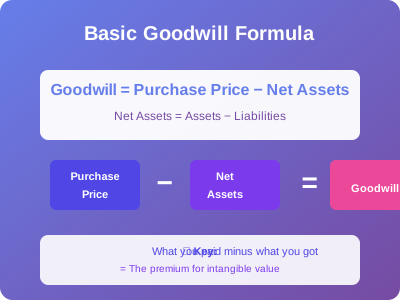
Goodwill = Purchase Price − Net Assets
Where Net Assets = Fair Value of Assets − Fair Value of Liabilities
That's the fundamental formula! Goodwill is what you paid minus what you actually got (tangible and identifiable intangible assets). The difference represents the premium for brand, customer relationships, synergies, and everything else that makes the business valuable.
The Primary Goodwill Formulas
I'll walk you through all the goodwill calculation formulas, starting with the most important ones.
1. Basic Acquisition Formula
Goodwill = Purchase Price − (Assets − Liabilities)
This is the standard formula used in 99% of M&A deals. It's required under ASC 805 (US GAAP) and IFRS 3 (International).
When to use: Every corporate acquisition, business purchase, and merger. This isn't optional—it's the accounting standard.
2. IFRS 3 Formula (with Non-Controlling Interest)
Goodwill = Purchase Price + NCI − Net Assets
When you acquire less than 100% of a company, you need to account for the portion other shareholders still own (Non-Controlling Interest or NCI).
When to use: When you're buying, say, 80% of a company and the other 20% is held by existing shareholders. The NCI is their share at fair value.

3. Profits-Based Methods
These methods calculate goodwill based on the company's earning power rather than asset values. They're commonly used for small business valuations and negotiation purposes.
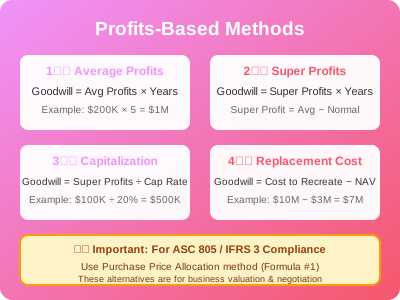
- •Average Profits Method: Goodwill = Average Profits × Number of Years
- •Super Profits Method: Goodwill = (Average Profits − Normal Profits) × Years
- •Capitalization Method: Goodwill = Super Profits ÷ Capitalization Rate
⚠️ Important: These are NOT for financial reporting under ASC 805/IFRS 3. Use them for business valuation and negotiation only.
Stop Calculating Goodwill Manually
I've built a free Goodwill Calculator that does all the math for you. Just enter the numbers and get instant results.
Use My Goodwill CalculatorWhy I Created This Guide
When I first learned about goodwill calculation, I found it confusing. Most resources either threw complex accounting formulas at me without context, or they oversimplified to the point of being useless.
I've been calculating goodwill for M&A deals for years, and I've learned that understanding the why behind each formula matters just as much as the what. Whether you're a student, a business owner preparing to sell, or an investment professional, I'll explain everything clearly.
Breaking Down the Basic Formula
Let me dissect the basic goodwill formula piece by piece:
Goodwill = Purchase Price − (Assets − Liabilities)
Purchase Price
Everything you paid to acquire the business. Cash, stock, debt assumption, earn-outs, non-compete agreements, consulting arrangements—everything of value transferred to the seller. Under ASC 805, even contingent payments like earn-outs must be valued at fair value at acquisition date.
Fair Value of Assets
The market value of everything you're acquiring. Tangible assets (cash, inventory, equipment, property) plus identifiable intangible assets (patents, trademarks, customer lists, software, non-compete agreements, domain names). If you can sell it separately, it's an identifiable asset.
Fair Value of Liabilities
All debts and obligations you're assuming. Bank loans, accounts payable, warranties, legal contingencies, deferred revenue, pension obligations—even uncertain liabilities must be estimated and included. Underestimating liabilities is a common mistake that inflates goodwill.
Real-World Goodwill Calculation Example
Let me walk you through a detailed example. Imagine TechCorp acquires SoftwareInc for $50 million.
The Deal Structure
Purchase Price: $50 million ($40M cash + $10M TechCorp stock)
What SoftwareInc Owns (Fair Values)
- • Cash: $5 million
- • Equipment & Property: $10 million
- • Software Code: $8 million
- • Customer Contracts: $7 million
- • Patents: $5 million
- • Total Assets: $35 million
What SoftwareInc Owes (Fair Values)
- • Bank Loan: $8 million
- • Accounts Payable: $4 million
- • Total Liabilities: $12 million
Step 1: Calculate Net Assets
Net Assets = $35M − $12M = $23 million
Step 2: Calculate Goodwill
Goodwill = $50M − $23M = $27 million
💡 TechCorp paid $50M for $23M of net identifiable assets. The $27M difference is goodwill—the brand value, customer relationships, synergies, and everything else that makes SoftwareInc valuable beyond its balance sheet.
Understanding the Profits-Based Methods
While purchase price allocation is the accounting standard, profits-based methods are incredibly useful for business valuation and negotiation. Let me explain each one.
1. Average Profits Method
This is the simplest profits-based approach. You take the average profits over several years and multiply by a number of years.
Goodwill = Average Profits × Number of Years
Example: A business has earned $200K, $220K, $180K over the past three years. Average = $200K.
Goodwill = $200K × 5 years = $1,000,000
When to use: Small business valuations, quick estimates, industries with stable earnings.
2. Super Profits Method
This method only counts excess profits—profits above what's considered "normal" for the industry.
Goodwill = (Average Profits − Normal Profits) × Number of Years
Example: Average profits = $200K. Normal return on assets ($1M at 10%) = $100K.
Super Profits = $200K − $100K = $100K
Goodwill = $100K × 5 years = $500,000
When to use: When the business earns above-average returns. It's more conservative than the average profits method.
3. Capitalization of Super Profits Method
This treats goodwill like a perpetuity—you capitalize the super profits at an appropriate rate.
Goodwill = Super Profits ÷ Capitalization Rate
Example: Super profits = $100K. Capitalization rate = 20%.
Goodwill = $100K ÷ 0.20 = $500,000
When to use: When super profits are expected to continue indefinitely. The cap rate should reflect the risk of those profits continuing.
4. Replacement Cost Method
This asks: "How much would it cost to recreate this business from scratch?"
Goodwill = Cost to Recreate − Net Asset Value
Example: It would cost $10M to build the brand, customer base, and systems from scratch. Net assets = $3M.
Goodwill = $10M − $3M = $7,000,000
When to use: Tech companies with strong platforms, businesses with significant brand value, startups with network effects.
⚠️ Critical Distinction: For financial reporting under ASC 805 (US GAAP) and IFRS 3 (International), you MUST use the purchase price allocation method (Formula #1). The profits-based methods are for business valuation, negotiation, and analysis only—not for accounting entries.
Negative Goodwill (Bargain Purchase)
What happens when the calculation results in negative goodwill? This is called a bargain purchase, and while rare, it's legitimate.
Understanding Bargain Purchases
Negative goodwill means you paid less than the fair value of net identifiable assets. This can happen in:
- Distressed sales: The seller is desperate—bankruptcy, divorce, health issues, retirement urgency
- Forced liquidations: Court-ordered sales, estate sales, regulatory requirements
- Fire sales: Quick exits where the seller values certainty over maximum price
- Miscalculated valuations: Sometimes you just get an incredible deal
Accounting Treatment: Under ASC 805 and IFRS 3, negative goodwill is recognized as a gain in the income statement at the acquisition date. It's like finding money—you record an immediate gain.
However, before recognizing a gain, you must reassess all assets and liabilities to ensure you didn't miss anything. The accounting standards assume bargain purchases are rare, so they require extra scrutiny.
Bargain Purchase Example
You acquire a business for $15 million. Assets = $30M, Liabilities = $10M.
Net Assets = $30M − $10M = $20M
Goodwill = $15M − $20M = −$5M (Negative Goodwill)
You recognize a $5M gain on your income statement. This is rare but legitimate—distressed sellers do exist.
Common Goodwill Calculation Mistakes
In my experience, here are the mistakes I see people make most often:
❌ Using Book Value Instead of Fair Value
Assets and liabilities should be recorded at fair value, not book value. Book value is historical cost minus depreciation. Fair value is what you could sell it for today. These can be dramatically different, especially for long-held assets like real estate or equipment.
❌ Forgetting Identifiable Intangible Assets
Customer lists, software, patents, trademarks, non-compete agreements—these are all identifiable intangible assets that should be valued separately, not lumped into goodwill. Missing these inflates goodwill and can cause problems later during impairment testing.
❌ Ignoring Contingent Liabilities
Lawsuits, warranties, environmental obligations—these need to be valued and included in liabilities, even if they're uncertain. Underestimating liabilities inflates net assets and understates goodwill. This is a major source of deal regret.
❌ Mishandling Earn-Outs
Earn-outs should be valued at fair value at acquisition date and included in the purchase price. Don't wait until they're paid to recognize them. This affects your goodwill calculation from day one. Many buyers get this wrong.
❌ Double-Counting Assets
Make sure you're not counting the same asset twice. If you value customer contracts as an identifiable intangible, don't also include that value in goodwill. Each asset gets counted once, and only once.
Which Formula Should You Use?
I've given you multiple goodwill calculation formulas. Here's my guidance on when to use each:
| Formula | When to Use | Purpose |
|---|---|---|
| Basic Purchase Price Allocation | All M&A deals for financial reporting | ASC 805 / IFRS 3 compliance |
| IFRS 3 with NCI | Partial acquisitions (<100%) | Accounting for minority shareholders |
| Average Profits Method | Small business valuation | Quick estimates, negotiation |
| Super Profits Method | Above-average earning businesses | Conservative valuation, negotiation |
| Capitalization Method | Businesses with sustainable excess profits | Perpetuity-based valuation |
| Replacement Cost Method | Tech companies, strong brands | Platform value analysis |
Practical Tools for Goodwill Calculation
Calculating goodwill manually is fine for learning, but in practice, you'll want tools to streamline the process. Here are resources I recommend:
🧮 Goodwill Calculator
My free Goodwill Calculator instantly computes goodwill using the purchase price allocation formula. Perfect for quick analysis and deal scenarios.
Use Goodwill Calculator →🏢 Business Valuation Calculator
Before calculating goodwill, you need to know what the business is worth. Use my Business Valuation Calculator to estimate value using SDE/EBITDA multiples.
Calculate Business Value →📖 Complete M&A Guides
Dive deeper into M&A valuation with my comprehensive guides on buying and selling businesses.
📊 How Do You Calculate Goodwill?
My comprehensive guide on goodwill calculation with step-by-step examples, purchase price allocation, and real-world M&A scenarios.
Read the Full Guide →Goodwill Impairment: What Happens Next?
After goodwill is recorded, it's not set in stone. Under current accounting rules, goodwill must be tested for impairment at least annually, or more frequently if there are indicators of decline.
How Impairment Testing Works
Here's the simplified process:
- Assign goodwill to reporting units: Goodwill is allocated to the business units that benefited from the acquisition.
- Step 1 - Fair Value Test: Compare the fair value of the reporting unit to its carrying value (including goodwill). If fair value ≥ carrying value, no impairment.
- Step 2 - Implied Goodwill Test: If fair value < carrying value, calculate implied goodwill (pretend you're acquiring the unit today) and compare to recorded goodwill. The difference is your impairment loss.
- Recognize impairment loss: The impairment loss reduces goodwill on the balance sheet and hits the income statement. Goodwill can never go below zero.
Key Point: Impairment is a one-way street. Once goodwill is impaired, it's gone forever. It doesn't recover if the business improves later. This is why buyers are so careful about what they pay.
Frequently Asked Questions
What is the basic goodwill calculation formula?
The basic goodwill calculation formula is: Goodwill = Purchase Price − (Fair Value of Assets − Fair Value of Liabilities). First, determine the total purchase price paid. Then, calculate the fair value of all identifiable assets and liabilities. Subtract liabilities from assets to get net assets. Finally, subtract net assets from the purchase price. The result is goodwill—the premium paid for intangible value beyond identifiable assets.
How do you calculate goodwill using the average profit method?
The average profit method formula is: Goodwill = Average Profits × Number of Years. First, calculate the average profits over a period (usually 3-5 years). Then, multiply by a number of years (typically 3-7 years). For example, if average profits are $200,000 and you use a 5-year multiple, goodwill = $200,000 × 5 = $1,000,000. This method is commonly used for small business valuation but not for financial reporting under ASC 805/IFRS 3.
What is the super profits method for calculating goodwill?
The super profits method formula is: Goodwill = (Average Profits − Normal Profits) × Number of Years. Super profits are the excess earnings above what's considered normal for the industry. For example, if average profits are $200,000 and normal return on assets is $100,000, super profits = $100,000. Multiplying by 5 years gives goodwill = $500,000. This method is more conservative than the average profit method and is used for business valuation, not accounting.
How do you calculate goodwill under ASC 805 / IFRS 3?
Under ASC 805 (US GAAP) and IFRS 3 (International), the formula is: Goodwill = Purchase Price − Fair Value of Net Identifiable Assets. Net Identifiable Assets = Fair Value of Assets − Fair Value of Liabilities. All assets and liabilities must be recorded at fair value, not book value. This includes identifiable intangible assets like patents, trademarks, customer lists, and software. This formula is mandatory for financial reporting in business combinations.
What is the IFRS 3 goodwill formula with non-controlling interest?
The IFRS 3 formula with non-controlling interest is: Goodwill = Purchase Price + Fair Value of NCI − Net Assets at Fair Value. NCI (Non-Controlling Interest) is the portion of the subsidiary not owned by the parent. For example, if you acquire 80% of a company for $50M and the remaining 20% is worth $10M, and net assets are $40M, goodwill = $50M + $10M − $40M = $20M. This formula is used for partial acquisitions.
How do you calculate negative goodwill?
Negative goodwill (bargain purchase) occurs when Purchase Price < Net Assets. For example, if you pay $15M for a business with $30M in assets and $10M in liabilities, Net Assets = $20M. Goodwill = $15M − $20M = −$5M. Under ASC 805 and IFRS 3, negative goodwill is recognized as a gain in the income statement at acquisition. However, you must first reassess all assets and liabilities to ensure nothing was missed.
What is the capitalization of super profits method?
The capitalization of super profits method formula is: Goodwill = Super Profits ÷ Capitalization Rate. Super Profits = Average Profits − Normal Return on Assets. For example, if super profits are $100,000 and the capitalization rate is 20%, goodwill = $100,000 ÷ 0.20 = $500,000. This method treats goodwill like a perpetuity and is used when super profits are expected to continue indefinitely. It's a valuation method, not an accounting method.
Which goodwill calculation formula should I use?
For financial reporting under ASC 805 or IFRS 3, you MUST use the purchase price allocation formula: Goodwill = Purchase Price − Net Assets. This is the only acceptable method for accounting. For business valuation, negotiation, and analysis, you can use profits-based methods (average profits, super profits, capitalization) depending on the situation. Small businesses often use the average profits method, while businesses with above-average returns use the super profits method.
How do you calculate goodwill for a small business?
For small businesses, goodwill is often calculated using the average profit method: Goodwill = Average Profits × Number of Years. Alternatively, use: Goodwill = Total Price − Fair Value of Tangible Assets. For example, if you pay $500K for a business with $300K in tangible assets, goodwill = $200K. This is less formal than corporate M&A but follows the same principle—paying for intangible value beyond hard assets. Always verify the numbers and adjust for one-time events.
What's the difference between book value and fair value in goodwill calculation?
Book value is historical cost minus accumulated depreciation. Fair value is what you could sell the asset for today. In goodwill calculation, you MUST use fair value, not book value. For example, equipment purchased 10 years ago for $1M might have a book value of $200K (after depreciation) but a fair value of $500K (current market price). Using book value would incorrectly inflate goodwill. This distinction is critical under ASC 805 and IFRS 3.
How do you identify intangible assets in goodwill calculation?
Identifiable intangible assets are assets that can be separated from the business or arise from legal rights. Examples include patents, trademarks, customer lists, software, non-compete agreements, domain names, and licenses. If you can sell it independently or it has legal protection, it's identifiable. These should be valued separately and included in assets, not bundled into goodwill. Goodwill only captures the residual value of everything that can't be specifically identified.
What happens to goodwill after acquisition?
After acquisition, goodwill is recorded on the balance sheet under non-current assets. It's NOT amortized like other intangibles. Instead, it's tested for impairment annually (or more frequently if there are impairment indicators). If the fair value of the acquired business falls below its carrying value, an impairment loss is recognized, reducing goodwill. Once impaired, goodwill doesn't recover even if the business improves later. Goodwill stays on the balance sheet indefinitely unless impaired.
How do earn-outs affect goodwill calculation?
Earn-outs are contingent payments based on future performance. Under ASC 805, earn-outs must be valued at fair value at the acquisition date and included in the purchase price, even though payment is uncertain. This affects goodwill calculation from day one. For example, if the deal includes $10M cash plus a potential $5M earn-out valued at $3M, the purchase price is $13M for goodwill calculation. Don't wait until the earn-out is paid to recognize it.
What are common mistakes in goodwill calculation?
Common mistakes include: (1) Using book value instead of fair value for assets and liabilities, (2) Forgetting to value identifiable intangible assets separately, (3) Ignoring contingent liabilities like lawsuits and warranties, (4) Mishandling earn-outs by not valuing them at acquisition date, (5) Double-counting assets by including them in both identifiable assets and goodwill, (6) Underestimating liabilities which inflates net assets and understates goodwill. Always use fair value and be thorough in identifying all assets and liabilities.
How do you calculate goodwill impairment?
Goodwill impairment testing involves two steps. Step 1: Compare the fair value of the reporting unit to its carrying value (including goodwill). If fair value ≥ carrying value, no impairment. If fair value < carrying value, proceed to Step 2. Step 2: Calculate implied goodwill as if acquiring the unit today (Purchase Price − Net Assets), then compare implied goodwill to recorded goodwill. If recorded goodwill exceeds implied goodwill, the difference is the impairment loss. The impairment reduces goodwill on the balance sheet and hits the income statement.
Can goodwill be negative?
Yes, negative goodwill (called a bargain purchase) occurs when you pay less than the fair value of net identifiable assets. For example, if you pay $15M for a business with $20M in net assets, goodwill = −$5M. Under ASC 805 and IFRS 3, negative goodwill is recognized as a gain in the income statement at acquisition. However, bargain purchases are rare, so you must reassess all assets and liabilities to ensure you didn't miss anything before recognizing the gain.
What is the replacement cost method for goodwill?
The replacement cost method formula is: Goodwill = Cost to Recreate − Net Asset Value. It asks: 'How much would it cost to build this business from scratch?' For example, if it would cost $10M to recreate the brand, customer base, and systems, and net assets are $3M, goodwill = $7M. This method is useful for tech companies with strong platforms, businesses with significant brand value, and startups with network effects. It's a valuation tool, not an accounting method.
Related Tools & Guides
Goodwill Calculator
Calculate goodwill in M&A deals instantly using the purchase price allocation formula.
How Do You Calculate Goodwill?
Complete step-by-step guide with real examples and M&A scenarios.
Business Valuation Calculator
Estimate business value using SDE/EBITDA multiples before calculating goodwill.
Company Valuation Formula
Every valuation formula explained with examples—Market, Income, and Asset approaches.
Ready to Calculate Goodwill?
Use my free Goodwill Calculator to instantly compute goodwill for any M&A deal. No manual calculations required.
Calculate Goodwill Now