Expected Value Calculator
I built this tool to help you make smarter decisions by calculating the expected value of any scenario involving probabilities. Know whether a bet, investment, or decision is worth taking.
Expected Value Calculator
Calculate the expected value of any decision involving probabilities and outcomes.
Outcomes & Probabilities
Outcome 1
Outcome 2
How Expected Value is Calculated
Outcome Breakdown
| Outcome | Value | Prob | Contribution |
|---|---|---|---|
| Win | +100 | 50% | +50.00 |
| Lose | -50 | 50% | -25.00 |
| Total | 0.00% | +0.00 |
Expected Value Calculator in 3 Simple Steps
I've designed this process to be as intuitive as possible. Here's how I use it to evaluate any decision involving uncertainty.
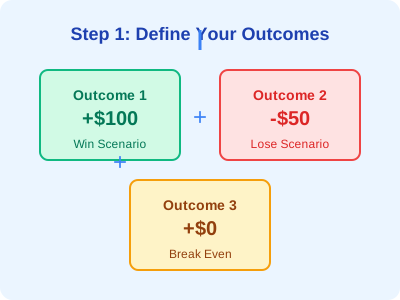
1. Define Your Outcomes
List all possible outcomes of your decision. Each outcome has a value (can be positive or negative) and a probability of occurring.
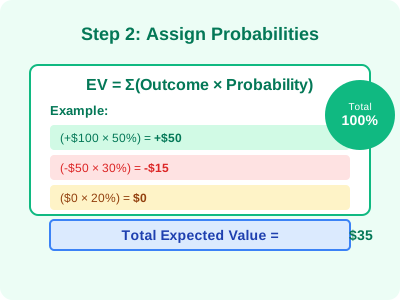
2. Assign Probabilities
For each outcome, assign the probability it will occur. Make sure all probabilities add up to 100% for accurate results.
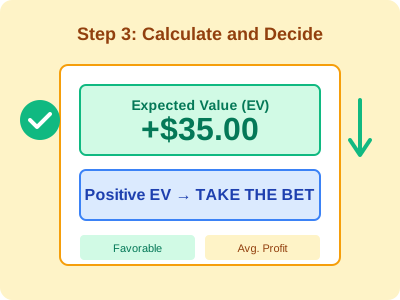
3. Calculate and Decide
The calculator shows you the expected value. Positive EV means the decision is favorable over time. Negative EV means avoid it.
Why Expected Value Matters
Expected value (EV) is one of the most powerful concepts in decision-making. It transforms uncertainty into a single number you can use to make rational choices. I use it constantly in investing, business decisions, and even everyday life.
Here's why EV matters: it tells you what happens on average if you repeat a decision many times. A single bet might go either way, but over 100 or 1,000 trials, your actual results will converge to the expected value.
This is professional gamblers, successful investors, and smart business leaders all think in terms of expected value. They don't focus on whether they won or lost the last hand—they focus on whether they made positive EV decisions.
I use expected value to:
- Evaluate investment opportunities: "This startup has a 10% chance of 100x return, 40% chance of 5x, and 50% chance of total loss. What's the EV?"
- Make business decisions: "Launching this product costs $50K. There's a 30% chance it generates $200K, 70% chance it flops. Is it worth it?"
- Analyze gambling scenarios: "This casino game has a 48.6% chance to win $100, 51.4% chance to lose $100. What's my expected loss per bet?"
- Decide whether to take risks: "Should I quit my job to start a business? What are the outcomes and probabilities?"
How to Calculate Expected Value: The Complete Formula
The math behind expected value is straightforward. You multiply each possible outcome by its probability, then sum all the results.
EV = Σ(Outcome × Probability)
Where Σ means "sum of all"
Here's a real example: You're considering a bet where you win $100 with 50% probability, or lose $50 with 50% probability.
- Outcome 1: Win $100 × 50% = +$50
- Outcome 2: Lose $50 × 50% = -$25
- Expected Value: $50 + (-$25) = +$25
The EV is +$25, which means on average, you'll profit $25 every time you take this bet. Over 100 bets, you'd expect to make $2,500. This is a positive EV scenario you should take.
My calculator handles all of this automatically. Just enter your outcomes and probabilities, and it calculates the EV instantly.
Expected Value in Real Life: Examples
Expected value isn't just for gamblers and mathematicians. It applies to countless real-world situations. Let me walk you through some examples.
Example 1: Job Offer Decision
You have two job offers. Job A pays $100K guaranteed. Job B has a commission structure where there's a 50% chance you earn $150K, 50% chance you earn $80K.
- Job A EV: $100K × 100% = $100,000
- Job B EV: ($150K × 50%) + ($80K × 50%) = $75K + $40K = $115,000
Job B has a higher expected value ($115K vs $100K), but it's riskier. The EV tells you that over many years, Job B would pay more on average. Whether that's worth the risk depends on your risk tolerance and financial situation.
Example 2: Launching a Product
You're a business owner considering launching a new product. It costs $50,000 to develop. Market research suggests:
- 30% chance of high demand: $200,000 profit
- 40% chance of moderate demand: $50,000 profit
- 30% chance of failure: $0 profit (lose the $50K investment)
EV = $60K + $20K - $15K = $65,000
The expected value is $65,000, which is positive. On average, this product launch would generate $65K profit. The fact that you might lose $50K 30% of the time is scary, but the EV says go for it.
Example 3: Insurance Decision
Should you buy insurance? Let's say your $10,000 car has a 5% chance of being totaled in an accident this year. Insurance costs $600.
- No insurance EV: (95% × $10K) + (5% × $0) - $600 = $9,500 - $600 = $8,900 (expected value of car after paying insurance)
- With insurance EV: $10K - $600 = $9,400 (guaranteed car value minus premium)
Wait, this shows insurance has negative EV ($9,400 vs $8,900 expected value without it). That's how insurance companies make profit. But most people still buy it because they can't afford the 5% worst-case scenario of losing $10K. This is where risk tolerance matters more than pure EV.
Expected Value in Gambling and Games
Casinos are built on expected value. Every game they offer has negative EV for players—that's how they stay in business. Understanding this changed how I think about gambling.
Let's look at a simple coin toss game. You bet $100 on heads. If you win, you get $200 back (your $100 plus $100 profit). If you lose, you get nothing.
This is a fair game with EV of $0. Over time, you'd break even. But casinos don't offer fair games. They take a cut called the "house edge."
In American roulette, betting on red (18 winning numbers, 20 losing numbers including 0 and 00):
For every $100 bet on red, you expect to lose $5.26. That's the house edge. You might get lucky and win a few times, but over thousands of spins, you'll lose exactly 5.26% of everything you bet.
Professional poker players succeed because they can make positive EV decisions by reading opponents and understanding pot odds. Amateurs play by "feel." Pros play by EV.
My calculator helps you analyze any gambling scenario. Just enter the possible outcomes and their probabilities to see if a bet is worth taking.
Expected Value in Investing
Smart investors think in expected value. Every stock purchase, every real estate deal, every angel investment has multiple possible outcomes. EV helps you make rational decisions.
When I evaluate a stock, I consider scenarios:
- Bull case (30%): Company crushes earnings, stock doubles (+$100)
- Base case (50%): Steady growth, stock up 20% (+$20)
- Bear case (20%): Economy crashes, stock down 40% (-$40)
The expected value is +$32 per share. This tells me the stock is undervalued if the current price is less than $32 below my fair value estimate.
Venture capitalists use EV constantly. They might invest in 10 startups knowing 8 will fail, 1 will return 5x, and 1 might return 100x. The portfolio has positive EV even though most individual investments fail.
The key insight: You don't need to win every time. You just need positive EV. A single investment with negative expected value is a mistake. A portfolio of 100 negative EV investments is a disaster. But a portfolio of 100 positive EV investments is likely to succeed—because the law of large numbers makes expected value become actual value.
When Expected Value Misleads: The Limits
Expected value is powerful, but it's not perfect. There are situations where EV alone doesn't tell the whole story.
1. One-Time Decisions
EV assumes you can repeat a decision many times. But you only get married once. You can't "average out" a marriage over 1,000 trials. For one-time decisions, consider other factors beyond EV.
2. Ruin Risk
A bet might have positive EV but a tiny chance of bankrupting you. If you can't survive the worst case, don't take the bet—no matter how good the EV looks. This is why professional traders limit position sizing.
3. Probability Uncertainty
EV is only as good as your probability estimates. If you think there's a 90% chance of success when it's really 10%, your EV calculation will be completely wrong. Be conservative with probabilities you're uncertain about.
4. Non-Monetary Outcomes
Some outcomes can't be easily quantified in dollars. Happiness, reputation, time, relationships—these matter too. A job with higher salary EV might make you miserable. Consider the whole picture.
5. Black Swan Events
EV calculations often miss rare, extreme events. The 2008 financial crisis was a "black swan"—something models said was virtually impossible but happened anyway. Always ask: "What am I missing?" and "What if the worst case is worse than I imagined?"
Expected Value vs. Most Likely Outcome
This is a crucial distinction that trips people up constantly. Expected value is NOT the same as the most likely outcome.
Let me give you an example. You're offered this bet:
- 99% chance: Win $1
- 1% chance: Lose $1,000
The most likely outcome is winning $1 (99% chance). But the expected value is -$9.01, which is terrible! Even though you'll probably win this single bet, the 1% chance of losing $1,000 makes the overall EV deeply negative.
This is why lottery tickets have negative EV. You'll probably win nothing (most likely outcome), but even if you occasionally win small amounts, the tiny probability of hitting the jackpot doesn't compensate for all the losing tickets. The EV of a lottery ticket is always negative.
When making decisions, ask yourself two questions:
- What's the most likely outcome? (What will probably happen?)
- What's the expected value? (What happens on average over many trials?)
Sometimes they align. Sometimes they don't. Smart decision-makers consider both.
My Rules for Using Expected Value
After years of using EV for investing, business, and life decisions, I've developed some rules:
- Always calculate EV before risky decisions: Don't rely on gut feelings. Do the math. Positive EV doesn't guarantee success, but negative EV guarantees long-term failure.
- Be conservative with probabilities: If you're unsure about probabilities, assume the worst. Better to be pleasantly surprised than disappointed.
- Consider ruin risk separately: No matter how good the EV looks, don't risk more than you can afford to lose. A positive EV bet that bankrupts you is a mistake.
- Think long-term, not short-term: EV shows what happens over many trials. A single positive EV bet might lose. But over 100 bets, you'll likely come out ahead.
- Combine EV with other factors: Money isn't everything. Consider time, happiness, relationships, and personal values. EV is one tool, not the whole toolkit.
- Update probabilities with new information: As you learn more, recalculate. Don't be married to outdated assumptions.
- Distinguish between EV and most likely outcome: Just because something is likely doesn't mean it has good EV. Just because EV is good doesn't mean success is likely.
- Use EV for investing, not gambling: Casinos always have the edge. Unless you're a professional advantage player, gambling has negative EV by design. Focus on positive EV activities like education, career growth, and smart investing.
More Popular Calculators
Check out these other powerful tools to help you optimize your decision-making.

Frequently Asked Questions
What is expected value?
Expected value (EV) is the average outcome you'd expect if you repeated a decision many times. It's calculated by multiplying each possible outcome by its probability, then summing all the results. EV transforms uncertainty into a single number you can use to make rational decisions. For example, if a bet has a 50% chance to win $100 and 50% chance to lose $50, the EV is ($100 × 0.5) + (-$50 × 0.5) = $25. Positive EV means the decision is favorable over time; negative EV means it's unfavorable.
How do I calculate expected value?
To calculate expected value: (1) List all possible outcomes, (2) Assign a probability to each outcome (probabilities must sum to 100%), (3) Multiply each outcome value by its probability, (4) Sum all the results. The formula is: EV = Σ(Outcome × Probability). My calculator automates this for you—just enter your outcomes and probabilities, and it calculates the EV instantly along with a breakdown of each outcome's contribution.
What does a negative expected value mean?
Negative expected value means that, on average, you'll lose money or value if you repeat the decision many times. It doesn't mean you'll definitely lose on any single trial—you might get lucky. But over the long run, negative EV guarantees losses. This is why casino games have negative EV for players—the house always wins in the long run. If a decision has negative EV, you should avoid it unless you have non-monetary reasons for taking it (entertainment, learning experience, etc.).
Can expected value be negative?
Yes, expected value can be negative. This happens when the potential losses outweigh the potential gains when weighted by probability. For example, a lottery ticket might cost $2 with a 1 in 10,000,000 chance to win $5,000,000. The EV is (1/10,000,000 × $5,000,000) - $2 = $0.50 - $2 = -$1.50. Negative EV tells you the bet is unfavorable over time, even though you might occasionally win. Most gambling and insurance premiums have negative EV for the buyer—that's how casinos and insurance companies profit.
How is expected value used in gambling?
Professional gamblers use expected value to determine which bets are profitable. Every casino game has a built-in 'house edge' that gives players negative EV. For example, American roulette has a 5.26% house edge—every $100 bet has an expected loss of $5.26. Professional poker players succeed by making positive EV decisions based on pot odds and opponent tendencies. Sports bettors look for 'value bets' where the odds offered imply a lower probability of winning than the bettor's actual estimate. If you think a team has a 60% chance to win but the odds only pay as if it's 50%, that's positive EV.
What's the difference between expected value and average?
Expected value and average are closely related but conceptually different. Average (or mean) is calculated from actual data that already happened—like the average height of people in a room. Expected value is calculated from probabilities—like what you'd expect the average height to be before you measure anyone. Expected value predicts what the average will be if you repeat an experiment many times. In fact, the Law of Large Numbers says that as you collect more data, the actual average converges to the expected value.
How do I use expected value for decision making?
Use expected value to compare different options: (1) Identify all possible outcomes for each decision, (2) Estimate probabilities for each outcome, (3) Calculate the EV of each option, (4) Choose the option with the highest EV—while also considering risk tolerance and non-monetary factors. For example, when choosing between jobs, calculate the EV of different compensation structures. When deciding whether to launch a product, calculate the EV of different market scenarios. Just remember: EV is a tool, not a rule. Consider your specific situation, risk tolerance, and values alongside the numbers.
What if probabilities are uncertain?
When probabilities are uncertain, use conservative estimates. If you think an outcome has somewhere between 30-70% probability, use 30% for negative outcomes and 70% for positive outcomes when calculating EV. This 'margin of safety' approach protects you from overconfidence. Also, consider doing a sensitivity analysis: calculate EV under different probability assumptions to see how robust your decision is. If a decision has positive EV under reasonable probability assumptions, it's likely a good choice. If it only has positive EV under optimistic assumptions, be cautious.
Does expected value guarantee results?
No, expected value does not guarantee any specific result on a single trial. It only tells you what happens on average over many repetitions. You can make a positive EV bet and lose. You can make a negative EV bet and win. But over many trials, your actual results will converge to the expected value. This is why professional traders and gamblers focus on making good decisions (positive EV) rather than short-term outcomes. A single loss doesn't mean they made a bad decision if the EV was positive. The key is having enough trials for the law of large numbers to work in your favor.
When should I ignore expected value?
Ignore expected value in one-time decisions where the outcome can't be repeated (like who to marry), when the worst-case outcome is catastrophic even if EV is positive (don't risk your life savings for a positive EV gamble), when probabilities are completely unknown (EV calculations with garbage inputs give garbage outputs), and when non-monetary factors dominate (happiness, ethics, relationships). Also, ignore EV for purely recreational activities where you're paying for entertainment, not profit—like buying a lottery ticket for fun knowing it has negative EV. EV is a powerful tool, but it's not the only consideration in decision-making.
Make Smarter Decisions with Expected Value
Stop guessing. Use the calculator above to calculate the expected value of any decision involving uncertainty.
Calculate Expected Value Now