EBITDA Calculator
I've built this comprehensive EBITDA calculator after valuing hundreds of businesses over my career. Whether you're preparing to sell your company, seeking investment, or just want to understand your business's true operating performance, I'll help you calculate EBITDA correctly and use it to determine your business value.
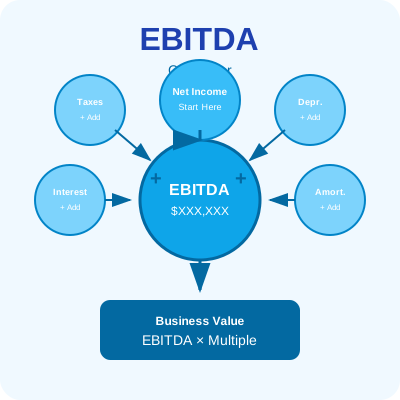
EBITDA Calculator
Calculate EBITDA, Margin & Business Value Instantly
Start from your bottom line (net profit) and add back interest, taxes, depreciation & amortization. Best when working from tax returns or financial statements.
Formula:
EBITDA = Net Income + Interest + Taxes + Depreciation + Amortization
EBITDA = $500,000 + $80,000 + $100,000 + $150,000 + $50,000 = $0
Industry multiples: SaaS (8-15x), Manufacturing (4-7x), Services (4-8x), Restaurants (2-5x)
EBITDA Calculation
💡 What This Means
Your EBITDA of $0 means:
Your business generates $0 in operating profit before interest, taxes, depreciation, and amortization. This is the cash flow available to service debt, pay taxes, and reinvest in the business.
At a 5x multiple, your business is worth ~$0:
Buyers would pay approximately $0 for your business based on its EBITDA and industry multiple. This is the enterprise value—the value of operations, not including excess cash or debt adjustments.
⚠️ Remember:
EBITDA multiples vary widely by industry, size, growth, and quality. Use this as a starting point. For an accurate valuation, consider working with a professional business valuator or broker who understands your specific market.
📊 Calculation Breakdown
Note: This is enterprise value. To get equity value, subtract debt and add cash. Also consider adjusting for working capital and non-operating assets. For a complete valuation, also calculate goodwill: Goodwill = Business Value - Net Tangible Assets.
Why I Built This EBITDA Calculator
Early in my career, I made a costly mistake: I tried to value a business using only net income and completely misunderstood EBITDA. The seller was asking $2M based on their "adjusted EBITDA," but when I dug into the numbers, half of their adjustments didn't hold up. The real EBITDA was 40% lower. I walked from the deal, but I learned a crucial lesson: EBITDA is powerful, but only if calculated correctly.
Since then, I've valued businesses across manufacturing, tech, retail, services, and restaurants. I've seen EBITDA misused, misunderstood, and manipulated. I've also seen it unlock tremendous value when used properly. This calculator captures everything I've learned about calculating EBITDA the right way and using it to determine realistic business value.
What makes this different? It doesn't just calculate EBITDA—it teaches you why EBITDA matters, how to calculate it correctly from different starting points, how to adjust it properly, and most importantly, how to translate EBITDA into a business valuation using real industry multiples.
⚠️ The $500K EBITDA Mistake
Most business owners miscalculate EBITDA by 20-40% because they: (1) start from the wrong number (net income vs. operating income), (2) miss add-backs or add back items that shouldn't be added, (3) don't understand adjusted EBITDA vs. reported EBITDA, (4) use wrong multiples for their industry. A business with $1M true EBITDA valued incorrectly can leave $500K-$1M on the table. Don't make that mistake.
Understanding EBITDA: The Complete Guide
EBITDA stands for Earnings Before Interest, Taxes, Depreciation, and Amortization. It measures your company's operating performance by stripping out financing decisions (interest), tax situations, and non-cash accounting items (depreciation & amortization). This makes it easier to compare businesses with different capital structures and tax strategies.
Method 1: From Net Income
Start from the bottom line of your income statement and add back the non-operating and non-cash items.
Formula:
Net Income + Interest + Taxes + Depreciation + Amortization
Best when starting from tax returns or financial statements
Method 2: From Operating Income
Start from operating profit (EBIT) and simply add back depreciation and amortization.
Formula:
Operating Income + Depreciation + Amortization
Simplest method when you have EBIT already calculated
Method 3: From Revenue
Start from the top line and subtract operating expenses excluding D&A.
Formula:
Revenue - Operating Expenses (excl. D&A)
Best for building from scratch or analyzing margins
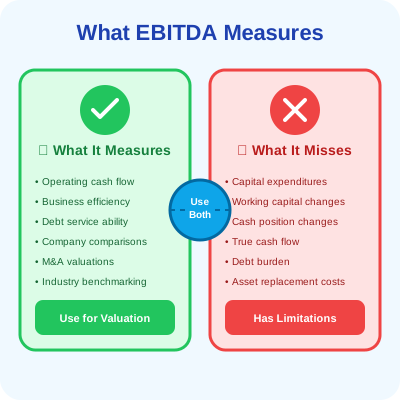
What EBITDA Actually Tells You (And What It Doesn't)
✅ What EBITDA Measures Well
Operating cash flow generation, business operational efficiency, ability to service debt, comparison of similar companies regardless of capital structure or tax strategy. It's the standard metric for business valuation in most industries.
❌ What EBITDA Misses
Capital expenditures needed to maintain assets, working capital requirements, changes in cash position, true cash flow (since D&A are added back but capex isn't subtracted). Warren Buffett famously criticized EBITDA for ignoring these real costs.
💡 When to Use EBITDA
Business valuation, comparing companies in the same industry, analyzing operating performance trends, calculating debt service coverage, M&A transactions, and communicating with investors and lenders.
🎯 Best Practices
Always use EBITDA alongside other metrics (free cash flow, net income), understand industry norms, consider capex requirements, and verify adjustments are legitimate. Never rely on EBITDA alone for investment decisions.
📈 EBITDA Margin
Calculate EBITDA Margin = (EBITDA ÷ Revenue) × 100%. This shows what percentage of revenue converts to operating profit. Healthy margins vary by industry: SaaS (40-60%), manufacturing (15-25%), retail (5-15%).
⚖️ Adjusted EBITDA
"Adjusted" EBITDA adds back one-time, non-recurring expenses to show normalized earnings. Common adjustments: one-time legal fees, restructuring costs, excess owner compensation (if unreasonable), non-operating income/expense. Be conservative—buyers will scrutinize aggressive adjustments.
Goodwill Calculator in 3 Simple Steps
When you value a business using EBITDA, you'll quickly discover that the sale price is much higher than the tangible assets. That difference is goodwill—the intangible value you're building every day. Let me show you how to calculate it.
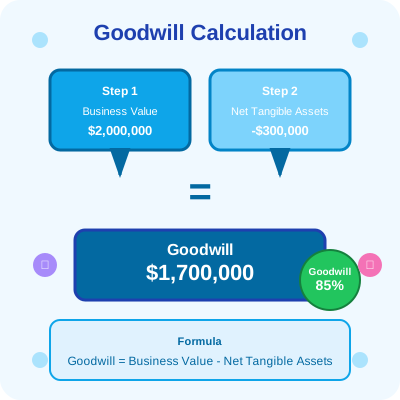
Step 1: Calculate Goodwill
Goodwill = Business Value (from EBITDA multiple) - Fair Market Value of Net Tangible Assets
Example Calculation:
• Business EBITDA: $500,000
• Industry multiple: 4x
• Business Value: $500K × 4 = $2,000,000
Tangible Assets:
• Equipment & FF&E: $300,000
• Inventory: $150,000
• Cash: $50,000
• Liabilities: ($200,000)
Net Tangible Assets: $300K + $150K + $50K - $200K = $300,000
Goodwill = $2,000,000 - $300,000 = $1,700,000
Goodwill represents 85% of the total business value
Step 2: Identify What Creates Goodwill
Goodwill represents the intangible value that makes your business worth more than its physical assets. Here's what buyers are actually paying for:
🏆 Brand & Reputation
Customer loyalty, reviews, brand recognition, market position
👥 Customer Relationships
Recurring revenue, long-term contracts, low churn rate
👨💼 Trained Team
Key employees, management depth, low turnover
📖 Systems & Processes
IP, proprietary tech, documented procedures, efficiency
📍 Market Position
Competitive advantages, barriers to entry, market share
🔮 Growth Potential
Expansion opportunities, new markets, product pipeline
Step 3: Analyze Goodwill Impact
For most businesses, goodwill represents 50-80% of the total sale price. Here's what's typical by business type:
Significant equipment and facilities reduce goodwill percentage
Value is in people, relationships, and systems
Almost all value is intangible—code, subscribers, data
Brand, customer base, systems drive value
💡 Use our free Goodwill Calculator for detailed analysis and purchase price allocation
EBITDA vs. Net Income: Why the Gap Matters
One of the most common questions I get: "Why is my EBITDA so much higher than my net income? Which one should I use for valuation?" Let me explain the critical difference.
EBITDA
What It Is:
Operating profit before interest, taxes, depreciation & amortization. Shows cash-generating ability from core operations.
Used For:
- • Business valuation (most common)
- • Comparing companies
- • M&A transactions
- • Debt capacity analysis
- • Industry benchmarking
Why It's Higher:
Adds back interest expense, tax expense, depreciation, and amortization—all legitimate expenses, but non-operating or non-cash.
Typical ratio to revenue: 10-30% (varies by industry)
Net Income
What It Is:
The bottom line after ALL expenses, including interest, taxes, depreciation, amortization. What's actually available to shareholders.
Used For:
- • GAAP financial reporting
- • Tax calculations
- • EPS for public companies
- • Profitability analysis
- • Dividend decisions
Why It's Lower:
Includes all expenses, even non-cash D&A and financing costs. More conservative but includes items that don't affect day-to-day operations.
Typical ratio to revenue: 5-15% (varies by industry)
💡 The Valuation Reality
Most businesses are valued using EBITDA multiples, not net income. Why? Because net income is distorted by capital structure (how much debt you have), tax strategy, and depreciation policy (which is accounting, not cash). EBITDA strips away these distortions to show operating performance. Example: A business with $1M EBITDA might only show $400K net income due to $300K interest, $200K depreciation, and $100K taxes. At a 5x multiple, it's worth $5M (based on EBITDA), not $2M (based on net income). That's why EBITDA matters.
Industry EBITDA Multiples (2026)
Not all industries are valued the same. After analyzing hundreds of business transactions in 2026, here are the typical EBITDA multiples I'm seeing across different sectors.
SaaS / Software
Cloud software, subscription platforms
8-15x
EBITDA Multiple
High growth, recurring revenue, strong margins. Top performers can reach 20x+. Lower end for traditional software with slower growth.
Professional Services
Consulting, agencies, legal, accounting
4-8x
EBITDA Multiple
People-dependent businesses with recurring client relationships. Higher multiples for specialized expertise and strong client retention.
E-commerce & DTC
Online retail, direct-to-consumer brands
3-7x
EBITDA Multiple
Brand strength, customer LTV, and retention drive multiples. Higher for owned brands vs. resellers. Strong growth commands premium.
Manufacturing
Industrial, B2B, consumer products
4-7x
EBITDA Multiple
Asset-heavy with steady cash flows. Higher for proprietary products, intellectual property, and strong customer contracts.
Restaurants & Hospitality
Restaurants, hotels, food service
2-5x
EBITDA Multiple
Lower multiples due to high failure rates and operational complexity. Franchises and established brands at higher end.
Distribution & Wholesale
B2B distribution, wholesalers
4-6x
EBITDA Multiple
Volume-driven with thin margins. Higher for exclusive territories, strong supplier relationships, and value-added services.
Healthcare & Medical
Clinics, practices, healthcare services
5-10x
EBITDA Multiple
Recession-resistant with predictable revenue. Higher for specialized practices, strong referral networks, and growth markets.
Construction & Trades
Contractors, trades, home services
2-4x
EBITDA Multiple
Project-based with cyclicality. Higher for established businesses with strong reputations, recurring contracts, and diversified services.
Note: These are typical ranges for healthy, profitable businesses. Top performers (strong brands, high growth, recurring revenue, defensible moats) can sell at 50-100% above these ranges. Struggling businesses, declining sales, or poor management sell below these ranges. Size matters too—businesses with $5M+ EBITDA command premium multiples vs. sub-$1M businesses. Location, customer concentration, and market conditions significantly impact multiples.
Adjusted EBITDA: When and How to Adjust
"Adjusted EBITDA" gets a bad reputation because some sellers abuse it. But legitimate adjustments are essential for showing the true earning power of your business. Let me show you what's legitimate and what's not.
✅ Legitimate Adjustments Buyers Accept
One-Time Legal Fees
Litigation, one-time contracts, IP filings. If it won't recur, add it back.
Restructuring Costs
Severance, lease terminations, consolidations. Non-operational and one-time.
Excess Owner Compensation
Only if above market rate for the role. Need to prove market rate.
Non-Operating Income/Expense
Investment gains/losses, non-business assets. Not part of core operations.
Bad Debt Write-Offs
One-time customer defaults that won't recur. Need documentation.
Disaster/Insurance Events
Fire, flood, theft losses (net of insurance). Truly exceptional events.
❌ Adjustments Buyers Reject
Normal Owner Salary
Owner compensation at market rate is a real expense. Don't add it back.
Personal Expenses Run Through Business
These aren't legitimate business expenses in the first place. Clean up your books instead.
Regular Maintenance & Repairs
Normal business upkeep. Not one-time if it happens every year.
Marketing & Customer Acquisition
Required to maintain the business. Not a one-time expense.
Standard Depreciation & Amortization
EBITDA definition adds these back. Don't double-count by adjusting again.
Bonuses to Key Employees
Regular compensation. Unless truly one-time retention bonus.
💡 How to Present Adjusted EBITDA
Example Bridge Table:
Pro tip: Document every adjustment. Have invoices, contracts, or explanations ready. Buyers will scrutinize adjustments—be conservative and transparent. If you can't defend it, don't include it.
When EBITDA Misleads: Understanding the Limitations
I've seen too many buyers overpay because they relied solely on EBITDA. And too many sellers overvalue their businesses for the same reason. EBITDA is a powerful tool, but it has real limitations you need to understand.
1. EBITDA Ignores Capital Expenditures
EBITDA adds back depreciation, but it doesn't subtract the capital expenditures (capex) needed to replace assets. A manufacturing business might show $2M EBITDA, but if it needs to spend $1M/year on equipment replacement, the true economic earnings are only $1M.
Example: Business A has $2M EBITDA, $0 capex. Business B has $2M EBITDA, $1M capex. Both look equal on EBITDA, but Business A is worth $6-10M (3-5x) while Business B is worth $3-5M (same multiple on true earnings of $1M). Always ask: "What's the maintenance capex?"
2. EBITDA Ignores Working Capital Changes
Growing businesses consume working capital (inventory, accounts receivable). EBITDA doesn't reflect this cash drain. A business growing 50%/year might show rising EBITDA while burning cash due to working capital needs.
Example: Revenue grows from $10M to $15M (+50%). EBITDA grows from $1M to $1.5M (+50%). But if accounts receivable increases by $500K and inventory by $300K, the business consumes $800K in cash despite higher EBITDA. Fast-growing businesses often need external capital for this reason.
3. EBITDA Masks Debt Burden
EBITDA adds back interest expense, making it easy to compare businesses. But this also masks whether a business can service its debt. Two businesses with identical EBITDA are not equal if one has $500K annual interest payments and the other has none.
Degrees of Leverage: Look at Debt/EBITDA ratio. Under 2x = healthy. 2-4x = moderate. Over 4x = risky. A business with $1M EBITDA and $4M debt (4x) is far riskier than the same business with $1M debt (1x). Both have the same EBITDA, but very different risk profiles and values.
4. EBITDA Can Be Manipulated
"Adjusted EBITDA" is often abused. I've seen sellers add back normal business expenses (marketing, owner's market-rate salary, regular maintenance) to inflate EBITDA by 30-50%. Be skeptical of aggressive adjustments—demand documentation and justification for every add-back.
Red Flags: Adjustments exceeding 20% of reported EBITDA, lack of documentation, adjustments that recur annually, personal expenses added back (these should be cleaned up, not adjusted), adjustments that make the business look too good to be true. If it walks like a duck...
💡 The Bottom Line: Use Multiple Metrics
Don't rely on EBITDA alone. Use EBITDA for valuation and comparisons, but also analyze: Free Cash Flow (EBITDA - capex - working capital changes - taxes), Return on Capital, Debt/EBITDA ratio, EBITDA margins trend, and organic growth rate. Smart buyers look at the complete picture, not just one metric. EBITDA is a tool, not the whole toolkit.
Frequently Asked Questions
How do I calculate EBITDA from my financial statements?
You can calculate EBITDA three ways: (1) From Net Income: Start with net profit, add back interest expense, tax expense, depreciation expense, and amortization expense. (2) From Operating Income (EBIT): Simply add depreciation and amortization to your operating profit. (3) From Revenue: Subtract all operating expenses except depreciation and amortization from revenue. Use our calculator above to automatically calculate EBITDA from any starting point.
What is a good EBITDA margin?
EBITDA margin = (EBITDA ÷ Revenue) × 100%. 'Good' varies widely by industry: SaaS/Software (40-60%+), Professional Services (20-35%), Manufacturing (15-25%), Retail (5-15%), Restaurants (10-20%). Compare your margin to industry benchmarks and historical trends. A rising margin indicates improving efficiency; a declining margin signals problems. For valuation, higher margins generally command higher multiples.
What's the difference between EBITDA and adjusted EBITDA?
Reported EBITDA is calculated directly from financial statements using standard accounting. Adjusted EBITDA adds back one-time, non-recurring, or non-operating expenses to show normalized earnings. Common adjustments: one-time legal fees, restructuring costs, excess owner compensation (if above market), non-operating income/expense, bad debt write-offs. Adjusted EBITDA provides a clearer picture of ongoing earning power but must be documented carefully—buyers will scrutinize aggressive adjustments. Typically, adjustments should not exceed 15-25% of reported EBITDA.
How is EBITDA used to value a business?
Business Value = Adjusted EBITDA × Industry Multiple. For example, a manufacturing business with $1M adjusted EBITDA, using a 5x multiple: $1M × 5 = $5M enterprise value. The multiple depends on industry (SaaS trades at 8-15x, restaurants at 2-5x), size ($5M+ EBITDA commands premium multiples), growth rate (high growth = premium), margins (better margins = better multiple), and risk factors. Then add/subtract net assets and adjust for working capital to get equity value. Use our calculator to see your estimated value.
Why is EBITDA higher than net income?
EBITDA adds back four major expenses that net income includes: Interest expense (debt payments), Tax expense (income taxes), Depreciation (spread of asset cost over time), and Amortization (spread of intangible asset cost). These are real expenses, but EBITDA removes them to show operating cash flow before financing decisions, tax strategy, and accounting methods. Example: Business has $500K net income, $200K interest, $150K taxes, $100K depreciation, $50K amortization. EBITDA = $500K + $200K + $150K + $100K + $50K = $1M. EBITDA is 2x higher than net income in this example.
What EBITDA multiple should I use for my business?
Multiples vary by industry, size, growth, and quality. For 2026, typical ranges: SaaS/Software (8-15x), Professional Services (4-8x), Manufacturing (4-7x), E-commerce (3-7x), Restaurants/Hospitality (2-5x), Distribution (4-6x), Healthcare (5-10x), Construction (2-4x). Adjust up for: strong growth, recurring revenue, defensible market position, excellent management, large scale ($5M+ EBITDA). Adjust down for: declining sales, customer concentration, small scale (<$500K EBITDA), competitive threats, management dependence. Research comparable sales in your industry for the most accurate multiple.
How do I calculate EBITDA margin and why does it matter?
EBITDA Margin = (EBITDA ÷ Revenue) × 100%. It shows what percentage of each sales dollar converts to operating profit. Example: $2M revenue, $500K EBITDA = ($500K ÷ $2M) × 100% = 25% EBITDA margin. It matters because: (1) Higher margins generally mean higher valuation multiples, (2) It measures operational efficiency, (3) Allows comparison across different-sized companies, (4) Investors use it to assess profitability and scalability. Track your margin trend over time—improving margins signal health; declining margins signal problems that need fixing.
Can I use EBITDA if my business is losing money?
Yes, but with caveats. Negative EBITDA means the business's core operations are unprofitable before financing and accounting. This dramatically reduces value and often makes the business unsellable (except as asset sale). However, high-growth startups often have negative EBITDA but still raise capital at high valuations based on growth potential. For valuing a money-losing business: if EBITDA is negative but improving, value based on projected future EBITDA; if consistently negative, value based on liquidation value of assets. Negative EBITDA businesses rarely sell for multiples—buyers pay for assets, not earnings.
What expenses should I add back to calculate adjusted EBITDA?
Legitimate add-backs are one-time, non-recurring, or non-operating expenses: (1) One-time legal fees - litigation, IP filings, extraordinary contracts, (2) Restructuring costs - severance, lease terminations, consolidation expenses, (3) Excess owner compensation - only if above market rate for the role, (4) Non-operating items - investment gains/losses, non-business asset expenses, (5) Bad debt write-offs - one-time customer defaults, (6) Disaster/insurance losses - fire, flood, theft (net of insurance). Document everything. Don't add back: normal owner salary, regular marketing, routine maintenance, standard expenses.
How does depreciation affect EBITDA vs. cash flow?
Depreciation is added back to calculate EBITDA, so EBITDA is higher than net income by the amount of depreciation. However, depreciation represents the cost of assets wearing out over time. If you don't spend money to replace assets (capex), EBITDA overstates true cash flow. Example: Business has $1M EBITDA, $200K depreciation. Free Cash Flow = $1M EBITDA - $200K maintenance capex = $800K. For valuation, consider both EBITDA (for the multiple) and capex requirements. Capital-intensive businesses (manufacturing, transportation) often have high depreciation and need significant ongoing capex, reducing real economic earnings vs. reported EBITDA.
What's better for business valuation: EBITDA or SDE?
EBITDA vs. SDE depends on business type and size. EBITDA (Earnings Before Interest, Taxes, Depreciation & Amortization) - used for businesses with professional management, revenue $500K-$5M+, selling to buyers adding to portfolio or PE groups. Does NOT add back owner's compensation at market rate. SDE (Seller's Discretionary Earnings) - used for owner-operated businesses under $500K revenue, selling to individual buyers. Adds back owner's total compensation, benefits, and personal expenses. For small service businesses and restaurants, SDE is typically used. For larger, professionally-managed businesses, EBITDA is standard. Calculate both, then use the method that puts your business in the best light legitimately.
How do I value a business using EBITDA if it has a lot of debt?
Calculate Enterprise Value (EV) = Adjusted EBITDA × Multiple. This is the value of the business operations regardless of capital structure. Then calculate Equity Value = Enterprise Value - Debt + Cash. Example: Business has $1M EBITDA, 5x multiple = $5M enterprise value. Business has $2M debt and $500K cash. Equity Value = $5M - $2M + $500K = $3.5M. This is what the equity is worth. The debt stays with the business (buyer assumes or refinances). If debt/EBITDA ratio is very high (over 4-5x), the business may be distressed, reducing the multiple buyers will pay. Always consider leverage when valuing.
What is EV/EBITDA and how is it different from P/E ratio?
EV/EBITDA (Enterprise Value to EBITDA) compares business value to operating earnings. P/E (Price to Earnings) compares equity value to net income. EV/EBITDA is better for: comparing companies with different debt levels, capital-intensive industries (since it adds back D&A), M&A valuation. P/E is better for: mature, profitable companies, comparing public companies, investor-focused analysis. Example: Company A: $5M enterprise value, $1M EBITDA = 5x EV/EBITDA. Company B: $5M equity value, $500K net income = 10x P/E. Both metrics are useful—EV/EBITDA for operating performance, P/E for shareholder returns.
How often should I calculate EBITDA for my business?
Calculate EBITDA monthly or quarterly for internal management, and annually for valuation and reporting. Monthly EBITDA helps you spot trends, measure operational performance, and make adjustments quickly. Annual EBITDA is used for: business valuation, tax planning, investor reporting, benchmarking against competitors. Track EBITDA margin trend over time—is it improving or declining? Also track EBITDA vs. budget to measure performance. Most sophisticated business owners review EBITDA monthly with their management team or accountant.
Can EBITDA be negative and what does that mean?
Yes, negative EBITDA means your operating expenses (excluding D&A, interest, taxes) exceed your revenue. The core business is unprofitable before financing and accounting. This is a major red flag indicating: fundamental business model problems, pricing too low, costs too high, or market/competitive issues. Negative EBITDA businesses are difficult to sell and typically sell at asset value rather than as going concerns. Exception: High-growth startups may have negative EBITDA due to aggressive investment in growth (marketing, R&D), but investors value them on growth potential, not current EBITDA. If you have negative EBITDA, fix the core business before considering a sale.
Related Calculators
🏛️ Goodwill Calculator
Calculate goodwill in business sales using purchase price allocation. Perfect for understanding intangible value.
Calculate Goodwill →🏢 Business Valuation Calculator
Estimate business value using SDE/EBITDA multiples. Comprehensive tool for small businesses.
Calculate Business Value →📊 DCF Calculator
Discounted Cash Flow valuation based on future projections. Advanced method for detailed analysis.
Calculate DCF →💼 Business Value Guide
Complete guide to determining business value. Methods, multiples, and step-by-step instructions.
Read Guide →Ready to Calculate Your EBITDA and Business Value?
Don't guess your EBITDA or leave money on the table with incorrect calculations. Use our free EBITDA calculator based on professional valuation methods and real industry multiples.