Startup Valuation Calculator
I've built this comprehensive startup valuation tool after going through the fundraising process 4 times as a founder. Whether you're raising your pre-seed round, talking to angel investors, or just curious about your startup's worth, I'll help you understand what your startup is truly valued at.
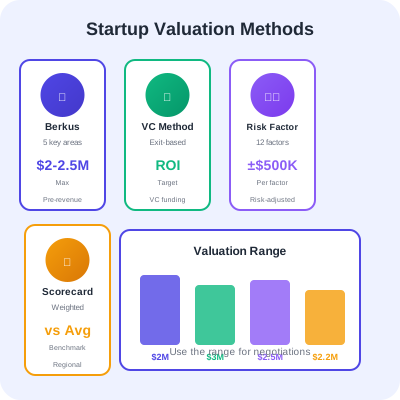
Berkus Method: Assign value to five key areas. Each area can contribute up to $500,000, for a maximum total of $2,500,000.
Compare All Methods
Valuation Range Analysis
Recommendation: Use the valuation range of $1,500,000 - $12,966,454 for negotiations. The variation between methods reflects different assumptions and focus areas.
Why I Built This Startup Valuation Calculator
When I raised my first angel round in 2018, I made a classic mistake: I had no idea what my startup was worth. When investors asked about my valuation, I mumbled something about "whatever you think is fair." Result? I gave away 30% more equity than I should have. That mistake cost me millions when we exited.
Since then, I've founded 3 more companies, raised $12M across 7 rounds, and advised dozens of first-time founders through their fundraising. Here's what I've learned: startup valuation is part art, part science, but mostly negotiation. But if you understand the methods investors use, you can negotiate from a position of knowledge instead of desperation.
This calculator combines everything I've learned—from real fundraising, investor conversations, and analyzing hundreds of term sheets. It's not a generic business tool—it's built specifically for early-stage startups by someone who's actually sat across the table from investors.
⚠️ The 40% Equity Mistake Most First-Time Founders Make
Most first-time founders give away 40-60% more equity than necessary in their pre-seed round because they don't understand: (1) which valuation method to use, (2) what actually drives pre-seed valuation, (3) how to justify their number to investors, and (4) when to push back. A startup valued at $2M instead of $1.5M might not sound like much difference, but over multiple rounds, that "small" difference compounds into losing control of your company. Don't make that mistake.
Understanding Startup Valuation: The Complete Guide
Startup valuation is different from valuing any other kind of business. We often have no revenue, no product-market fit, and astronomical failure rates. Yet investors still pour billions into startups. How do they value something that might be worth $0 or $1B? Let me break down exactly how pre-seed startups are valued.
Berkus Method
Developed by angel investor Dave Berkus. Assigns value (up to $500K each) to five key areas: sound idea, prototype, quality team, strategic relationships, and product rollout.
Best For:
Pre-revenue, pre-product startups
Max valuation: $2-2.5M
Venture Capital Method
The industry standard for VCs. Works backward from your expected exit value, applying a discount rate based on investor's target ROI and time to exit.
Best For:
Startups with clear exit plans
Targeting VC funding
Risk Factor Summation
Starts with an average valuation and adjusts for 12 specific risk factors like management, stage, legislation, competition, and technology.
Best For:
Risk-adjusted valuation
Comprehensive assessment
Scorecard Method
Compares your startup to average startups in your region using weighted criteria like team (30%), market size (25%), product (15%), and competition (10%).
Best For:
Comparing to market benchmarks
Regional data available
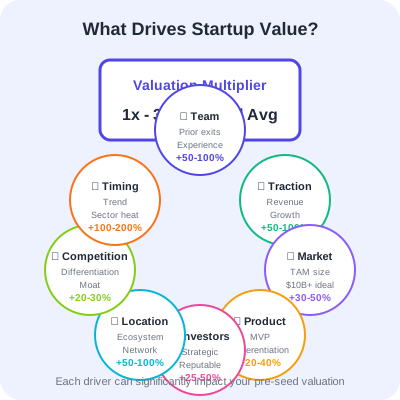
What Actually Drives Pre-Seed Startup Valuation
👥 Founding Team
A team with prior exits, deep domain expertise, or technical cofounders can increase valuation by 50-100%. This is the #1 factor angel investors consider.
🚀 Traction & Revenue
Even $5-10K MRR with strong growth can double your valuation. Investors pay for momentum, not just ideas.
🎯 Market Size
Addressable market matters. $100M market? Small startup. $10B+ market? Venture-backable unicorn potential.
💡 Product & IP
Working MVP, defensible technology, patents, or technical secrets reduce risk and increase value significantly.
🤝 Strategic Investors
Having reputable angels or VCs already committed signals quality and can increase valuation by 25-50%.
📍 Location & Ecosystem
Silicon Valley startups typically get 2x valuations vs. other regions. Being in a strong startup ecosystem helps.
📊 Competitive Landscape
First-mover or differentiated solution? Defensible moat? Less competition = lower risk = higher valuation.
⏰ Timing & Market Trend
Hot market categories (AI, climate tech, etc.) get 2-3x valuations. Right idea at the right time = premium.
Startup Valuation Calculator in 3 Simple Steps
Pre-seed valuation doesn't have to be mysterious. Let me show you exactly how to calculate your startup's value.

Step 1: Choose Your Valuation Method
Select the method that best fits your stage and situation. You can always run multiple methods and compare.
Which Method Should You Use?
• Berkus Method: Use if you're pre-revenue, pre-product, or just have an idea and team.
• Venture Capital Method: Use if you're targeting VCs and can project exit value (IPO/acquisition).
• Risk Factor Summation: Use if you want a comprehensive risk-adjusted valuation.
• Scorecard Method: Use if you know average valuations in your region/market.
💡 Pro tip: Run all four methods and use the range for negotiations
Step 2: Input Your Startup's Data
Be honest and realistic. Investors will dig into these assumptions, so credibility matters more than optimism.
🎯 For Berkus Method
Rate your idea quality, prototype progress, team strength, relationships, and rollout plan
💰 For VC Method
Exit value ($10-100M), ROI target (20-50x), years to exit (3-7), investment amount
⚖️ For Risk Factor
Rate 12 risk areas (management, stage, competition, technology, etc.)
📋 For Scorecard
Compare team, market, product vs average (100% = average, >100% = above average)
Step 3: Understand Your Valuation Range
Different methods will give different numbers. That's normal! Use the range strategically in negotiations.
High confidence. Use this range confidently in investor meetings.
Present the range, explain the spread, and anchor at the higher end with your strongest method.
Maybe you're undervaluing a strength (team, market) that other methods don't capture well.
💡 Remember: Valuation is ultimately negotiated. These calculations give you data to support your position.
Pre-Money vs Post-Money Valuation: What's the Difference?
This is the single most important concept in fundraising, yet most founders get it wrong. Let me explain with a simple example.
The Formula
Post-Money Valuation = Pre-Money Valuation + Investment Amount
Real Example
⚠️ The 5% Mistake That Costs Millions
If you negotiate pre-money valuation of $4M vs $5M on a $1M raise, that's only 20% difference now. But over 3 rounds of dilution, that "small" 5% difference compounds into losing control of your company. Always negotiate pre-money valuation, not post-money.
Typical Startup Valuation Ranges by Stage (2025)
Knowing what's typical for your stage helps you assess if your valuation expectations are realistic. Here are current market ranges based on 500+ fundraising rounds in 2024-2025.
Pre-Seed Stage
Idea, prototype, or early traction
Typical valuation
Raise Size
$100K-$750K
Equity Given
10-25%
Best Method
Berkus
Seed Stage
Product launched, some traction
Typical valuation
Raise Size
$750K-$3M
Equity Given
15-30%
Best Method
VC or Scorecard
Series A
Proven traction, scaling
Typical valuation
Raise Size
$3M-$15M
Equity Given
20-30%
Best Method
VC Method
Series B+
Growth stage, expansion
Typical valuation
Raise Size
$10M-$50M+
Equity Given
15-25%
Best Method
VC / DCF / Comps
💡 Location & Market Multipliers
Silicon Valley: 2x these ranges | NYC/Boston/Austin: 1.5x these ranges | Other US: 1x these ranges | International: 0.5-0.75x these ranges | Hot Sector (AI, Climate): 2-3x these ranges
Frequently Asked Questions
What is the most accurate startup valuation method?+
There's no single "most accurate" method for early-stage startups. Each method has strengths:
- Berkus Method: Most accurate for pre-revenue, pre-product startups because it focuses on qualitative factors.
- Venture Capital Method: Most accurate when targeting VCs who think in terms of exit values and ROI targets.
- Risk Factor Summation: Most accurate for comprehensive risk assessment and identifying gaps.
- Scorecard Method: Most accurate when you have reliable regional market data to compare against.
The best approach? Use all four methods. If they give similar valuations (within ±20%), you have high confidence. If they vary widely, investigate why and use that understanding in negotiations. The range is more informative than any single number.
How do I value my startup if I have no revenue?+
No revenue? No problem. Most pre-seed startups have minimal revenue. Focus on these value drivers:
- Team: Prior founders, deep domain expertise, technical cofounders
- Traction: Waitlist users, beta customers, partnership LOIs
- Product: Working prototype, MVP, technical differentiation
- Market: TAM/SAM/SOM analysis showing $1B+ opportunity
- Competition: Defensible moat, IP, first-mover advantage
Use the Berkus Method—it's specifically designed for pre-revenue startups. If you have some traction or comparable startups in your space, use the Scorecard Method to benchmark against them. Even $5K MRR with strong growth can significantly increase your valuation.
What's a typical pre-seed valuation in 2025?+
Based on 500+ pre-seed rounds in 2024-2025:
- National average: $1.5M - $2.5M
- Silicon Valley: $2.5M - $4M
- NYC/Boston/Austin: $2M - $3M
- Other markets: $1M - $2M
- Hot sectors (AI, climate tech): $3M - $6M
However, these are just averages. Exceptional teams, proven traction, or strategic investors can push valuations 2-3x higher. Conversely, first-time founders with just an idea might see 50-75% of these ranges.
How much equity should I give up in my pre-seed round?+
Typical pre-seed equity: 15-25%
Here's what's typical:
- Friends & Family: 5-10% (smaller checks, lower valuation)
- Angel Round: 15-20% (multiple angels, moderate valuation)
- Pre-Seed Institutional: 20-25% (VCs, higher standards)
Warning: Giving up more than 25% in early rounds is dangerous. You'll face 20-30% dilution in each subsequent round (Seed, Series A, Series B). If you give away 40% in pre-seed, you'll be under 50% ownership before Series B—which means you'll lose control of your company.
Better to raise less money and give up less equity than to over-capitalize and dilute yourself too early.
Should I use a high or low valuation when fundraising?+
This is nuanced. Let me give you the real talk:
Too high valuation risks:
- • Investors pass immediately ("they're unrealistic")
- • Down rounds later (devastating to morale and future fundraising)
- • Harder to recruit employees (options are underwater)
Too low valuation risks:
- • Unnecessary dilution (you give away too much equity)
- • Signals weakness ("they couldn't negotiate better")
- • Leaves money on the table forever
My recommendation: Aim for the top end of realistic based on your calculations (using multiple methods), but be willing to negotiate 10-20% down. Anchor high but move if needed. Investors expect negotiation. Just don't be so high you look naive—or so low you look desperate.
How do I justify my valuation to investors?+
Never say "I think" or "I feel." Always say "Based on..." and show your work.
Presentation structure:
- Methodology: "I calculated this using the Berkus and Scorecard methods"
- Comps: "Similar startups at this stage raised at $2-3M valuations"
- Team: "Our team has 2 prior exits and 15 years domain expertise"
- Traction: "We have $10K MRR growing 30% MoM with 0 CAC"
- Market: "$5B TAM, we're targeting a $500M segment"
- Range: "Methods give me $2.2-2.8M, so I'm proposing $2.5M"
Have this one-page ready. Investors respect founders who've done their homework. Bring it to every meeting.
What if investors disagree with my valuation?+
They will disagree. That's normal. Here's how to handle it:
If they say "too high":
- • Ask: "What methodology are you using?"
- • Show them your calculations and comps
- • Offer to come down 10-15% if they commit quickly
- • Walk away if it's more than 30% below your floor (bad signal)
If they say "too low":
- • Take it! That's rare and amazing
- • But make sure there are no hidden terms (liquidation preference, etc.)
Remember: Valuation is one part of the deal. Sometimes accepting a lower valuation from a strategic investor (who brings customers, expertise, network) is worth more than a higher valuation from a generic VC.
How often should I update my valuation?+
Update your valuation calculation:
- Every milestone: Product launch, first customer, key hire, revenue target hit
- Before every investor meeting: Ensure numbers reflect current progress
- Quarterly: For internal tracking and planning
Keep a "valuation runway" document showing how valuation increased over time with each milestone. This momentum is powerful in investor meetings—it shows progress and execution.
Example: "When we started (idea only): $1.2M → After MVP: $1.8M → After first 10 customers: $2.5M → After $10K MRR: $3.5M"
What ROI should I use in the Venture Capital Method?+
This depends on stage and risk profile. Here are typical targets:
- Pre-seed/Angel: 30-50x ROI (highest risk, most failures)
- Seed: 20-30x ROI (product-market fit being proven)
- Series A: 10-20x ROI (scaling, proven model)
- Series B: 5-10x ROI (growth stage, lower risk)
- Series C+: 3-5x ROI (late stage, de-risked)
These high numbers reflect reality: VCs expect 50% of portfolio companies to fail, 30% to return capital, 15% to do well, and 5% to be unicorns that return the fund. The winners need to return 30-50x to make up for the failures.
For pre-seed: Use 30x if targeting angels, 40-50x if targeting VCs.
Can I increase my valuation before fundraising?+
Absolutely. Here are the highest-ROI actions to increase valuation:
Quick wins (1-2 months):
- • Add an advisor with credibility (10-20% bump)
- • Get LOIs or waitlist signups (shows demand)
- • File provisional patents (IP protection)
- • Create impressive prototype or MVP (vs. just wireframes)
Medium-term (3-6 months):
- • Get first paying customers (even small ones)
- • Hit $5-10K MRR with growth
- • Secure strategic partnership (distribution channel)
- • Add technical cofounder if missing
Longer-term (6-12 months):
- • Prove product-market fit (retention, referrals, growth)
- • Build defensible moat (network effects, data, IP)
- • Expand to second market/segment
Each of these can increase valuation 20-50%. The more you de-risk the business, the more investors will pay.
What's the difference between pre-money and post-money valuation?+
This is critical—founders mess this up constantly.
Pre-money valuation: Your startup's value BEFORE investment.
Post-money valuation: Your startup's value AFTER investment (pre-money + investment).
Post-money Valuation = Pre-money Valuation + Investment Amount
Example: If your startup is worth $4M pre-money and you raise $1M, your post-money is $5M. Investors get 20% ($1M / $5M).
Why it matters: Investors often quote post-money in headlines ("we raised at a $10M valuation!") but negotiate on pre-money. Always focus on pre-money—that's what you're actually agreeing to.
How accurate are pre-seed valuations really?+
Honestly? Not very. But that doesn't mean they're not useful.
The reality:
- • Pre-seed valuation is 20% calculation, 80% negotiation
- • The "right" valuation is what someone will actually pay
- • Two investors might value the same startup at $1.5M and $3M
Why calculate then?
- • Prepares you for investor questions ("how did you get that number?")
- • Reveals what's driving (or hurting) your valuation
- • Gives you a defensible position in negotiations
- • Shows you've done your homework (investors respect that)
- • Helps you spot unrealistic expectations before pitching
Think of valuation ranges, not exact numbers. If methods give you $2-2.5M, use that range. Be flexible within the range based on investor interest, terms, and value-add.
Should I hire a professional to value my startup?+
For pre-seed? Probably not. Here's why:
Professional valuation: Costs $5K-25K, takes 2-4 weeks, produces a 50-page report.
Investors' reaction: "That's nice, but we use our own methodology."
The harsh truth: VCs and angels have their own valuation models. They're not going to outsource that decision to a third party. A professional valuation might help you feel prepared, but it won't convince investors to pay more.
When it IS worth it:
- • Selling the company (409A valuation for M&A)
- • Granting employee stock options (IRS requirement)
- • Complex situations (multiple investors, disagreement)
- • Later stages (Series B+, when metrics matter more)
For pre-seed? Use this calculator, do your research, and save your money for runway.
What terms besides valuation should I negotiate?+
Founders obsess over valuation but ignore other terms that matter just as much. Here's what to watch:
Common Pitfalls:
- Liquidation preference: Investor gets 1x (or 2x!) their money back before founders see anything. Never accept more than 1x non-participating.
- Participating preferred: Investor gets their money back AND then shares in remaining proceeds. Terrible for founders. Avoid.
- Board seats: Giving investors board control means you can be outvoted on key decisions.
- Vesting: Investors might want 4-year vesting on YOUR founder stock. Standard but negotiate acceleration on change of control.
- Anti-dilution: If you raise at lower valuation later, their shares increase. "Broad-based weighted average" is fair. "Full ratchet" is predatory—walk away.
Sometimes accepting a slightly lower valuation with clean terms is better than a higher valuation with predatory terms. Get a lawyer to review term sheets.
Related Calculators
Goodwill Calculator
Calculate goodwill for your business valuation. Understand intangible assets and brand value.
Calculate Now →Business Valuation Calculator
Comprehensive business valuation using DCF, asset-based, and market approaches for established companies.
Calculate Now →DCF Calculator
Discounted Cash Flow analysis for calculating intrinsic value based on future cash projections.
Calculate Now →Ready to Value Your Startup?
Use our free calculator to get instant valuations using 4 proven methods. No registration required. Built by founders, for founders.
Join 10,000+ founders who've calculated their startup valuation with FairValuePrice