How Much Can I Sell My Business For?
I've been through the selling process myself, and I'll tell you exactly what your business is worth in today's market. No fluff, just real numbers and strategies.
Why I Built This Guide
When I first thought about selling my business, I had no idea what it was worth. I searched online and got answers ranging from "2x profit" to "10x revenue." The confusion was overwhelming.
After months of research, talking to brokers, and eventually selling, I learned that business valuation isn't a mystery—it's a formula. And in 2026, the market is hotter than ever for well-run businesses.
I built this guide to give you the straight answers I wish I had. You'll learn exactly how much your business is worth, what buyers are paying in 2026, and how to maximize your sale price.
The 3-Step Process to Value Your Business
I've broken down the complex world of business valuation into three simple steps. This is exactly how professional appraisers and buyers determine value.
1. Calculate Your SDE or EBITDA
First, determine your normalized profit. For businesses under $2M revenue, use SDE (Seller's Discretionary Earnings). For larger businesses, use EBITDA. This is the foundation of your valuation.
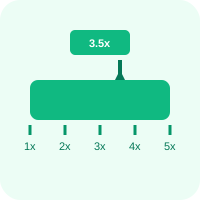
2. Apply the Right Multiplier
Multiply your profit by an industry-specific multiple. Small businesses typically sell for 2.5–3.5x SDE, while larger companies can command 4–6x EBITDA or more.

3. Find Qualified Buyers
List your business on marketplaces, work with a broker, or find a strategic buyer. In 2026, there's strong demand for profitable businesses, especially in tech, healthcare, and services.
What Is Your Business REALLY Worth?
Before we talk multipliers, we need to get your profit number right. This is where most sellers make mistakes that cost them thousands.
SDE vs. EBITDA: The Critical Difference
Choosing the wrong profit metric can lead to valuing your business at half (or double) its actual worth. Here's how to choose:
SDE (Seller's Discretionary Earnings)
Best for: Businesses with <$2M Revenue
SDE adds back your salary, personal benefits (car, insurance, travel), and one-time expenses to net profit. It shows the total cash flow available to an owner-operator. This is the standard for main street businesses, restaurants, and service companies.
Typical Multiplier: 2.0x – 3.5x SDE
EBITDA
Best for: Businesses with >$2M Revenue
Earnings Before Interest, Taxes, Depreciation, and Amortization. This removes the owner's salary and shows the business's standalone profitability. Used by private equity, strategic buyers, and for larger companies with management teams.
Typical Multiplier: 3.0x – 6.0x+ EBITDA
How to Calculate SDE (Step-by-Step)
I'll walk you through an example. Let's say your business shows these numbers:
- Net Profit (on tax return): $150,000
- Your Salary: $80,000
- Personal Car Lease: $8,000
- Health Insurance: $12,000
- One-time Legal Expense: $15,000
SDE Calculation:
$150,000 + $80,000 + $8,000 + $12,000 + $15,000 = $265,000 SDE
This $265,000 is the number buyers will use to value your business—not the $150,000 showing on your tax return.
The Multiplier Breakdown: What Your Business Commands
Once you have your SDE or EBITDA, the multiplier determines your final sale price. But here's the thing—multipliers aren't random. They reflect risk, growth, and transferability.
SDE Multiplier Ranges (Small Businesses)
1x – 1.9x SDE: High Risk / Job Replacement
The business heavily relies on you. If you leave, revenue collapses. Common in solo consulting, one-person service businesses, or businesses with declining revenue.
2.0x – 2.9x SDE: Average Small Business
You have some staff, documented processes, and consistent profits. The business can operate without you for short periods. This is where most restaurants, retail stores, and local service businesses land.
3.0x – 3.5x SDE: Strong, Transferable Business
You have a management team, growing revenue, and systems in place. The business doesn't depend on you daily. Buyers pay a premium for this because it's lower risk.
3.5x – 5.0x SDE: Exceptional Business
Reserved for businesses with recurring revenue, proprietary technology, or dominant market position. Think niche SaaS, specialized manufacturing, or healthcare practices.
EBITDA Multiplier Ranges (Mid-Market & Larger)
3.0x – 4.0x EBITDA: Standard Business
Solid performance but no standout growth. Typical for mature businesses in competitive industries.
4.0x – 6.0x EBITDA: Above Average
Strong management team, good growth trajectory (10-20% annually), and defensible market position. This is the sweet spot for most quality mid-market companies.
6.0x – 10.0x+ EBITDA: Premium/Strategic
High-growth businesses (25%+), recurring revenue models, or strategic value to a buyer. Common in software, healthcare, and business services.
Industry-Specific Multipliers (2026 Data)
Every industry is different. Here's what businesses are actually selling for in 2026, based on real market data:
| Industry | Typical Multiple | Key Factors |
|---|---|---|
| Restaurants / Food Service | 1.5x – 2.5x SDE | Location, lease terms, staff retention |
| Retail Stores (E-commerce) | 2.5x – 4.0x SDE | Traffic sources, repeat customers, brand |
| Service Businesses (Home Services) | 2.0x – 3.0x SDE | Reviews, technician staff, repeat bookings |
| SaaS / Software | 4.0x – 8.0x ARR (Revenue!) | Churn rate, growth rate, MRR composition |
| Manufacturing | 3.0x – 5.0x EBITDA | Equipment, customer contracts, facilities |
| Healthcare Practices | 2.5x – 4.0x SDE | Patient base, payer mix, location |
| Digital Agencies / Marketing | 2.0x – 3.5x SDE | Client retention, team expertise, niche |
| Construction / Trades | 2.0x – 3.0x SDE | Backlog, reputation, skilled workforce |
Pro Tip: These are averages. Your business could sell above or below these ranges based on growth rate, profitability trends, and how transferable it is. A restaurant with 30% year-over-year growth might sell for 3.5x SDE, while a declining one might only get 1.5x.
2026 Market Conditions: Why Now Is a Great Time to Sell
I've been tracking business sales for years, and 2026 is shaping up to be a seller's market for the right businesses. Here's what I'm seeing:
Strong Buyer Demand
Corporate buyers, private equity, and individual entrepreneurs are actively seeking profitable businesses. There's more capital looking for deals than quality businesses available.
Low Interest Rates = Higher Valuations
Buyers can finance acquisitions at reasonable rates, which means they can afford to pay higher multiples. This directly boosts your sale price.
Remote & Online Businesses Premium
E-commerce, SaaS, and digital agencies are commanding record multiples. Buyers love businesses that can be run from anywhere.
Baby Boomer Exit Wave
Thousands of business owners are retiring, creating opportunities. But quality businesses are still scarce and getting top dollar.
The Bottom Line
If your business is profitable, growing, and can operate without you daily, 2026 is an excellent time to sell. Buyers are paying premiums for businesses that check these boxes. I've seen SaaS businesses sell for 8x+ revenue and service businesses at 4x SDE—numbers we haven't seen since 2021.
How to MAXIMIZE Your Sale Price (Before You List)
Here's something most brokers won't tell you: You can significantly increase your business value before selling. I've seen owners boost their sale price by 30-50% just by making these changes 6-12 months before listing.
1. "Fire Yourself" Gradually
The less your business depends on you, the more valuable it is. Hire a manager, document your processes, and take a 2-week vacation to prove the business runs without you. This alone can move you from a 2x to a 3.5x multiple.
2. Clean Up Your Financials
Get your books reviewed by a CPA. Ensure expenses are properly categorized. Buyers will dig into your financials during due diligence—messy books kill deals or lower prices. Having clean, reviewed financials signals professionalism and reduces buyer risk.
3. Show Growth, Not Just Stability
Buyers pay for future growth, not past performance. If your revenue has been flat, invest in marketing or a new product line to show upward trends. Even 10-15% year-over-year growth can justify a premium multiple.
4. Secure Customer Contracts
Convert handshake agreements into written contracts with renewal terms. Recurring revenue (contracts, subscriptions, retainers) is worth significantly more than one-off sales. A business with 80% recurring revenue can command 2x the multiple of a project-based business.
5. Reduce Customer Concentration
If one customer represents more than 20% of your revenue, you have a risk problem. Diversify your customer base. I've seen deals fall apart or get discounted 30% because of single-customer dependence.
6. Document Everything
Create operations manuals, training guides, and process checklists. Buyers fear what they don't understand. When you can hand over a "business in a box," you reduce their risk and increase your price.
Real Example: How One Owner Added $200K to His Sale Price
A client of mine had a home services business generating $300K SDE. Initially valued at 2.5x ($750K), he spent 8 months hiring a general manager, documenting processes, and winning multi-year service contracts. When he sold, the business went for 3.5x SDE = $1,050,000. That's an extra $300K for less than a year of preparation.
Common Selling Mistakes (And How to Avoid Them)
❌ Valuing Based on Revenue, Not Profit
"I made $2M in revenue, so my business is worth $2M." Wrong. Buyers care about cash flow. A business with $2M revenue but no profit is worth zero. Always value based on SDE or EBITDA.
❌ Waiting Too Long to Sell
Sell when you're growing, not when you're declining or burned out. I've seen owners wait until revenue drops 30%, then wonder why their business is worth half what they expected. The best time to sell is when things are going well.
❌ Skipping Pre-Sale Preparation
Listing your business without clean financials, documentation, or a management team is like selling a house you haven't cleaned. You'll get lowball offers or no offers at all. Spend 3-6 months preparing before listing.
❌ Pricing Based on "What I Need to Retire"
Buyers don't care what you need. They care what the business is worth. I've seen owners turn down fair offers hoping for their "retirement number," only to watch their business decline and ultimately sell for less.
❌ Not Using an NDA (Non-Disclosure Agreement)
Sharing confidential business information without protection is reckless. Competitors, employees, and customers can learn you're selling. Always use an NDA before sharing financials or operations details.
❌ Ignoring Deal Structure
The offer isn't just the price—it's the structure. $500K all-cash at closing is very different from $500K with $200K seller financing and an earnout. Understand the total economics, not just the headline number.
The Sales Process: What to Expect
Selling a business typically takes 6-12 months. Here's the timeline you should expect:
Preparation Phase
Organize financials (3 years tax returns, P&L), create an executive summary, document operations, hire a business valuation expert if needed, and decide on your minimum acceptable price.
Marketing & Listing
List on business-for-sale marketplaces (BizBuySell, Flippa, Empire Flippers), work with a broker, or reach out to strategic buyers directly. Expect 50-100 inquiries for a quality business.
Negotiation & LOI
Screen buyers, share financials (with NDA), conduct meetings, and negotiate a Letter of Intent (LOI). Most serious buyers will want to see your operations and meet your team.
Due Diligence
The buyer verifies everything you claimed. They'll review financials, customer contracts, employee records, legal documents, and operations. Be transparent—hiding issues here kills deals.
Closing
Finalize purchase agreements, secure financing (if applicable), handle legal paperwork, and transfer ownership. The closing process itself takes 2-4 weeks once due diligence is complete.
Transition & Training
You typically stay on for 1-3 months to train the new owner, introduce them to customers, and ensure a smooth handover. After that, you're free—with a nice check in hand.
Broker vs. Selling Yourself: What's Right for You?
One of the first decisions you'll face is whether to hire a business broker or sell it yourself. I've done both, and here's my honest take:
Work with a Business Broker
✅ Best For:
Businesses valued over $500K, owners who value privacy, first-time sellers
Pros:
- • Access to qualified buyer network
- • Handles confidential marketing
- • Negotiates on your behalf
- • Manages paperwork and process
Cons:
- • Commission: 8-12% of sale price
- • Less control over the process
- • Some brokers push quick sales
Sell It Yourself (For Sale By Owner)
✅ Best For:
Businesses under $500K, experienced sellers, B2B businesses with strategic buyers
Pros:
- • No commission (save $40K-$120K on a $1M sale)
- • Full control over buyer selection
- • Direct communication with buyers
- • You know your business best
Cons:
- • Time-consuming (100+ hours)
- • Steep learning curve
- • Must qualify buyers yourself
- • Legal/financial complexity
My Recommendation
If your business is worth over $1M, use a broker. The 10% commission pays for itself through better buyer access, higher sale prices, and avoiding costly mistakes. For businesses under $500K, consider DIY—but educate yourself first or hire a lawyer for the closing.
Tools to Calculate Your Business Value
I've built these free calculators to help you estimate what your business is worth. Use them to get a ballpark figure before talking to brokers or buyers.
🏢 Business Valuation Calculator
Estimate your business value using SDE or EBITDA multiples. Just enter your revenue, profit, and industry to get an instant valuation range.
Calculate My Business Value →📊 Stock Valuation Calculator
If you're planning to invest your sale proceeds in stocks, use this DCF calculator to find undervalued companies and grow your wealth.
Calculate Stock Value →📈 Future Value Calculator
See how your sale proceeds can grow over time. Calculate the future value of your investment with compound interest and regular contributions.
Calculate Future Growth →💰 Compound Interest Calculator
Understand the power of compounding. See how investing your business sale proceeds can create generational wealth over time.
Calculate Compound Growth →Frequently Asked Questions
How accurate are online business valuation calculators?
Online calculators provide a ballpark estimate based on industry averages. They're useful for getting started, but your actual sale price will depend on factors like growth rate, customer concentration, management team, and market conditions. For businesses over $1M, I recommend getting a professional valuation from a certified business appraiser.
Should I value my business based on revenue or profit?
Almost always profit. Buyers buy cash flow, not revenue. The only exception is high-growth SaaS companies, which sometimes sell on revenue multiples (4x-8x ARR). For 95% of businesses, value your SDE or EBITDA, then apply a multiple. A business with $2M revenue but $50K profit is worth very little. A business with $500K revenue and $200K profit is valuable.
What's the difference between an asset sale and a stock sale?
In an asset sale, the buyer purchases specific assets (equipment, inventory, customer lists) and assumes certain liabilities. This is common for small businesses and C-Corps. In a stock sale, the buyer purchases the entire company entity, including all assets and liabilities. This is typical for S-Corps and larger companies. Stock sales are generally preferred by sellers due to better tax treatment, but buyers often prefer asset sales to avoid unknown liabilities.
How long does it take to sell a business?
On average, 6-12 months from preparation to closing. Here's the breakdown: 1-3 months preparing financials and documentation, 1-2 months marketing and finding a buyer, 1-2 months negotiating and due diligence, and 1-2 months closing paperwork. Well-prepared businesses in hot industries can sell faster (3-6 months), while businesses with messy books or declining revenue can take 18+ months or not sell at all.
What is seller financing, and should I offer it?
Seller financing means you, the seller, lend part of the purchase price to the buyer. For example, if your business sells for $500K, the buyer might pay $300K at closing and finance $200K over 5 years at 8% interest. Offering seller financing can attract more buyers and justify a higher price. However, it carries risk—if the buyer fails, you might not get paid. I recommend limiting seller financing to 20-30% of the purchase price and requiring a personal guarantee from the buyer.
What is an earnout, and why do buyers want it?
An earnout is a provision where you receive additional payments if the business hits performance targets after the sale. For example: '$1M at closing, plus $200K if revenue exceeds $2M in Year 1.' Buyers use earnouts to bridge valuation gaps and reduce risk. Sellers dislike them because you're tied to the business post-sale and might not get the full payment. Earnouts are common in businesses with uncertain future performance or high growth projections.
Do I need a lawyer to sell my business?
Yes, absolutely. Even if you're selling without a broker, you need a business transaction attorney to draft or review the purchase agreement, handle the closing documents, and protect your interests. The cost ($3K-$10K depending on complexity) is worth it to avoid legal issues later. Don't use your cousin who does real estate law—business sales require specialized expertise.
Will I have to work for the buyer after selling?
In most cases, yes—but only for a limited time. Buyers typically require a transition period of 1-3 months where you stay on to train them, introduce customers, and ensure smooth handover. For larger businesses, this might extend to 6-12 months. Employment beyond the transition period is negotiable. Some buyers want the founder to stay on as an employee or consultant for 1-3 years, often with equity incentives. This should be negotiated as part of the deal.
What happens to my employees when I sell?
In most small business sales, the buyer wants to retain key employees because they're essential to operations. You should notify key employees after signing the LOI but before closing—this maintains confidentiality while giving them certainty. Be prepared for some turnover; employees often fear change. For larger businesses, WARN Act requirements may apply (60 days notice for mass layoffs). Most buyers offer retention bonuses to key staff to ensure they stay through the transition.
Is 2026 a good year to sell my business?
Yes, 2026 is shaping up to be a strong seller's market for profitable, well-run businesses. Interest rates have stabilized, buyer demand is high (especially for online, service, and healthcare businesses), and there's significant capital looking for acquisitions. If your business is profitable and growing, you're in a good position. However, economic uncertainty exists, so buyers are cautious about businesses with declining revenue or high customer concentration. The best time to sell is when you're growing, not when you're desperate.
Ready to Find Out What Your Business Is Worth?
Don't guess. Use my free Business Valuation Calculator to get a realistic estimate based on your actual numbers and industry standards.
Calculate My Business Value Now