Fair Value vs Market Value: What's the Difference?
I'm going to break down one of the most misunderstood concepts in investing—fair value versus market value. These terms get thrown around like they're the same thing, but they're not. And understanding the difference? That's how you make money in the stock market.
Look, I've been investing for years, and when I first started, I thought "fair value" and "market value" were just fancy ways of saying "how much something's worth." Boy, was I wrong. And it cost me money.
Here's the deal: Market value is what the market says something is worth right now. Fair value is what YOU calculate it's actually worth based on the fundamentals. Sometimes they align. Sometimes they're miles apart. And that gap? That's where opportunities happen.
In this guide, I'm going to explain both concepts in plain English (no accounting jargon, I promise), show you real examples, and teach you how I use the difference between fair value and market value to find undervalued stocks. I'll even share the calculators I use to crunch the numbers.
What is Market Value? (The Easy Part)
Market value is straightforward. It's the price at which an asset would actually trade in a competitive auction setting. It's the current market price—the price you see on your screen when you pull up a stock quote.
Market Value in One Sentence:
Market value = What someone will actually pay for it right now.
That's it. No calculations, no estimates, no complex formulas. Market value is determined by supply and demand. If people want to buy Apple stock more than sellers want to sell it, the market value goes up. If sellers outnumber buyers, it goes down. It's real, it's tangible, and it changes every second the market is open.
Key Characteristics of Market Value:
1. It's Actual and Realized
Market value isn't theoretical. It's the price at which real transactions are happening. When you see Apple trading at $175, that means someone actually bought Apple shares at $175. It's not a guess—it's a fact.
2. It Reflects Real-Time Conditions
Market value captures everything happening right now—news, emotions, economic data, investor sentiment, even the overall mood of the market. It's constantly adjusting to new information.
3. It's Determined by Supply and Demand
At its core, market value is simple. More buyers than sellers? Price goes up. More sellers than buyers? Price goes down. That's the entire stock market in one sentence.
4. It Can Be Irrational
Here's the thing about market value: it's not always rational. Sometimes the market overreacts to good news (sending prices too high) or bad news (sending prices too low). That's why market value doesn't always equal "true value."
Real Example: On March 9, 2020, the S&P 500 dropped nearly 8% in a single day due to COVID-19 fears. Did the fundamental value of those 500 companies really drop 8% in one day? Of course not. That was market value reacting to panic. Fair value didn't change nearly that much.
What is Fair Value? (The Important Part)
Okay, this is where things get interesting. Fair value is the price that would be received to sell an asset or paid to transfer a liability in an orderly transaction between market participants at the measurement date.
I know, I know—that sounds like accounting gibberish. Let me translate: Fair value is an estimate of what an asset is actually worth based on its fundamentals, not what the market happens to be charging for it right now. It's calculated using valuation models, not by looking at the stock ticker.
Fair Value in One Sentence:
Fair value = What the asset SHOULD be worth based on its actual cash-generating ability.
Key Characteristics of Fair Value:
1. It's Hypothetical and Estimated
Unlike market value, fair value isn't an actual transaction price. It's a calculated estimate based on valuation models like Discounted Cash Flow (DCF), comparable company analysis, or asset-based valuation. Two people can calculate different fair values for the same company.
2. It Assumes Ideal Market Conditions
Fair value assumes a rational, orderly transaction between knowledgeable, willing parties. It doesn't account for panic selling, irrational exuberance, or temporary market dislocations. It's the "rational" price.
3. It's Based on Fundamentals
Fair value is calculated using actual business metrics: cash flows, growth rates, profit margins, risk, and the time value of money. It's grounded in cold, hard numbers, not emotions or market sentiment.
4. It's Primarily an Accounting Concept
Fair value is defined by accounting standards like IFRS 13 and ASC 820. Companies use fair value for financial reporting—marking assets to their fair value on balance sheets. It's a legal construct as much as an investment concept.
Side-by-Side Comparison
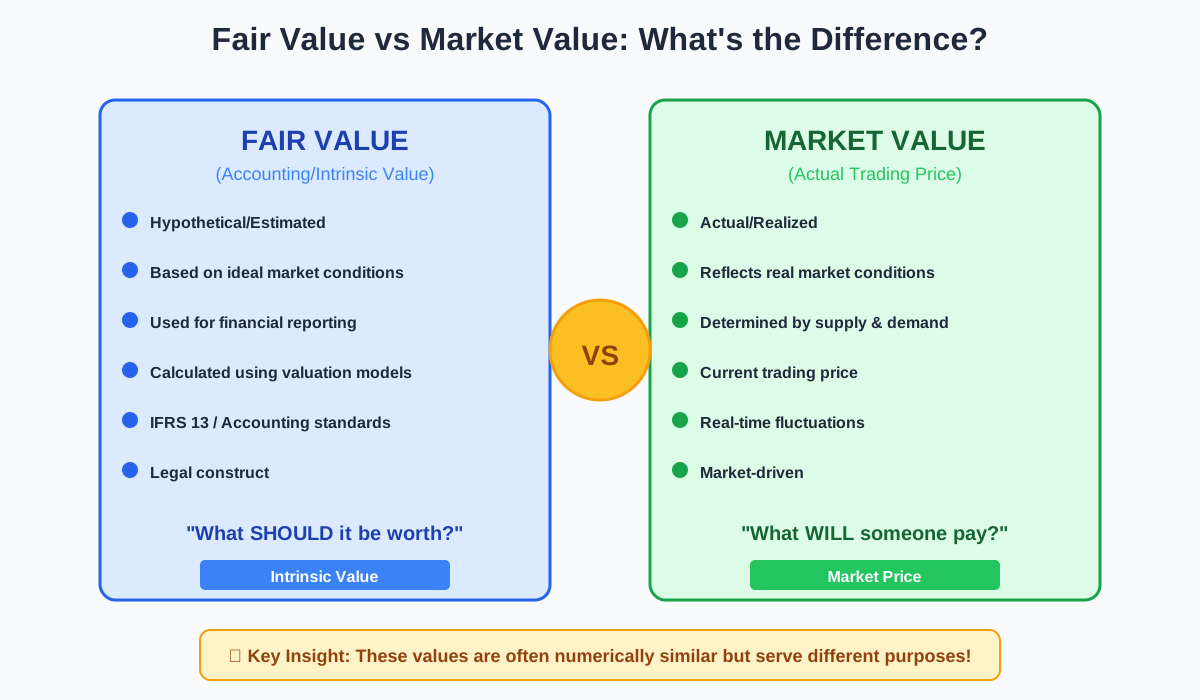
Fair value is theoretical and calculated; market value is actual and observed
The 5 Critical Differences (That Actually Matter)
Alright, let's get specific. Here's how fair value and market value differ in ways that actually impact your investment decisions:
| Aspect | Fair Value | Market Value |
|---|---|---|
| Nature | Hypothetical estimate | Actual price |
| Determination | Calculated using models | Determined by supply & demand |
| Market Conditions | Assumes ideal conditions | Reflects actual conditions |
| Primary Use | Financial reporting, investing | Market transactions, trading |
| Stability | Relatively stable | Highly volatile |
Why These Differences Matter
Here's the thing: if market value always equaled fair value, there would be no opportunities to make money in the stock market. Everyone would know exactly what every company was worth, and prices would perfectly reflect fundamentals.
But that's not how the world works. Market value is constantly bouncing around based on news, emotions, and short-term thinking. Fair value changes much more slowly, based on actual business performance. And when market value deviates significantly from fair value? That's your opportunity.
The Investment Opportunity:
- When Market Value < Fair Value: The stock is undervalued. The market is pricing it below what it's actually worth. This is your buying opportunity.
- When Market Value > Fair Value: The stock is overvalued. The market is pricing it above what it's actually worth. This might be a time to sell or avoid.
- When Market Value ≈ Fair Value: The stock is fairly valued. The market has it priced right. Whether you buy depends on your confidence in the company's future.
Real-World Examples: How I Use Both Concepts
Let me show you how this plays out in the real world. These aren't hypothetical examples—I've seen these scenarios play out time and time again.
Example 1: The Undervalued Tech Company
Let's say I'm analyzing a tech company (let's call it "TechCorp"). Here's what I find:
- • Market Value: $150 per share (what the stock is trading for)
- • Fair Value (my DCF calculation): $200 per share
- • Conclusion: Undervalued by 25%
Here's my thinking: The market is pricing TechCorp at $150, but based on its cash flows, growth rate, and risk, I calculate it's actually worth $200. Why the discrepancy? Maybe the market is worried about short-term earnings, or maybe there's negative sentiment in the sector.
My Action: I'll consider buying, but only if there's a sufficient margin of safety. I might wait for it to drop to $140 or $130 before pulling the trigger. I never pay full fair value—I want a discount.
Example 2: The Overvalued Hype Stock
Now let's look at the opposite scenario—a hyped-up stock everyone's talking about:
- • Market Value: $250 per share
- • Fair Value (my DCF calculation): $180 per share
- • Conclusion: Overvalued by 39%
The market has gone crazy for this stock. Maybe it's a hot AI company, or maybe there's speculation about a buyout. Whatever the reason, the market value ($250) is way above what the fundamentals justify ($180).
My Action: I avoid it. Or if I own it, I might consider selling. Sure, the stock could keep going up—hype can drive prices higher in the short term. But eventually, gravity takes hold. I'd rather invest in undervalued companies with solid fundamentals than chase overvalued hype stocks.
Example 3: The Fairly Valued Opportunity
Sometimes, the market gets it right:
- • Market Value: $175 per share
- • Fair Value (my DCF calculation): $175 per share
- • Conclusion: Fairly valued
In this case, the market has accurately priced the stock. There's no obvious bargain here, but there's no obvious rip-off either.
My Action: It depends. If I'm extremely confident in the company's future (maybe they have a game-changing product coming out, or exceptional management), I might still buy at a fair valuation. But if I'm lukewarm on the company, I'd rather wait for a better opportunity elsewhere. Life's too short to buy "just okay" investments.
Visualizing the Scenarios
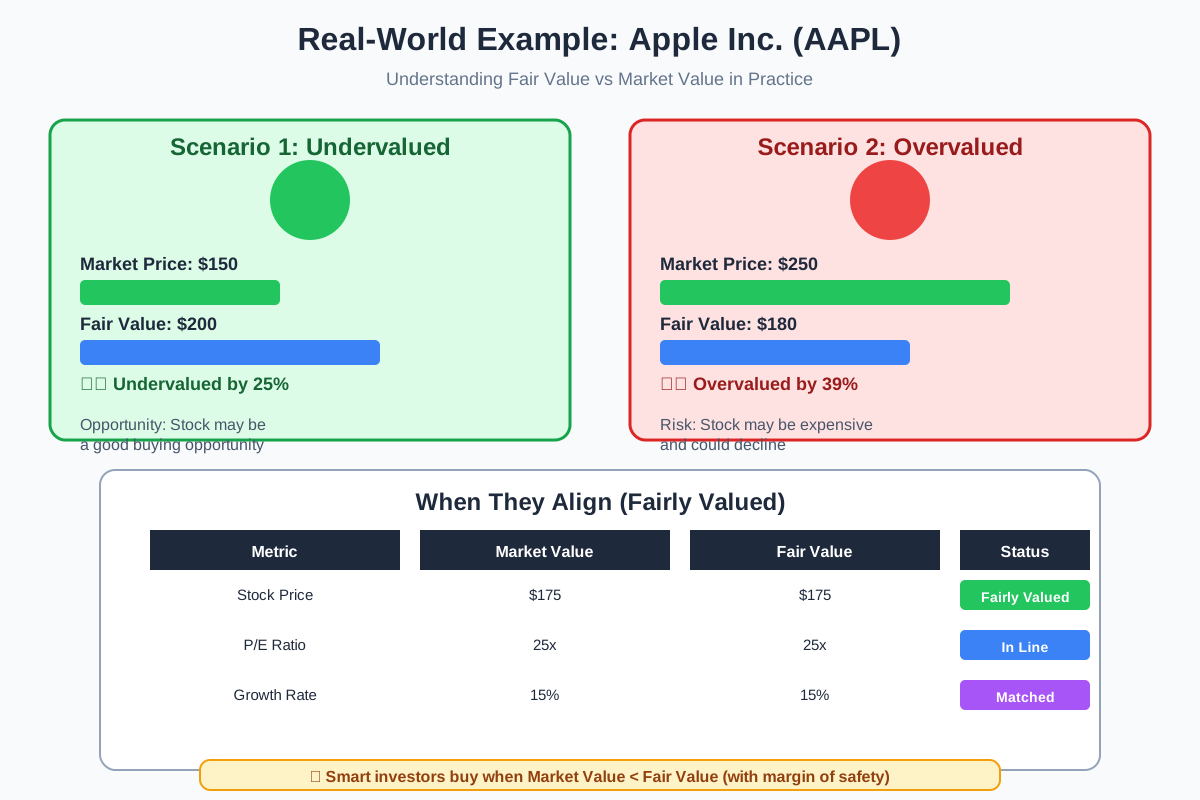
The gap between fair value and market value creates investment opportunities
How I Calculate Fair Value (Step-by-Step)
You might be wondering: "Okay, but how do I actually calculate fair value? It sounds complicated." It's not as hard as you think. Here's the exact process I use:
Method 1: Discounted Cash Flow (DCF) — My Go-To
This is the gold standard. Here's how it works:
- Step 1: Estimate the company's future cash flows for the next 5-10 years. Be conservative—don't assume 50% growth year after year.
- Step 2: Calculate terminal value (what the company will be worth at the end of your projection period).
- Step 3: Discount all those future cash flows back to today's dollars using a discount rate (usually the company's WACC or a standard 10%).
- Step 4: Add up the discounted cash flows to get enterprise value, then divide by shares outstanding to get fair value per share.
Sound complicated? It's not—I built a calculator that does all the heavy lifting for you. You can find it here: DCF Calculator
Method 2: Comparable Company Analysis — The Quick Check
This method compares the company to similar public companies:
- Step 1: Find 3-5 similar companies in the same industry.
- Step 2: Look at their valuation multiples (P/E ratio, EV/EBITDA, P/B ratio).
- Step 3: Apply those multiples to your company's metrics to estimate fair value.
Example: If similar tech companies trade at 25x earnings, and your company has $10 in earnings per share, fair value might be around $250 per share.
Method 3: Benjamin Graham Formula — For Defensive Investors
This is a simplified formula from the father of value investing:
Fair Value = √(22.5 × EPS × Book Value per Share)
Where EPS = Earnings Per Share. This formula is conservative and perfect for finding defensive value stocks. I built a calculator for this too: Benjamin Graham Calculator
Pro Tip: Use Multiple Methods
I never rely on just one valuation method. I calculate fair value using DCF, comparable analysis, and the Graham formula. If all three methods give me similar results (say, $180, $190, and $200), I'm confident in my fair value estimate. If they're all over the place (one says $100, another says $300), I know I need to dig deeper.
My Investment Decision Framework
So how do I actually use fair value vs market value to make investment decisions? Here's my framework:
Step 1: Calculate Fair Value
Use DCF, comparable analysis, or both. Get a range for fair value (not a single number). For example: "Fair value is between $180 and $220 per share."
Step 2: Check Market Value
Look at the current stock price. This is the market value.
Step 3: Apply Margin of Safety
Benjamin Graham taught me to never pay full fair value. I require a margin of safety—typically 20-30%. So if fair value is $200, I only buy if market value is $140-160 or lower.
Step 4: Investigate the Discount
If the stock is trading below fair value, find out WHY. Is the market missing something? Or is there a real problem with the company? Sometimes discounts are justified.
Step 5: Make the Decision
- • Market Value < Fair Value - Margin of Safety: Buy
- • Market Value ≈ Fair Value: Hold or skip (unless you're extremely confident)
- • Market Value > Fair Value: Sell or avoid
Why This Works
This framework forces you to be disciplined. You're not chasing hype or panic-selling. You're making decisions based on calculated fair value, not emotions. Over time, this approach beats the market.
Investment Decision Flowchart
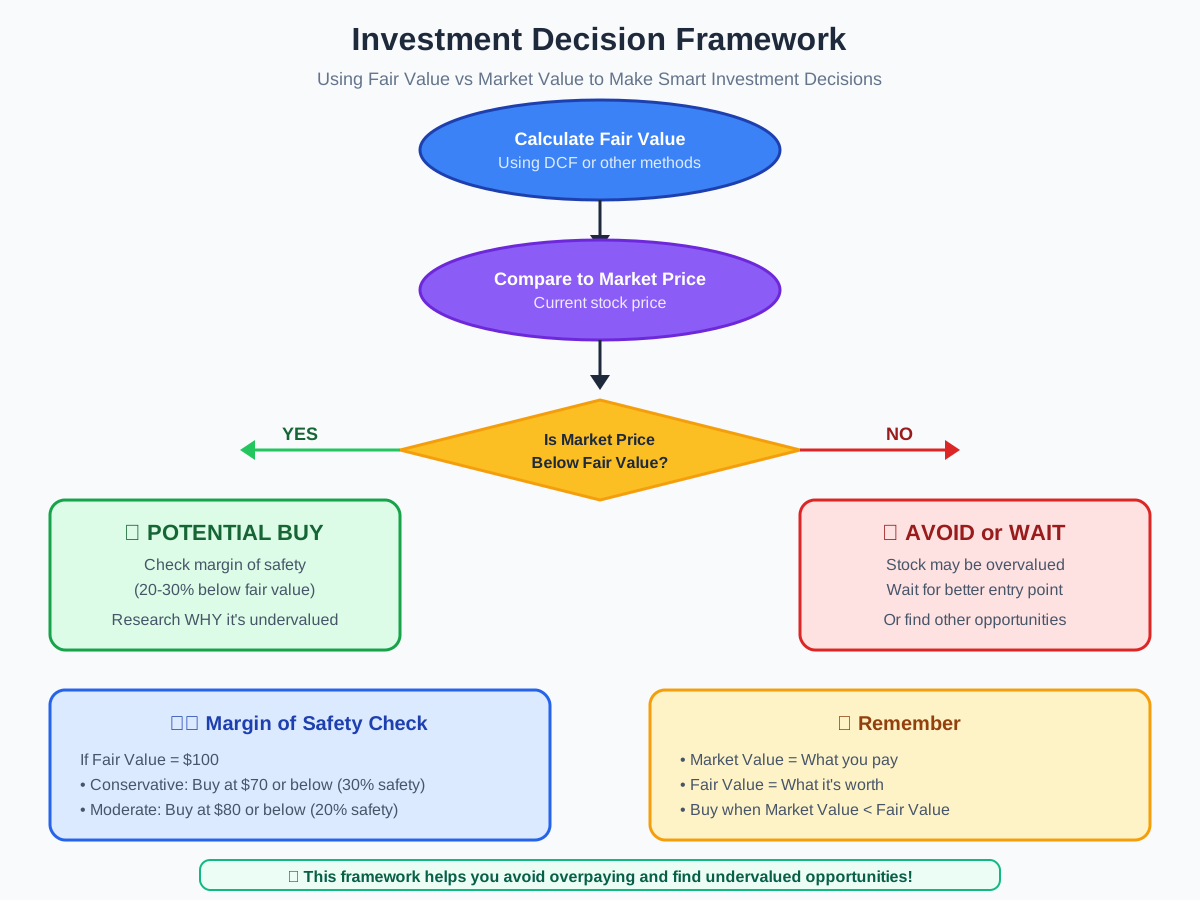
A systematic approach to making investment decisions using fair value analysis
Common Mistakes I've Made (So You Don't Have To)
❌ Confusing Fair Value with Market Value
When I first started, I'd look at a stock's market value ($150) and assume that's what it was worth. I didn't calculate fair value. Big mistake. Now I always calculate fair value first, then compare it to market value.
❌ Assuming Market Value Is Always Right
The market is wrong. A lot. Sometimes it's irrationally exuberant (think dot-com bubble). Sometimes it's irrationally pessimistic (think March 2020). Market value is just the price—you need to figure out the value.
❌ Being Too Precise with Fair Value
Fair value is an estimate, not a precise calculation. If I calculate fair value at $187.43, I don't actually think it's worth exactly $187.43. It's a range—maybe $180-195. Don't fool yourself into thinking your fair value calculation is exact.
❌ Ignoring Margin of Safety
I used to buy stocks trading at fair value. Bad idea. Now I require a 20-30% margin of safety. If fair value is $200, I won't buy unless it's trading at $160 or below. This protects me from errors in my analysis.
❌ Not Updating Fair Value Calculations
Fair value isn't static. It changes as the company's fundamentals change. I recalculate fair value quarterly, or whenever there's major news (earnings, acquisitions, management changes). An old fair value calculation can be worse than useless.
❌ Using Fair Value for High-Growth (or No-Profit) Companies
DCF and fair value calculations work best for stable, profitable companies. For early-stage tech companies with no earnings, fair value is almost impossible to calculate accurately. In those cases, I use other methods (or I avoid them entirely).
Tools I Use to Calculate Fair Value
Look, calculating fair value by hand is tedious. That's why I built a suite of free calculators that do the heavy lifting for you. These are the exact tools I use:
📊 DCF Calculator (Main Tool)
Calculate the intrinsic value of any stock using the Discounted Cash Flow method. This is my go-to calculator for finding fundamentally undervalued stocks.
Try the DCF Calculator →🧮 Stock Valuation Calculator
Quick and easy stock valuation using multiple methods (DCF, P/E, PEG, P/B). Great for screening stocks quickly and getting a fair value range.
Calculate Stock Value →🧠 Benjamin Graham Formula Calculator
Use the classic formula from the father of value investing. Perfect for defensive investors looking for a margin of safety.
Calculate Graham Number →📈 Peter Lynch Fair Value Calculator
Calculate fair value using the PEG ratio method. Ideal for growth stocks and investors who follow Peter Lynch's approach.
Calculate PEG Fair Value →🏢 Business Valuation Calculator
Estimate the value of any business using SDE or EBITDA multiples. Useful if you're looking at private companies or considering buying a business.
Calculate Business Value →Frequently Asked Questions About Fair Value vs Market Value
Q: What's the difference between fair value and fair market value?
Great question. "Fair value" is an accounting concept defined by IFRS 13 and used for financial reporting. "Fair market value" is a legal and tax concept often used in valuations for estate, tax, or divorce purposes. They're similar in spirit (both represent an estimate of true value), but they have different technical definitions and use cases. For investing, focus on fair value—that's what matters for stock valuation.
Q: Which is more important: fair value or market value?
They're both important, but for different reasons. Market value tells you what you have to pay to buy the stock right now. Fair value tells you what the stock is actually worth. The key is comparing the two. If market value is below fair value (with a margin of safety), that's a potential buy. If market value is above fair value, that's a potential avoid or sell. You need both concepts to make smart investment decisions.
Q: Can market value ever be wrong?
Market value is never "wrong" in the sense that it's the actual trading price. But it can be wrong in terms of reflecting true value. The market is driven by humans, and humans are emotional. Sometimes fear drives prices too low (creating buying opportunities). Sometimes greed drives prices too high (creating bubbles). Market efficiency is a theory, not a law. The market is often wrong—sometimes spectacularly so.
Q: How often should I compare fair value to market value?
I check market value daily (it's just the stock price), but I only recalculate fair value quarterly or when there's major news. Fair value doesn't change that often unless the company's fundamentals change. However, market value swings around constantly. This creates opportunities—sometimes the gap between fair value and market value widens, and that's when I act.
Q: What if my calculated fair value is very different from market value?
This happens all the time—and it's exactly what you're looking for. If market value is way below your calculated fair value, you might have found an undervalued stock. But first, double-check your calculations. Make sure your assumptions are realistic. Then ask: why is the market pricing it so low? Is there a valid reason (real problems with the company) or is the market being irrational? If it's irrational, and you're confident in your fair value calculation, that's your buying opportunity.
Q: Is fair value the same as intrinsic value?
Pretty much. "Intrinsic value" is the more general investing term (what Warren Buffett uses). "Fair value" is the accounting term. For practical purposes, they mean the same thing: the true worth of an asset based on its fundamentals. I use them interchangeably. The key point is that both are distinct from market value.
Q: Do professional investors use fair value or market value?
Both. Hedge funds, mutual funds, and sophisticated investors constantly calculate fair value and compare it to market value. That's literally their job—find assets where market value ≠ fair value, and profit from the gap. Market makers and day traders might focus more on market value (short-term price movements), but long-term investors absolutely use fair value analysis.
Q: Can fair value be calculated for any asset?
In theory, yes. Any asset that generates cash flows (or could generate cash flows) can be valued. In practice, fair value is easiest to calculate for stable, profitable businesses. It's harder for startups (no cash flow yet), commodities (no cash flows), or cryptocurrencies (no cash flows). That doesn't mean these assets can't be valued—just that different methods are needed.
Q: How accurate are fair value calculations?
They're estimates, not prophecies. If I calculate fair value at $200, I'm not saying the stock will trade at exactly $200. I'm saying that based on the fundamentals, $200 is a reasonable estimate of its true worth. The actual market value might be $150 or $250 for years. Over time, though, market value tends to converge toward fair value. That's the bet you're making as a value investor.
Q: Should I ever buy a stock when market value is above fair value?
Generally, no. I avoid overvalued stocks. But there are exceptions. If you're extremely confident in the company's future (maybe they have a monopoly, or a game-changing product), you might pay a premium. Or if it's a high-growth company where fair value is hard to calculate, you might accept a higher valuation. Just be aware that you're taking more risk. For most investors, most of the time, it's better to wait for market value to drop below fair value.
Q: How does Warren Buffett use fair value vs market value?
Buffett is the ultimate value investor. He calculates the intrinsic value (fair value) of businesses using DCF analysis, and he only buys when market value is significantly below intrinsic value—with a huge margin of safety. His famous quote: "Price is what you pay, value is what you get." That's fair value vs market value in one sentence. Buffett became one of the richest people in the world by exploiting the gap between these two concepts.
Q: What's the easiest way to start comparing fair value to market value?
Start with my free DCF calculator here on this site. Plug in a company's numbers (free cash flow, growth rate, discount rate), calculate fair value, then compare it to the current stock price (market value). If the stock is trading 20-30% below your calculated fair value, and you understand why it's undervalued, you might have found a good investment opportunity. Practice with companies you know well until you get comfortable with the process.
My Final Thoughts: Why This Matters
Look, I could've given you a textbook definition of fair value vs market value and called it a day. But that's not how you learn. You learn by understanding why these concepts matter and how to use them.
Here's the bottom line: Market value is the price. Fair value is the value. Sometimes they're the same. Often they're not. And that gap—that disconnect between price and value—is where you make money as an investor.
When you understand this distinction, you stop chasing hot stocks (overvalued market value) and start hunting for bargains (undervalued market value). You become a value investor. And historically, value investors have beaten the market.
If You're New to This, Start Here:
- 1. Pick a company you understand. Don't start with a complex tech company. Start with something simple like Coca-Cola or McDonald's.
- 2. Calculate fair value using my DCF calculator. Don't overthink it. Use reasonable assumptions.
- 3. Compare your fair value to the current stock price. Is the stock undervalued, overvalued, or fairly valued?
- 4. If it's undervalued by 20-30% or more, investigate. Why is it cheap? Is the market missing something, or are there real problems?
- 5. If you're confident, buy with a margin of safety. Don't pay full fair value. Buy at a discount.
- 6. Be patient. The market can remain irrational longer than you can remain solvent. But eventually, price converges to value.
Remember: Investing is a marathon, not a sprint. You won't get rich overnight by comparing fair value to market value. But over time, consistently buying undervalued stocks and avoiding overvalued ones—that's how you build wealth.
Good luck, and invest smart!
Ready to Find Undervalued Stocks?
Use my free valuation calculators to compare fair value vs market value and start making smarter investment decisions today.