How to Calculate Fair Market Value: The Complete Guide
I'm going to walk you through the exact formulas and methods I use to calculate fair market value. Whether you're valuing a business, real estate, or any asset, I'll show you step-by-step calculations with real numbers.
Let me be honest with you: calculating fair market value can seem intimidating at first. All those formulas, approaches, and technical jargon—it's enough to make anyone's head spin. But here's the thing: once you understand the core principles, it's actually pretty straightforward. I've calculated hundreds of FMVs over my career, and I'm going to share exactly how I do it.
Fair market value (FMV) is the price an asset would sell for on the open market between a willing buyer and a willing seller, both having reasonable knowledge of the relevant facts and neither being under any compulsion to act. It's not what you HOPE your asset is worth, and it's not what you NEED it to be worth—it's what it would actually sell for.
In this guide, I'm going to break down the three primary approaches to calculating FMV, give you the actual formulas I use, walk through real calculation examples with numbers, and point you to free calculators that can do the math for you. No theory—just practical, actionable information you can use right now.
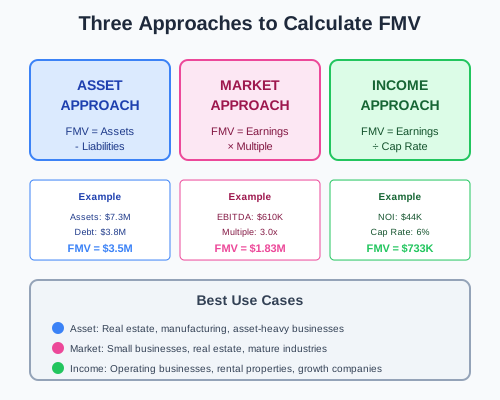
📌 Quick Overview: The Three Approaches
Calculate based on the current market value of assets minus liabilities
Compare with similar assets that have recently sold
Calculate based on the income the asset can generate
Why Accurate FMV Calculation Matters
Before we dive into the formulas, let me explain why getting this calculation right is so important. I've seen people make costly mistakes because they didn't calculate FMV correctly—or worse, they didn't calculate it at all and just guessed.
Selling a Business
Price it too high and it sits on the market. Price it too low and you leave money on the table. I've seen sellers lose $500K+ by not calculating FMV properly.
Tax Compliance
The IRS uses FMV for estate taxes, gift taxes, and property taxes. Get it wrong and you could face penalties, interest, and an audit. Trust me, you don't want that.
Legal Proceedings
Divorce, partnership disputes, shareholder litigation—all these require accurate FMV calculations. Courts won't accept guesswork.
Buying Decisions
Don't overpay for an asset. Knowing how to calculate FMV helps you negotiate better deals and avoid bad investments.
Method 1: Asset Approach (The Cost Method)
The asset approach is the most straightforward method to calculate fair market value. It's based on a simple idea: figure out what everything the business owns is worth, subtract what it owes, and that's your FMV. I use this method constantly for asset-heavy businesses like manufacturing, real estate holding companies, and businesses going through liquidation.
The Asset Approach Formula
Or, for equity value specifically:
Equity FMV = Total Asset FMV - Total Debt + Cash
Step-by-Step Calculation
Step 1: List All Assets at Fair Market Value
Go through everything the business owns and determine what it would sell for TODAY:
Current Assets:
- • Cash: Use face value (simple!)
- • Accounts Receivable: Estimate collectible amount (usually 80-95% of book value)
- • Inventory: Use current market value (what you could sell it for now, not what you paid)
Fixed Assets:
- • Equipment: Get current resale value (not book value after depreciation)
- • Real Estate: Use appraised market value or comparable sales
- • Vehicles: Check Kelley Blue Book or similar for current market value
Intangible Assets:
- • Patents, trademarks, customer lists: These need separate valuation (often using income method)
- • Goodwill: Value of the business's reputation and customer relationships
Step 2: List All Liabilities
List everything the business owes at current market value:
- • Accounts payable
- • Short-term debt (use current market value if traded)
- • Long-term debt (loans, bonds)
- • Tax obligations
- • Deferred tax liabilities
- • Lease obligations
Step 3: Subtract Liabilities from Assets
Take the total fair market value of all assets and subtract the total fair market value of all liabilities. The result is the fair market value of the equity (what the business is worth to shareholders).
Real Calculation Example
Let me walk you through a real example. Here's a manufacturing company I valued recently:
Assets (at Fair Market Value):
- Cash: $500,000
- Accounts Receivable (net): $300,000
- Inventory (current market value): $800,000
- Equipment (appraised value): $2,000,000
- Real Estate (market value): $3,500,000
- Patents (valued separately): $200,000
- Total Assets FMV: $7,300,000
Liabilities:
- Accounts Payable: $200,000
- Bank Loan: $1,500,000
- Mortgage on Property: $2,000,000
- Tax Payable: $100,000
- Total Liabilities: $3,800,000
Calculation:
When to Use the Asset Approach
- ✓ Asset-heavy businesses (manufacturing, real estate, construction)
- ✓ Holding companies or investment firms
- ✓ Businesses going through liquidation or bankruptcy
- ✓ When the business has minimal or negative earnings
- ✓ For financial institutions (banks, insurance companies)
Limitations to Watch Out For
- ⚠️ Doesn't capture future earnings potential
- ⚠️ Intangible assets can be difficult and expensive to value accurately
- ⚠️ Book values on balance sheets often differ significantly from market values
- ⚠️ Ignores the value of the business as a going concern
Visual Comparison: The Three FMV Calculation Approaches
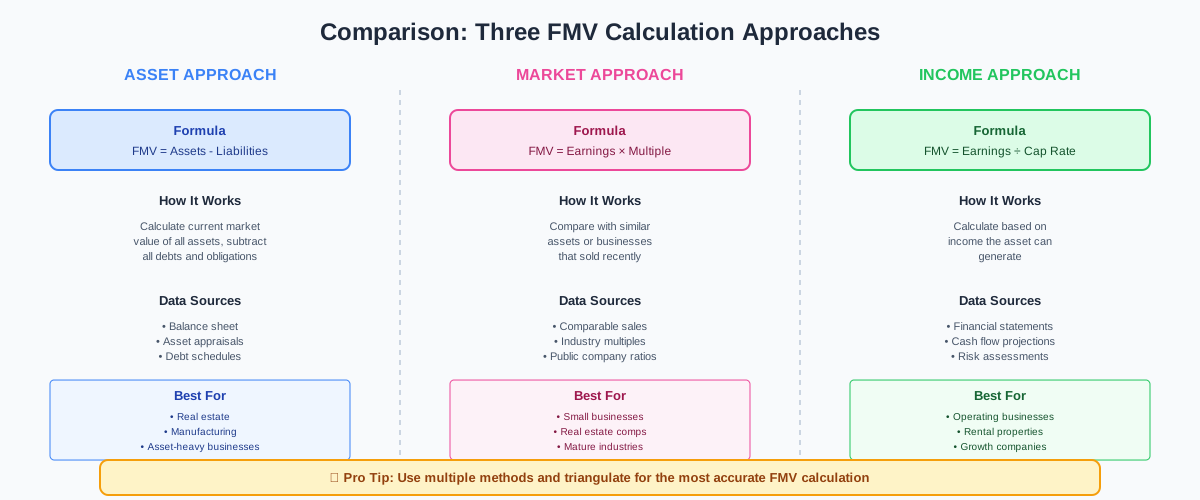
Each approach has its strengths—use the one that fits your situation, or combine multiple approaches
Method 2: Market Approach (Comparable Sales)
The market approach is based on the principle of substitution: a rational buyer wouldn't pay more for an asset than the cost of acquiring a similar asset. This method looks at what similar assets have actually sold for recently. It's the same approach a real estate appraiser uses when valuing your home—find comparable sales and adjust for differences.
The Market Approach Formulas
For Businesses using Multiples:
For Real Estate (Comparable Sales):
For Public Company Comparables:
Business Valuation Using Multiples
This is the method I use most often for small to mid-sized businesses. Here's how it works:
Step 1: Calculate Normalized Earnings
First, determine the business's earnings. For most small businesses, use SDE (Seller's Discretionary Earnings). For larger businesses, use EBITDA.
The key is "normalizing" earnings—adding back expenses that are specific to the current owner and wouldn't apply to a new owner.
Step 2: Find Industry Multiples
Research what similar businesses are selling for. Here are typical ranges:
| Industry | Typical SDE Multiple | Typical EBITDA Multiple |
|---|---|---|
| Manufacturing | 2.0-3.5x | 4.0-7.0x |
| Retail | 1.5-3.0x | 3.0-6.0x |
| Restaurants | 1.5-3.0x | 3.0-5.0x |
| Technology/SaaS | 3.0-6.0x | 8.0-15.0x |
| Services (B2B) | 2.0-4.0x | 5.0-9.0x |
Step 3: Apply Multiple and Adjust
Multiply your normalized earnings by the appropriate multiple, then adjust for factors that make your business more or less valuable than average.
Market Approach Example: Service Business
Let's value a consulting business:
Step 1: Calculate SDE
- • Pre-tax Income: $400,000
- • Owner Salary (above market): $150,000
- • Depreciation & Amortization: $30,000
- • Interest Expense: $20,000
- • One-time Legal Fees: $10,000
- Total SDE = $400,000 + $150,000 + $30,000 + $20,000 + $10,000 = $610,000
Step 2: Apply Industry Multiple
For B2B services, typical SDE multiple is 2.5-3.5x. Let's use 3.0x.
Step 3: Adjust for Specific Factors
- • Positive: Long-term client contracts (+10%)
- • Positive: Recurring revenue model (+15%)
- • Negative: Customer concentration (top client = 40% revenue) (-10%)
- • Negative: Key-person dependence (-5%)
Net adjustment: +10%
Real Estate Comparable Sales Method
For real estate, the market approach is the gold standard. Here's the process:
Find 3-6 Comparable Properties
Look for properties that sold recently (ideally within 6 months) in the same neighborhood with similar characteristics:
- • Square footage (within 20%)
- • Age (within 10 years)
- • Condition (similar quality)
- • Lot size
- • Number of bedrooms/bathrooms
- • Amenities (garage, pool, etc.)
Adjust for Differences
For each comparable, adjust the sale price for differences from your property:
Example Adjustments:
- • Extra bathroom: +$15,000
- • Smaller lot: -$10,000
- • Better condition: +$20,000
- • Older by 5 years: -$25,000
If a comp sold for $500,000 but has one more bathroom than your property, you'd subtract $15,000: Adjusted comp value = $485,000
Calculate the Average
After adjusting all comps, take the average. That's your estimated FMV.
When to Use the Market Approach
- ✓ When there are plenty of comparable transactions
- ✓ For real estate (most common use)
- ✓ For mature, stable businesses
- ✓ When you need a quick, straightforward valuation
- ✓ For businesses in industries with active M&A markets
Common Mistakes
- ⚠️ Using inappropriate comparables (different industries, size ranges)
- ⚠️ Not adjusting earnings for one-time or discretionary expenses
- ⚠️ Ignoring market conditions (multiples vary with economic cycles)
- ⚠️ Forgetting that multiples represent enterprise value, not equity value (need to subtract debt)
Method 3: Income Approach (Earnings-Based)
The income approach values an asset based on the income it can generate. This is my favorite method for operating businesses because it captures the most important thing: cash flow. After all, why do you buy a business? For the future cash flows it will generate. The income approach quantifies that.
The Income Approach Formulas
Capitalization of Earnings Method:
Discounted Cash Flow (DCF) Method:
Where: FCFt = Free Cash Flow in year t, r = discount rate (WACC), t = time period, n = number of projection years
Method 3A: Capitalization of Earnings
This is the simpler income approach method, great for stable businesses with consistent earnings:
Step 1: Determine Normalized Earnings
Use the average of the past 3-5 years of earnings, adjusted for one-time items. For businesses, this is typically EBITDA or net operating income (NOI) for real estate.
Step 2: Select a Capitalization Rate
The cap rate represents the return an investor would require. It varies by risk:
Typical Cap Rates by Asset Type (2026):
- • Stable businesses: 8-12%
- • Growth businesses: 12-18%
- • High-risk startups: 25-40%
- • Real estate (multifamily): 4-6%
- • Real estate (retail): 6-8%
Higher risk = higher cap rate = lower valuation. This makes sense—you'd pay less for a riskier investment.
Step 3: Divide Earnings by Cap Rate
That's it! The formula is simple: FMV = Earnings ÷ Cap Rate
Cap Method Example: Rental Property
Let's value a rental property:
Step 1: Calculate Net Operating Income (NOI)
- • Rental Income: $60,000/year
- • Other Income: $2,000/year (parking, laundry)
- • Gross Income: $62,000
- • Operating Expenses: $18,000 (taxes, insurance, maintenance, management)
- • NOI = $62,000 - $18,000 = $44,000
Step 2: Select Cap Rate
For this type of property in this market, cap rates are 6%
Step 3: Calculate FMV
So an investor paying $733K would earn a 6% return on their investment (before financing costs)
Method 3B: Discounted Cash Flow (DCF)
The DCF method is more complex but more accurate for growing businesses. I use this constantly. Let me break it down step by step:
Step 1: Project Future Cash Flows
Start with current free cash flow and project how it will grow over the next 5-10 years. Be conservative—I can't stress this enough.
Example: Current FCF = $500K, expected growth = 10% for 5 years
Step 2: Calculate Terminal Value
After your projection period, the company continues forever. Calculate this terminal value:
Where g = perpetual growth rate (usually 2-3%, matching GDP), r = discount rate
Step 3: Determine Discount Rate
The discount rate is your required return, accounting for risk. Use WACC (Weighted Average Cost of Capital):
Typical Discount Rates:
- • Stable companies: 8-10%
- • Average risk: 10-12%
- • High-risk/growth: 12-15%
- • Startups: 25-40%
Step 4: Discount to Present Value
For each year's projected cash flow and the terminal value, calculate present value:
Step 5: Sum All Present Values
Add up all discounted cash flows plus discounted terminal value. That's your enterprise value. To get equity value: subtract net debt (debt - cash).
DCF Example: SaaS Company
Let's value a SaaS business:
Assumptions:
- • Current FCF: $1,000,000
- • Growth rate: 20% for 5 years (high growth)
- • Terminal growth: 3%
- • Discount rate (WACC): 12%
- • Net debt: $2,000,000
Projected Cash Flows:
- Year 1: $1,200,000 → PV: $1,071,429
- Year 2: $1,440,000 → PV: $1,147,959
- Year 3: $1,728,000 → PV: $1,230,845
- Year 4: $2,073,600 → PV: $1,317,734
- Year 5: $2,488,320 → PV: $1,410,231
Terminal Value:
TV = $2,488,320 × (1.03) ÷ (0.12 - 0.03) = $28,451,653 → PV: $16,146,865
Sum of PVs:
Enterprise Value = $1,071,429 + $1,147,959 + $1,230,845 + $1,317,734 + $1,410,231 + $16,146,865 = $22,325,063
Equity Value:
When to Use the Income Approach
- ✓ For operating businesses with positive cash flow
- ✓ For income-producing real estate
- ✓ When future cash flows are predictable
- ✓ For growth companies (use DCF method)
- ✓ For stable businesses (use cap method)
Common DCF Mistakes I See
- ⚠️ Being too optimistic with growth rates (very few companies grow 20% forever)
- ⚠️ Using unrealistic terminal growth rates (anything above 3-4% is too high)
- ⚠️ Forgetting that small changes in assumptions create huge value swings
- ⚠️ Not running sensitivity analysis (test different scenarios)
Which Method Should You Use?
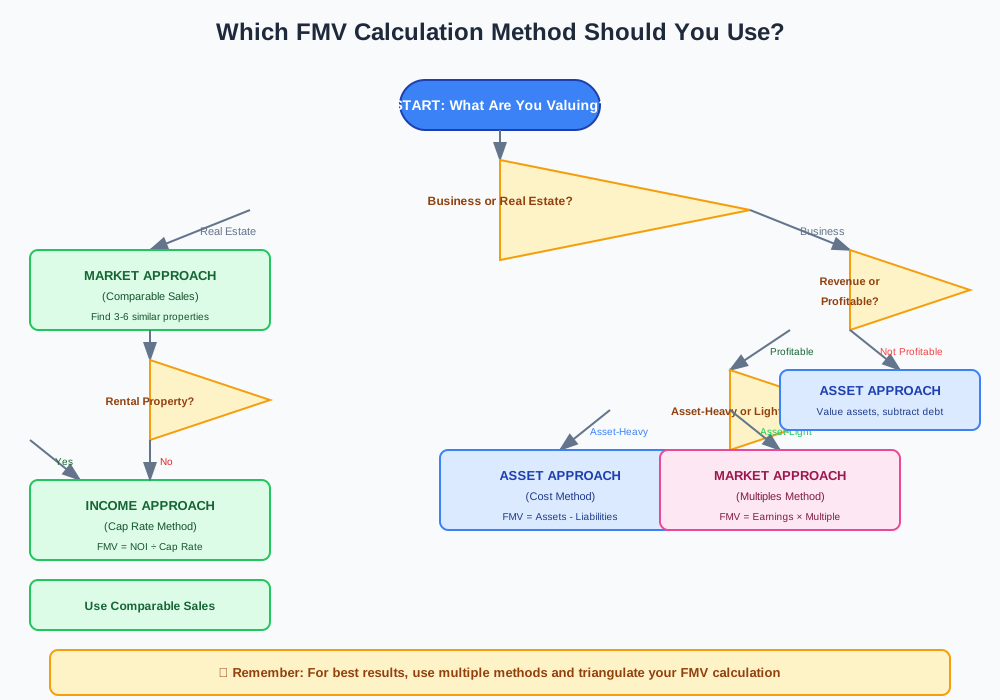
Use this flowchart to decide which FMV calculation method fits your situation
Choosing the Right Method for Your Situation
So which method should YOU use? Here's my practical guide based on years of experience:
Use Asset Approach When:
- ✓ The business is asset-heavy (manufacturing, construction, real estate)
- ✓ The business has minimal or negative earnings
- ✓ You're valuing a holding company or investment firm
- ✓ The business is going through liquidation or bankruptcy
- ✓ You need a floor value (minimum the business is worth)
Use Market Approach When:
- ✓ There are plenty of comparable transactions in your industry
- ✓ You're valuing real estate (most common use case)
- ✓ The business is in a mature, stable industry
- ✓ You need a quick, straightforward valuation
- ✓ You're dealing with a small business ($500K-$5M revenue range)
Use Income Approach When:
- ✓ The business has stable, positive cash flow
- ✓ Future earnings are predictable
- ✓ The business is asset-light (consulting, SaaS, services)
- ✓ You're valuing for acquisition by a strategic buyer
- ✓ Growth is a key value driver
💡 Pro Tip: Use Multiple Methods
Here's what I do: I calculate FMV using at least two different methods, then reconcile the results. If asset approach gives me $3M, market approach gives me $3.2M, and income approach gives me $3.5M, I might conclude FMV is around $3.2M (weighted average). This triangulation gives me more confidence than relying on a single method.
When the different methods give wildly different results (like $2M vs $10M), that's a red flag. It means either I made a mistake, or the business has unique characteristics I need to understand better. I investigate further before finalizing my valuation.
Quick Reference: All FMV Formulas
Asset Approach
FMV = Total Asset FMV - Total Liabilities
Equity FMV = (Asset FMV) - (Debt) + (Cash)
Market Approach
FMV = Earnings × Industry Multiple
FMV = Average of Adjusted Comparable Sales
Enterprise Value = EBITDA × Multiple
Equity Value = Enterprise Value - Debt + Cash
Income Approach
FMV = Earnings ÷ Capitalization Rate
FMV = Σ[FCFt ÷ (1+r)t] + [TV ÷ (1+r)n]
Terminal Value = FCF × (1+g) ÷ (r-g)
Free Calculators to Make FMV Calculations Easier
Look, I get it—doing all these calculations by hand is tedious. That's why I built free calculators to automate the math. Here are the tools I personally use:
🏢 Business Valuation Calculator
Calculate business value using SDE/EBITDA multiples. Perfect for the market approach. Just input your financials and get instant FMV.
Calculate Now →📊 DCF Calculator
Full discounted cash flow analysis. Project future cash flows, calculate terminal value, and determine intrinsic value automatically.
Calculate DCF →📈 Stock Valuation Calculator
Calculate the fair market value of stocks using multiple methods including DCF, P/E, PEG, and more.
Value Stocks →💰 EBITDA Calculator
Calculate EBITDA from different starting points and estimate business value using industry multiples.
Calculate EBITDA →Frequently Asked Questions About Calculating FMV
Q: What's the easiest way to calculate fair market value?
The easiest method is the market approach using multiples. For a small business, take your normalized SDE or EBITDA, multiply by the industry average, and you've got a ballpark FMV. For example, if your SDE is $200K and the industry multiple is 2.5x, FMV ≈ $500K. It's not perfect, but it gives you a reasonable estimate quickly. Use our free Business Valuation Calculator to automate this.
Q: What's the most accurate method for calculating FMV?
The most accurate method is to use multiple approaches and triangulate. I calculate FMV using at least two methods (usually market approach and income approach), then reconcile the results. When both methods give similar values, I'm confident in the estimate. When they differ significantly, I investigate why and adjust my assumptions. The discounted cash flow (income) approach is considered the gold standard for operating businesses because it's based on the fundamental driver of value: future cash flows.
Q: How do I calculate fair market value of a small business with no revenue?
For pre-revenue businesses, traditional earnings-based methods don't work. Use these alternatives: (1) Asset approach: Value what's been invested to date (if you've raised $500K and have tangible IP developed, FMV is at least $500K); (2) Comparable transactions: Look at what similar pre-revenue startups raised at recently; (3) Berkus Method: Assign value to progress milestones (sound idea $0-500K, prototype $0-500K, quality team $0-500K, strategic relationships $0-500K, product rollout/sales $0-500K); (4) Backsolve method: If recent financing occurred, start with the price per share and adjust for differences in rights/preference between investor and common shares. A 409A valuation is required for startups to establish defensible FMV for employee stock options.
Q: Can I calculate FMV myself or do I need a professional appraiser?
You can absolutely calculate FMV yourself for internal planning, preliminary sale prep, or basic understanding. Use our free calculators to get started quickly. However, professional appraisers are REQUIRED for: 409A valuations (IRS requirement), ESOP valuations (ERISA requirement), financial reporting for public companies (GAAP), litigation/expert testimony, and tax audits. They're highly recommended for major transactions (selling a business over $1M), estate/gift tax returns with substantial assets, and divorce proceedings. Professional appraisers cost $5K-$50K but bring independence, credentials, and defensible methodology. For anything with legal/tax implications, invest in a pro.
Q: How often should I recalculate fair market value?
FMV changes over time, so it needs to be recalculated periodically. Recalculate when: (1) For 409A valuations—annually or after material events (new funding, pivot, major financial change); (2) For ESOPs—annually by IRS requirement; (3) For financial reporting—quarterly/annually or when impairment indicators exist; (4) For tax purposes—as of the date of gift or death; (5) For transaction planning—6-12 months before anticipated sale; (6) For internal management—annually or when major business changes occur. Remember that market conditions, business performance, and economic factors all affect FMV. A valuation from 12 months ago may no longer be accurate today.
Q: What's the difference between SDE and EBITDA when calculating FMV?
SDE (Seller's Discretionary Earnings) and EBITDA (Earnings Before Interest, Taxes, Depreciation, and Amortization) are both measures of cash flow, but used differently: SDE is for small businesses (typically under $5M revenue). It adds back owner's total compensation, one-time expenses, and personal expenses run through the business. EBITDA is for larger businesses. It adds back only actual business expenses (depreciation, amortization), not owner compensation above market rate. SDE multiples are lower (1.5-3.5x) than EBITDA multiples (3-8x) because SDE is a larger number. Example: A business with $300K pre-tax income, $200K owner salary, $30K D&A has SDE = $530K and EBITDA = $330K. At 2.5x SDE multiple = $1.3M FMV. At 5x EBITDA multiple = $1.65M FMV. The methods give different numbers because they're used for different business sizes.
Q: How do I calculate fair market value for divorce?
Divorce valuations require special care because they're legally binding and often contentious. The process: (1) Hire a qualified business appraiser (this is worth the cost); (2) Gather all documentation: 3-5 years tax returns, financial statements, P&L, balance sheets; (3) Determine valuation date (usually date of filing or separation); (4) Use multiple approaches (asset, market, income) and reconcile; (5) Consider whether it's a personal goodwill (stays with owner) vs. enterprise goodwill (marital property); (6) Document everything thoroughly; (7) Be prepared for the other spouse to hire their own appraiser—if values differ significantly, the court may decide. I strongly recommend professional valuation for divorce because DIY valuations rarely hold up under scrutiny and can be very expensive to defend later.
Q: How does debt affect fair market value calculation?
Debt is subtracted from the value of assets to determine equity FMV. Using the asset approach: Equity FMV = Total Asset FMV - Total Liabilities (including debt). Using the market approach with EBITDA multiples: Enterprise Value = EBITDA × Multiple, then Equity Value = Enterprise Value - Debt + Cash. Example: Business has $1M EBITDA, 5x multiple = $5M enterprise value. If business has $2M debt and $500K cash: Equity FMV = $5M - $2M + $500K = $3.5M. Key distinction: Enterprise value is the value of operations independent of capital structure. Equity value is what belongs to shareholders after paying off all debts. Most business sales are priced on an equity value basis (what the seller actually receives).
Q: What discount rate should I use in DCF calculations?
The discount rate reflects the risk of the investment—higher risk = higher discount rate = lower valuation. Here's what I use: Stable, blue-chip companies: 7-9%; Mature businesses in established industries: 9-11%; Average risk businesses: 10-12%; Small businesses, higher risk: 12-15%; Startups, early-stage: 25-40%. You can calculate WACC precisely (weighted average cost of capital) or use rules of thumb. The key is consistency: if you're valuing a tech startup, don't use a 10% discount rate just because that's "standard"—you'll dramatically overvalue it. When in doubt, be conservative. Better to underestimate value than overpay. Our free DCF Calculator can help you model different scenarios.
Q: How do I calculate fair market value of real estate?
Real estate FMV typically uses the market approach (comparable sales): (1) Find 3-6 comparable properties that sold recently in the same area; (2) Adjust for differences (size, age, condition, location, amenities); (3) Average the adjusted comp prices = FMV. For income-producing property, you can also use the income approach: FMV = Net Operating Income ÷ Cap Rate. For example, rental property with $44K NOI at 6% cap rate = $733K FMV. Professional appraisals cost $400-$800 for residential, $3K-$15K for commercial. For mortgage purposes, lenders require professional appraisals. For estimating value quickly, check Zillow/Redfin but understand these are automated estimates and can be off by 10-20% in either direction.
Q: What is a 409A valuation and how is FMV calculated for startups?
A 409A valuation is an independent appraisal of a startup's fair market value for setting strike prices for employee stock options (required under IRS Section 409A). The 409A valuation calculates FMV using: (1) Backsolve Method (most common): Start with the price per share paid in recent preferred stock financing, then adjust for lack of marketability and special rights (liquidation preference, participation) to derive common stock FMV; (2) Market Approach: Compare to similar public companies or recent M&A transactions; (3) Income Approach: DCF analysis (less common for early-stage). The report documents methodology, assumptions, data sources, and concludes with a specific FMV per share. Startups need a new 409A annually or after material events (new funding round, pivot, major financial change). Cost: $3K-$15K depending on stage and complexity.
FMV Calculation Process Overview
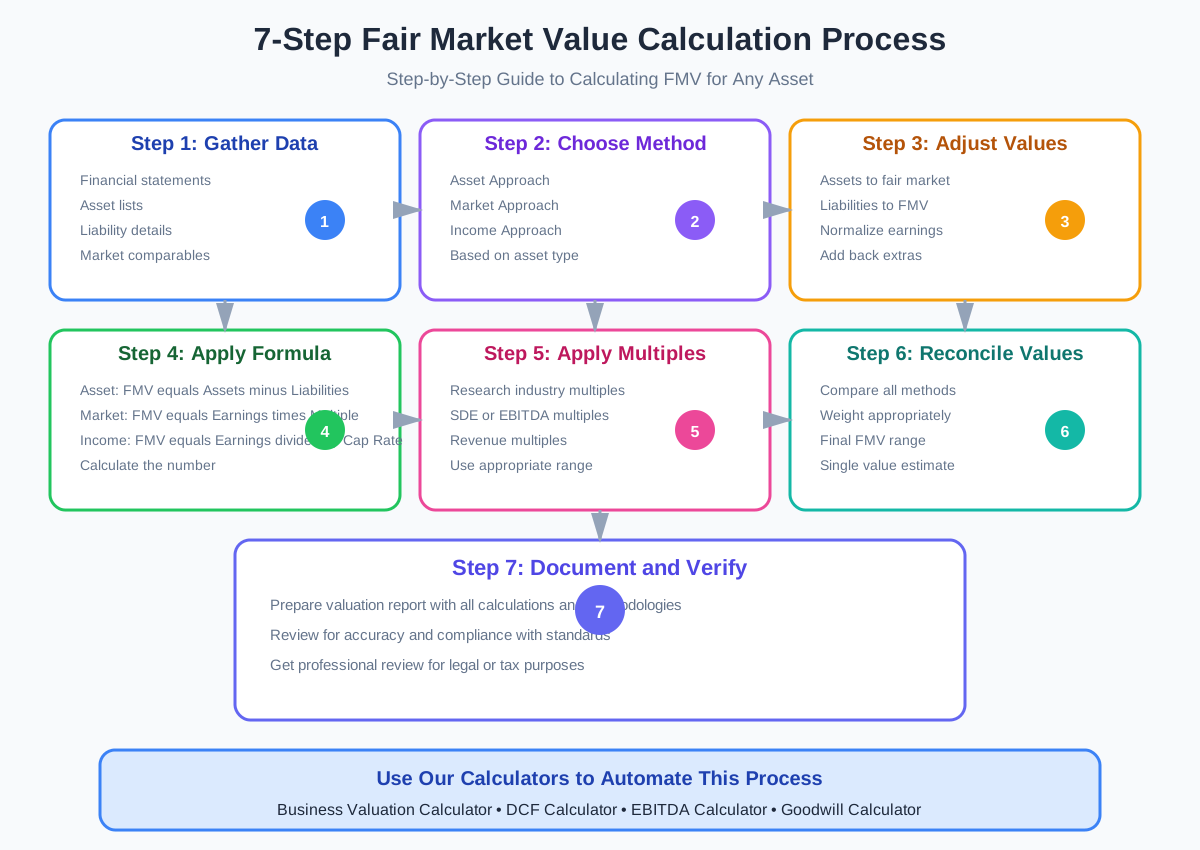
Follow these 7 steps for any FMV calculation: from gathering data to reconciling results
My Final Tips for Accurate FMV Calculations
After calculating hundreds of fair market values over my career, here's what I've learned:
✓ Be Conservative with Assumptions
When in doubt, use lower growth rates, higher discount rates, and more pessimistic multiples. It's better to undervalue slightly and be pleasantly surprised than to overvalue and make bad decisions. Build in a margin of safety.
✓ Use Multiple Methods
Never rely on just one approach. Calculate FMV using at least two different methods, then reconcile. If they give similar results, great. If they differ significantly, investigate why.
✓ Document Everything
Keep records of your data sources, calculations, and assumptions. This makes your FMV defensible if challenged and helps you understand how you arrived at the number.
✓ Run Sensitivity Analysis
Test how changes in assumptions affect your FMV. What if growth is 5% lower? What if the discount rate is 2% higher? If small changes dramatically change your valuation, be cautious.
✓ Know When to Call a Pro
For internal planning, DIY is fine. For legal/tax purposes, hire a professional appraiser. The cost ($5K-$50K) is cheap compared to the cost of getting it wrong (IRS penalties, bad deals, lost lawsuits).
✓ Update Regularly
FMV changes as market conditions, business performance, and economic factors change. Recalculate at least annually, or whenever there's a material change in circumstances.
Calculating fair market value is part art, part science. The formulas are straightforward, but the judgment calls (what growth rate? what multiple? what discount rate?) make all the difference. Use the methods and calculators I've shared here, but always apply your own judgment and understanding of the specific situation.
And remember: FMV is an estimate, not a precise number. Think in ranges, not exact decimals. A business worth between $2M and $2.5M is very different from a business worth exactly $2,345,678. Be honest with yourself about the uncertainty in your valuation.
Ready to Calculate Fair Market Value?
Use our free calculators to determine FMV quickly and accurately. No manual math required.