How to Calculate Fair Value Price: The Complete Guide
Master the three proven methods professional investors use to determine what a stock is really worth—and never overpay for an investment again.
You know that feeling when you're about to buy something and you wonder, "Am I paying too much?" That's exactly what calculating fair value helps you answer when it comes to stocks. Fair value price is the true, intrinsic worth of an asset based on its fundamentals—not what the market happens to be charging for it today.
Here's the thing: the market price can be influenced by hype, fear, speculation, and all sorts of irrational behavior. Fair value, on the other hand, is grounded in cold, hard numbers. It's the difference between gambling and investing.
In this guide, we'll walk you through the three main methods professional analysts use to calculate fair value. By the end, you'll know exactly how to determine whether a stock is overpriced, underpriced, or just right.
The Three Methods at a Glance
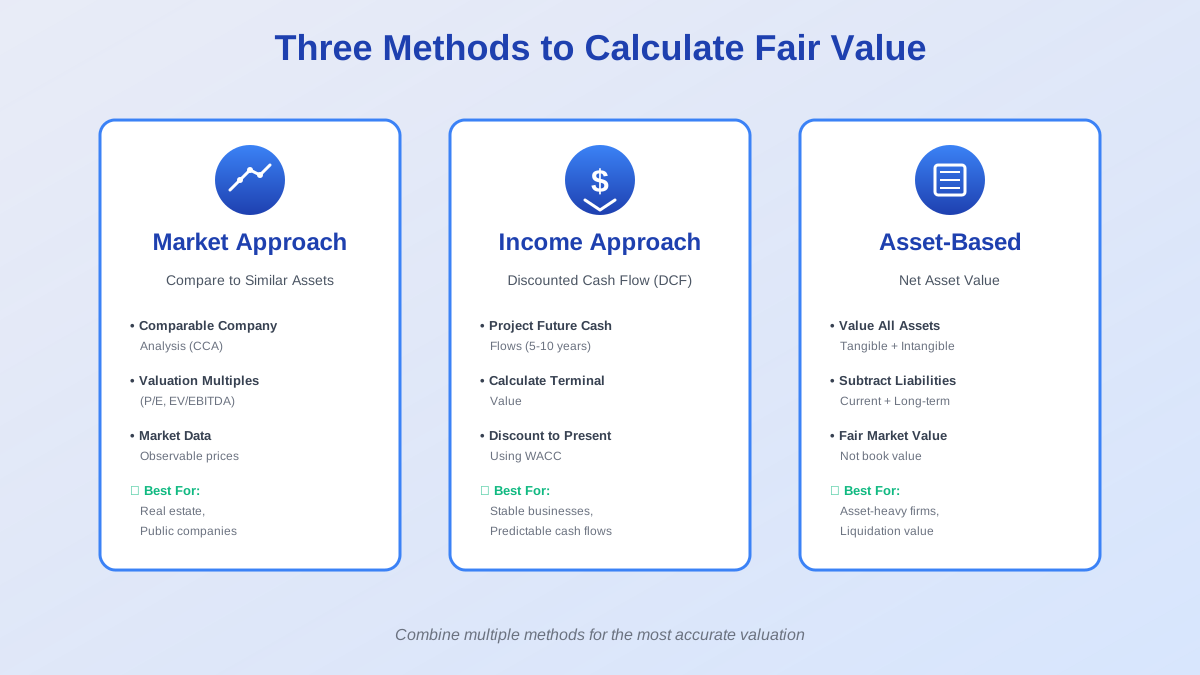
Method 1: Market Approach (Comparable Company Analysis)
The market approach is probably the most intuitive method. It's like checking what similar houses in your neighborhood sold for before pricing your own. You compare the asset you're valuing to similar assets that have recently been sold in active markets.
How It Works
The core idea is simple: similar assets should have similar prices in an efficient market. If Company A and Company B operate in the same industry, have similar growth rates, and face similar risks, they should trade at similar valuations.
Step-by-Step Process
- Identify Comparable Companies: Find 3-5 publicly traded companies that are similar to your target company. They should be in the same industry, have similar business models, and ideally be of similar size.
- Gather Financial Data: Collect key financial metrics like revenue, EBITDA, earnings, and book value for each comparable company.
- Calculate Valuation Multiples: For each comparable, calculate ratios like:
- Price-to-Earnings (P/E) = Market Price ÷ Earnings Per Share
- Enterprise Value-to-EBITDA (EV/EBITDA) = Enterprise Value ÷ EBITDA
- Price-to-Sales (P/S) = Market Cap ÷ Revenue
- Price-to-Book (P/B) = Market Price ÷ Book Value Per Share
- Find the Average Multiple: Calculate the median or average of each multiple across your comparable companies.
- Apply to Your Target: Multiply the average multiple by your target company's corresponding metric to estimate its fair value.
Practical Example
Let's say you want to value a tech company. You find that comparable tech companies trade at an average P/E ratio of 25. Your target company has earnings per share (EPS) of $4.
Fair Value = 25 × $4 = $100 per share
If the stock is currently trading at $70, it might be undervalued. If it's at $130, it might be overvalued.
When to Use the Market Approach
- ✓ When there are plenty of comparable companies with public data
- ✓ For real estate valuation
- ✓ For mature, stable industries
- ✓ When you need a quick, straightforward valuation
Limitations to Watch Out For
- ✗ Finding truly comparable companies can be difficult
- ✗ Market multiples can be distorted during bubbles or crashes
- ✗ Doesn't account for unique competitive advantages
- ✗ Assumes the market is correctly pricing the comparables
Method 2: Income Approach (Discounted Cash Flow)
The Discounted Cash Flow (DCF) method is considered the gold standard of valuation. Warren Buffett uses it. Professional analysts swear by it. Why? Because it's based on a fundamental truth: a company is worth the sum of all the cash it will generate in the future, adjusted for the time value of money.
The Core Concept
Here's the key insight: a dollar today is worth more than a dollar tomorrow because you could invest that dollar today and earn returns. DCF accounts for this by "discounting" future cash flows back to their present value.
The DCF Formula
Where: FCFt = Free Cash Flow in year t, r = Discount rate (WACC), n = Number of projection years
Step-by-Step DCF Calculation
Step 1: Project Future Free Cash Flows
Start with the company's current free cash flow (FCF). This is the cash left over after paying for operations and capital expenditures. You can find it on the cash flow statement or calculate it as:
Then, project how this will grow over the next 5-10 years based on your expected growth rate. For example, if current FCF is $100M and you expect 10% annual growth:
- Year 1: $100M × 1.10 = $110M
- Year 2: $110M × 1.10 = $121M
- Year 3: $121M × 1.10 = $133M
- And so on...
Step 2: Calculate Terminal Value
After your projection period, the company will continue generating cash forever (hopefully!). We capture this with the terminal value, typically calculated using the perpetuity growth model:
Where g is the perpetual growth rate (usually 2-3%, matching long-term GDP growth) and r is your discount rate.
Step 3: Determine the Discount Rate (WACC)
The discount rate represents the return you require to invest in this company, accounting for risk. The Weighted Average Cost of Capital (WACC) is the standard choice. As a rule of thumb:
- • 8-9% for stable, low-risk companies (utilities, consumer staples)
- • 10-12% for average companies
- • 12-15% for high-risk businesses (small-caps, volatile industries)
Step 4: Discount Everything to Present Value
For each year's projected cash flow and the terminal value, calculate the present value:
Where t is the number of years in the future. For example, if Year 3's FCF is $133M and your discount rate is 10%:
Step 5: Sum It All Up
Add all the discounted cash flows plus the discounted terminal value. This gives you the enterprise value. To get the fair value per share:
Note: For a more precise equity value, subtract net debt (total debt minus cash) from enterprise value before dividing by shares.
Real-World Example
Let's value a company with these characteristics:
- • Current FCF: $500M
- • Expected growth rate: 8% for 5 years
- • Terminal growth rate: 2.5%
- • Discount rate (WACC): 10%
- • Shares outstanding: 100M
Projected Cash Flows:
- Year 1: $540M → PV: $491M
- Year 2: $583M → PV: $482M
- Year 3: $630M → PV: $473M
- Year 4: $680M → PV: $465M
- Year 5: $735M → PV: $456M
Terminal Value: $10,031M → PV: $6,227M
Total Enterprise Value: $8,594M
Fair Value Per Share: $8,594M ÷ 100M = $85.94
When to Use DCF
- ✓ For companies with stable, predictable cash flows
- ✓ When you want the most comprehensive valuation
- ✓ For mature businesses with established track records
- ✓ When you have confidence in your growth assumptions
Common DCF Mistakes
- ❌ Being too optimistic with growth rates: Very few companies can sustain double-digit growth for a decade. Be conservative.
- ❌ Using unrealistic terminal growth rates: Anything above 3-4% is probably too aggressive. No company grows faster than the economy forever.
- ❌ Treating the result as gospel: DCF is highly sensitive to assumptions. Always run sensitivity analysis with different growth rates and discount rates.
Method 3: Asset-Based Approach (Net Asset Value)
The asset-based approach is the most straightforward method: you simply add up what the company owns, subtract what it owes, and that's your fair value. It's like valuing a house based on the land, building, and fixtures, minus any mortgage.
How It Works
This method values a company based on its balance sheet—but with a crucial twist. Instead of using book values (what the accountants say things are worth), you use fair market values (what you could actually sell them for today).
The Basic Formula
Or, per share: Fair Value Per Share = Net Asset Value ÷ Shares Outstanding
Step-by-Step Process
Step 1: Identify and Value All Assets
Make a comprehensive list of everything the company owns:
Tangible Assets:
- • Cash and cash equivalents (easy—use face value)
- • Inventory (use current market value, not historical cost)
- • Property, plant, and equipment (may need professional appraisal)
- • Real estate (use current market comparables)
Intangible Assets:
- • Patents and trademarks (use relief-from-royalty method)
- • Customer relationships (use excess earnings method)
- • Brand value (can be complex to value)
- • Goodwill (often written down to zero in asset-based valuation)
Step 2: Identify and Value All Liabilities
List everything the company owes:
- • Current liabilities (accounts payable, short-term debt)
- • Long-term debt (bonds, loans—use current market value if traded)
- • Pension obligations
- • Deferred tax liabilities
- • Off-balance-sheet items (operating leases, pending lawsuits)
Step 3: Calculate Net Asset Value
Subtract total liabilities from total assets to get the net asset value (NAV). Then divide by shares outstanding to get the per-share value.
Practical Example
Let's value a manufacturing company:
Assets (Fair Market Value):
- Cash: $50M
- Inventory: $100M
- Equipment: $200M (appraised value)
- Real estate: $300M (current market value)
- Patents: $50M (valued using royalty method)
- Total Assets: $700M
Liabilities:
- Accounts payable: $30M
- Short-term debt: $20M
- Long-term debt: $150M
- Pension obligations: $50M
- Total Liabilities: $250M
Net Asset Value: $700M - $250M = $450M
Shares Outstanding: 50M
Fair Value Per Share: $450M ÷ 50M = $9.00
When to Use Asset-Based Valuation
- ✓ For asset-heavy businesses (real estate, manufacturing, utilities)
- ✓ When valuing a company for liquidation
- ✓ For holding companies or investment firms
- ✓ When cash flows are unpredictable or negative
- ✓ For financial institutions (banks, insurance companies)
Limitations
- ✗ Doesn't capture future earnings potential
- ✗ Intangible assets can be very difficult to value accurately
- ✗ Not suitable for service businesses or tech companies with few physical assets
- ✗ Book values on balance sheets often differ significantly from market values
- ✗ Ignores the value of the business as a going concern
Pro Tip: The asset-based approach often gives you a "floor value"—the minimum the company should be worth if you liquidated everything. If a company is trading below its net asset value, it might be significantly undervalued (or there might be hidden problems with the assets).
Comparing the Three Methods
| Method | Best For | Key Advantage | Main Drawback | Complexity |
|---|---|---|---|---|
| Market Approach | Public companies, real estate | Simple, uses real market data | Hard to find true comparables | Low |
| Income (DCF) | Stable, cash-generating businesses | Most comprehensive, intrinsic value | Highly sensitive to assumptions | High |
| Asset-Based | Asset-heavy firms, liquidation | Provides a floor value | Ignores future earnings potential | Medium |
Best Practice: Don't rely on just one method. Professional analysts typically use multiple approaches and then triangulate to find a reasonable fair value range. If all three methods point to a similar value, you can have more confidence in your estimate.
Practical Tips for Calculating Fair Value
✓ Always Be Conservative
When in doubt, use lower growth rates, higher discount rates, and more pessimistic assumptions. It's better to be pleasantly surprised than disappointed. This builds in a margin of safety.
✓ Run Sensitivity Analysis
Don't just calculate one fair value. Try different scenarios: best case, base case, worst case. See how the fair value changes if growth is 2% higher or lower, or if the discount rate changes by 1%. This gives you a range rather than a single number.
✓ Use Multiple Methods
Calculate fair value using at least two different methods. If DCF says $100 and the market approach says $95, you're probably in the right ballpark. If one says $100 and another says $50, dig deeper to understand why.
✓ Understand the Business First
No valuation method works if you don't understand the business. Before you start crunching numbers, make sure you understand the company's business model, competitive advantages, industry dynamics, and risks. Garbage in, garbage out.
✓ Require a Margin of Safety
Even if your fair value calculation is perfect (it won't be), don't buy at fair value. Require a 20-30% discount to fair value before investing. This protects you from errors in your assumptions and unexpected events.
✓ Update Regularly
Fair value isn't static. Recalculate whenever there's a significant change in fundamentals (new earnings report, major business development, industry shift) or at least quarterly. Companies evolve, and so should your valuation.
Common Mistakes to Avoid
❌ Confusing Price with Value
Just because a stock is expensive (high price) doesn't mean it's overvalued, and just because it's cheap doesn't mean it's undervalued. Always compare price to your calculated fair value, not to the stock's historical prices.
❌ Using the Wrong Method for the Business
Don't use DCF for a startup with no cash flow. Don't use asset-based valuation for a software company. Match the method to the business type. When in doubt, use multiple methods.
❌ Anchoring to Current Market Price
Don't let the current market price influence your fair value calculation. Calculate fair value independently, then compare. If you start with the market price in mind, you'll unconsciously adjust your assumptions to match it.
❌ Ignoring Qualitative Factors
Numbers don't tell the whole story. Management quality, competitive moats, industry trends, regulatory risks—these qualitative factors matter enormously. Use them to adjust your assumptions or apply a larger margin of safety.
❌ Forgetting About Debt and Cash
When using DCF or market approach, remember that enterprise value ≠ equity value. To get the true value for shareholders, you need to subtract net debt (total debt minus cash) from enterprise value before dividing by shares.
❌ Treating Fair Value as Precise
Fair value is an estimate, not a precise number. Don't fool yourself into thinking that $87.43 is meaningfully different from $87.50. Think in ranges: "This stock is probably worth between $80 and $95" is more honest than "It's worth exactly $87.43."
Frequently Asked Questions
Q: Which method is the most accurate?
There's no single "most accurate" method—it depends on the type of business you're valuing. DCF is considered the most comprehensive for stable, cash-generating businesses. The market approach is great when you have good comparables. Asset-based works best for asset-heavy companies. The best approach is to use multiple methods and triangulate.
Q: How do I know if my assumptions are reasonable?
Compare your assumptions to historical data, analyst estimates, and industry averages. If you're assuming 20% growth for a mature company in a slow-growing industry, you're probably being too optimistic. When in doubt, be conservative. It's also helpful to see what assumptions would be required to justify the current market price—if they seem unrealistic, the stock might be overvalued.
Q: Can I use these methods for cryptocurrency or commodities?
Not really. These methods are designed for cash-generating assets (businesses, real estate, bonds). Cryptocurrencies and commodities like gold don't generate cash flows, so DCF doesn't work. For these, you'd need different valuation approaches based on supply/demand dynamics, utility value, or relative pricing.
Q: What if the fair value I calculate is very different from the market price?
First, double-check your assumptions—are they realistic? Second, try to understand why the market might be pricing it differently. Maybe the market knows something you don't, or maybe the market is being irrational. Large discrepancies can represent opportunities, but they can also signal that you've made an error. Always require a margin of safety before acting.
Q: How often should I recalculate fair value?
Recalculate whenever there's a material change in the company's fundamentals (quarterly earnings reports, major business developments, industry changes) or at least quarterly for stocks you own. Fair value isn't static—as the company evolves and new information emerges, your valuation should evolve too.
Q: Do professional investors really use these methods?
Absolutely. DCF is the foundation of how investment banks value companies for M&A deals. Value investors like Warren Buffett use DCF-based thinking (though they might not write out the formal calculation every time). Hedge funds and mutual funds employ teams of analysts who spend their days building valuation models using these exact methods.
Q: Where can I find the data I need for these calculations?
For public companies, check their annual reports (10-K filings), quarterly reports (10-Q), and investor relations websites. Financial websites like Yahoo Finance, Google Finance, Seeking Alpha, and Morningstar provide free data. For more detailed information, services like Bloomberg, FactSet, or S&P Capital IQ are used by professionals (but they're expensive).
Ready to Calculate Fair Value Like a Pro?
Use our free DCF calculator to determine the fair value of any stock in minutes.
Try Our Fair Value Calculator