Pre Money and Post Money Valuation Calculator
I've compiled everything I've learned about startup valuation into one comprehensive guide. Whether you're raising your first round or your fifth, understanding pre-money vs post-money valuation is critical for protecting your ownership and negotiating fair deals.
Why Understanding Pre-Money vs Post-Money Matters
When I first started fundraising, I made a mistake that cost me dearly. An investor offered me $500K for 20% of my company, and I focused entirely on the $500K. I didn't understand that by accepting those terms, I was agreeing that my company was worth only $2M pre-money—and giving away way more equity than I needed to.
Here's what I wish someone had told me then: Pre-money and post-money valuations aren't just technical terms—they're the foundation of every funding negotiation. Get them wrong, and you'll give away too much equity, set unrealistic expectations, or face painful down rounds later.
After years of fundraising, advising founders, and studying countless term sheets, I've created this comprehensive guide to help you understand valuation better than most investors do. Let's dive in.
⚠️ The $50K Mistake I Made
By not understanding pre-money valuation, I agreed to a $2M pre-money when I could have negotiated $2.5M. That difference of $500K in pre-money meant I gave away an extra 5% equity. When we exited for $50M three years later, that extra 5% cost me $2.5M. Don't make my mistake—learn valuation before you negotiate.
What is Pre-Money Valuation?
Pre-money valuation is what your startup is worth before new investment comes in. It's the value investors assign to everything you've built so far: your product, traction, team, intellectual property, and market opportunity.
Think of it this way: If you sold your company right now, without any new investment, what would someone pay for it? That's your pre-money valuation.
Pre-Money Valuation Formula
Pre-Money = Post-Money - Investment
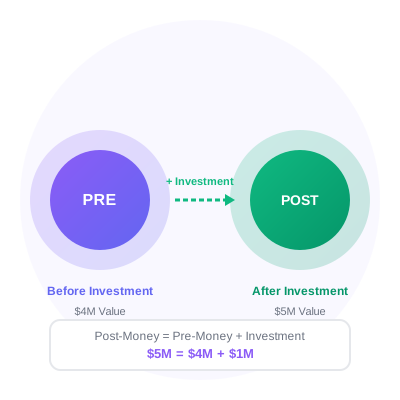
If an investor offers you $1M for 20% equity, they're saying your post-money valuation is $5M ($1M ÷ 0.20). Your pre-money valuation is therefore $5M - $1M = $4M.
What Determines Pre-Money Valuation?
📊 Traction & Revenue
Actual revenue, user growth, engagement metrics, and growth rate. $10K MRR growing 20% month-over-month beats a great idea with $0 revenue.
👥 Team
Technical co-founders, experienced operators, previous exits, and domain expertise. Investors bet on people first.
🚀 Market Opportunity
Total addressable market (TAM), growth rate, and why now. A $1B market opportunity commands higher valuation than a $10M niche.
💡 Product & IP
Proprietary technology, patents, defensible moat, product-market fit, and competitive advantages.
💡 Pro Tip: Pre-Money is What You're Negotiating
When investors say "we're looking at a $4-6M pre-money," that's your negotiation window. The investment amount is usually fixed, but your pre-money valuation determines how much equity you give up. Focus on increasing the pre-money number, not just the investment size.
What is Post-Money Valuation?
Post-money valuation is what your startup is worth after adding the new investment. It's your pre-money valuation PLUS the investment cash. This represents what investors think your company will be worth with their capital and involvement.
Post-money valuation is how you calculate investor equity percentage. If an investor puts in $1M and your post-money is $5M, they own 20% ($1M ÷ $5M).
Post-Money Valuation Formula
Post-Money = Investment ÷ Investor Equity %
If an investor wants 20% equity for $1M, your post-money valuation is $1M ÷ 0.20 = $5M. This $5M represents the total value of your company after their investment.

⚠️ Critical: Post-Money Sets Future Expectations
Your post-money valuation today sets the benchmark for your next round. If you raise at a $10M post-money seed, investors will expect you to grow into that valuation quickly. If you can't justify a $15-20M Series A, you might face a painful down round. Be careful not to overprice your round.
The Relationship: How Pre-Money and Post-Money Work Together
The relationship between pre-money and post-money is simple but powerful. Understanding this relationship is the key to negotiating better deals and avoiding costly mistakes.
Here's the golden rule: Investment = Post-Money × Investor Equity %
Real-World Example: $1M for 20%
Investment
$1M
Cash invested
Pre-Money
$4M
Value before investment
Post-Money
$5M
Value after investment
How It Works
Step 1: Investor wants 20% equity → Post-money = $1M ÷ 0.20 = $5M
Step 2: Pre-money = Post-money - Investment = $5M - $1M = $4M
Step 3: Founder keeps 80% = 80% of $5M = $4M worth of shares
Step 4: Investor owns 20% = 20% of $5M = $1M worth of shares

✓ Key Insight: Founder Value Stays the Same
Notice that in this example, the founder's stake is worth $4M both before and after the investment. The new money doesn't increase the value of existing shares—it just adds new shares. The founder still owns $4M worth, but now it's 80% of a $5M company instead of 100% of a $4M company. This is dilution in action.
How to Calculate Pre-Money and Post-Money Valuation
I've made this dead simple with my free calculators, but it's important to understand the math. Here's exactly how to calculate both valuations.
Method 1: Starting with Investment and Equity %
This is the most common scenario. An investor offers you a specific amount for a specific equity percentage.
Example: $2M investment for 25% equity
Step 1: Calculate Post-Money = $2M ÷ 0.25 = $8M
Step 2: Calculate Pre-Money = $8M - $2M = $6M
Result: Your company is worth $6M before investment, $8M after. You keep 75% ($6M worth), investor gets 25% ($2M worth).
Method 2: Starting with Pre-Money and Investment Amount
Sometimes you and the investor agree on a pre-money valuation first, then determine how much they'll invest.
Example: $5M pre-money, $1M investment
Step 1: Calculate Post-Money = $5M + $1M = $6M
Step 2: Calculate Investor Equity % = $1M ÷ $6M = 16.67%
Result: Investor gets 16.67% for their $1M. You keep 83.33% ($5M worth).
Method 3: Calculating Price Per Share
If you know your share count, you can calculate the price per share, which is how valuation actually gets implemented.
Example: 1M shares outstanding, $2M for 20%
Step 1: Post-Money = $2M ÷ 0.20 = $10M
Step 2: Pre-Money = $10M - $2M = $8M
Step 3: Post-money shares = 1M ÷ 0.80 = 1.25M shares
Step 4: New shares issued = 1.25M - 1M = 250,000 shares
Step 5: Price per share = $2M ÷ 250,000 = $8/share
Verification: Pre-money = 1M × $8 = $8M ✓ Post-money = 1.25M × $8 = $10M ✓
🛠️ Use My Free Calculators
Don't do this math manually—use my free calculators instead:
Understanding Equity Dilution
Dilution is what happens every time you raise money—your ownership percentage decreases. But here's the thing most founders miss: dilution isn't necessarily bad if the company's value is increasing.
I've seen founders obsess over keeping 100% ownership, only to watch their startup run out of cash and die. I've also seen founders give away 60% in their seed round and regret it forever. The key is understanding smart dilution vs. dumb dilution.
Example: Dilution Across Funding Rounds
| Round | Investment | Pre-Money | Post-Money | Your Equity | Your Stake Value |
|---|---|---|---|---|---|
| Starting | — | — | — | 100% | $0 |
| Seed | $1M | $4M | $5M | 80% | $4M |
| Series A | $5M | $20M | $25M | 64% | $16M |
| Series B | $15M | $60M | $75M | 51% | $38M |
| Series C | $30M | $120M | $150M | 41% | $61M |
The Key Insight
Notice that even though your ownership dropped from 100% to 41%, the value of your stake increased from $0 to $61M. You own a smaller slice of a massively bigger pie. That's smart dilution—you gave up equity to grow the company's value.
⚠️ The Danger: Down Rounds
A "down round" happens when your pre-money valuation is lower than your previous post-money valuation. Example: You raised at $10M post-money last year. Now investors value you at $8M pre-money. That's a down round. It crushes morale, triggers anti-dilution protections for early investors, and makes future fundraising harder. Avoid down rounds at all costs—they're incredibly painful.
✓ Smart Dilution
You give up 20% equity to raise $1M at a reasonable valuation. You use that money to grow revenue from $10K MRR to $100K MRR. Your next round is at 3x the previous valuation. You diluted, but created massive value.
✗ Dumb Dilution
You give up 40% equity in a $500K pre-seed round at a low valuation. Six months later you need more money, but your previous round sets a low ceiling. You're forced into a down round or give up even more equity.
Average Pre-Money Valuations by Stage (2026)
So what should YOUR pre-money valuation be? After analyzing thousands of funding rounds and tracking 2026 market trends, here are the typical ranges I'm seeing:
Pre-Seed
Idea stage, team in place, maybe MVP
$500K - $2M
Pre-Money
Typical investment: $100K - $500K for 10-25% equity
Post-money: $600K - $2.5M
Seed
Product launched, early traction, revenue <$500K
$2M - $8M
Pre-Money
Typical investment: $500K - $2M for 15-25% equity
Post-money: $2.5M - $10M
Series A
Proven product, $1M-$5M ARR, growth engine working
$10M - $30M
Pre-Money
Typical investment: $3M - $15M for 15-25% equity
Post-money: $13M - $45M
Series B
$5M-$20M ARR, scaling, hiring aggressively
$30M - $80M
Pre-Money
Typical investment: $10M - $30M for 15-25% equity
Post-money: $40M - $110M
Series C+
$20M+ ARR, market leader, IPO prep
$100M - $500M+
Pre-Money
Typical investment: $20M - $100M+ for 10-20% equity
Post-money: $120M - $600M+
Important Note: These are averages. Top startups (Y Combinator companies, AI startups with ex-Google founders, biotech with Nobel laureates) can raise at 2-5x these numbers. Struggling startups might raise at 50% of these ranges. Location matters—Silicon Valley and NYC command 2-3x higher valuations than other areas. Industry matters—AI/ML and climate tech get premium valuations in 2026.
Market Conditions: In 2026, venture capital is tighter than 2021-2022 but still active. Investors are more selective, due diligence takes longer, and valuations are more conservative than the peak bubble years. Plan your fundraising strategy accordingly.
How to Increase Your Pre-Money Valuation
Want a higher valuation? Of course you do. Here's what actually moves the needle with investors in 2026, based on my experience raising money and advising dozens of startups.
1. Show Revenue Growth (The #1 Driver)
Nothing beats actual revenue. $10K MRR growing 20% month-over-month will get you a better valuation than a great idea with $0 revenue. Investors pay for traction, not potential. If you have revenue, show it. If you don't, show user growth, engagement metrics, waitlists, or pre-sales—anything that demonstrates demand.
2. Reduce Chorn & Show Unit Economics
If you have subscribers, demonstrate low churn (less than 5% monthly for B2C, less than 2% for B2B). Low churn proves customers love your product. Also show that CAC < LTV—you can profitably acquire customers. Prove you have a scalable business model, not just a cool product.
3. Build a Stellar Team
Investors bet on people, not ideas. Having a technical co-founder, experienced advisors, or team with previous exits can double your valuation. I've seen a solo founder with $50K revenue raise at $3M pre-money, while a team of ex-Google engineers with the same revenue raised at $8M pre-money. Team quality matters enormously.
4. Create Competitive Tension (FOMO)
If multiple investors want in, your valuation goes up. Always try to generate FOMO (fear of missing out). Even having one warm intro from a respected investor can increase leverage. Schedule multiple investor meetings in parallel. Create deadlines. Make investors feel like if they don't move now, they'll miss out. This is the single most effective negotiation tactic I know.
5. Time Your Raise Perfectly
Raise when you have 6+ months of runway left. Desperation = lower valuation. Also, raise after hitting a milestone (product launch, key hire, revenue milestone, major partnership)—not before. Investors pay for momentum, so always raise when things are going well, not when you're running out of cash.
6. Understand Your Multiples
For SaaS, know your ARR multiple (valuation ÷ annual recurring revenue). In 2026, healthy SaaS companies raise at 5-15x ARR. For consumer apps, know your user multiple (valuation ÷ active users). Being able to say "we're raising at 8x ARR, which is below market" shows you've done your homework and can justify your valuation.
🚀 The "Hot Sector" Premium in 2026
Right now, AI/ML startups, climate tech, biotech, and defense tech are getting 2-3x higher valuations than other sectors at the same stage. If you can position your startup in a hot category (without being misleading), you'll command a premium. But be careful—if you're not truly in a hot sector, don't fake it. Investors will see through it and you'll lose credibility.
⚠️ What Doesn't Move the Needle
Here's what doesn't impress investors: fancy pitch decks, press releases, social media followers, product features without users, "we'll be big someday" promises, or how much money you've spent building the product. Investors care about traction, team, market size, and unit economics. Focus on those four things.
Valuation Negotiation Strategies That Work
After negotiating dozens of funding rounds on both sides of the table, here are the strategies that actually work to increase your valuation.
Strategy 1: Anchor High, But Be Realistic
The first number mentioned in a negotiation becomes the "anchor." If you say you're worth $8M pre-money, and they were thinking $4M, now $4M seems low. But don't anchor so high that you seem delusional. Research comparable startups and anchor at the top of the reasonable range.
Example: "Based on our $20K MRR, 200% MoM growth, and technical team, we're looking for a $6M pre-money valuation. Similar companies in our space are raising at $4-8M pre-money."
Strategy 2: Trade Valuation for Other Terms
Sometimes investors won't budge on valuation, but you can trade other terms. Common trade-offs: smaller option pool, no liquidation preference, simpler participation rights, board observer instead of board seat. Every concession has value.
Example: "I can accept a $4M pre-money if you're willing to keep the option pool at 10% instead of 20% and waive the liquidation preference."
Strategy 3: Use Competitive Offers
Nothing increases your leverage like having multiple term sheets. Even if you don't have competing offers, create the perception of demand. Schedule investor meetings close together. Mention you're in conversations with other firms.
Example: "We've had strong interest from two other firms and expect term sheets by Friday. We'd love to work with you—what's your timeline?"
Strategy 4: Focus on Pre-Money, Not Just Investment
Many founders get excited about a big investment number and forget to check the pre-money. A $2M investment for 33% ($4M pre-money) is worse than a $1.5M investment for 20% ($6M pre-money). Always calculate the pre-money implied by their offer.
Example: "Thanks for the $2M offer. If that's for 33%, that implies a $4M pre-money. We were targeting $6M pre-money based on our metrics. Can we do $2M for 25% instead?"
Strategy 5: Use Our Calculators to Run Scenarios
Before every meeting, run multiple scenarios using my calculators. Know exactly what each offer means for your ownership, dilution, and stake value. Being able to instantly calculate and compare offers makes you look sophisticated and prepared.
The Hidden Diluter: Understanding Option Pools
Here's something that trips up even experienced founders: option pools. Most investors require you to create an employee option pool (typically 10-20% of post-money) before they invest. The catch? This pool comes out of YOUR equity, not theirs.
Let me show you how this works with a real example.
Example: The Option Pool Trap
✓ Without Option Pool
Investment: $1M for 20% equity
Post-Money: $1M ÷ 0.20 = $5M
Pre-Money: $5M - $1M = $4M
Your Stake: 80% = $4M worth
✗ With 20% Option Pool (Coming From You)
Investment: $1M for 20% equity
Option Pool: 20% of post-money = 1M shares
Your Shares: Post-money - Investor - Pool = 100% - 20% - 20% = 60%
Your Stake: 60% of $5M = $3M worth
Effective Pre-Money: $5M × 60% = $3M (not $4M!)
The option pool just cost you $1M in valuation and 20% of your equity. This is why negotiating whether the option pool is included in pre-money or created post-investment is critical.
⚠️ Negotiation Tip: Who Pays for the Option Pool?
Always negotiate whether the option pool is included in the pre-money valuation or created post-investment. Included in pre-money = you pay for it (your effective valuation drops). Created post-investment = investor shares the dilution. This is a massive difference that can cost you millions. Always ask for the pool to be created post-investment.
Convertible Notes and SAFEs: Valuation Without Setting Valuation
Not all funding rounds set an immediate valuation. Convertible notes and SAFEs (Simple Agreement for Future Equity) delay valuation to a future priced round. Here's how they work and what they mean for your pre-money and post-money.
Valuation Cap
The valuation cap is the maximum pre-money valuation at which your convertible will convert in the future. It protects early investors by guaranteeing they get equity at or below the cap, even if your next round is at a much higher valuation.
Example:
You raise $500K on a $5M cap. A year later you raise a priced round at $10M pre-money. The SAFE converts as if the valuation was $5M (the cap), giving investors double the equity they'd get at $10M.
Discount
The discount gives convertible investors a percentage discount on the next round's price. It rewards early investors for taking more risk. Typical discounts are 10-20%.
Example:
You raise on a 20% discount. Your next round is $10M pre-money at $10/share. Convertibles convert at $8/share (20% discount), giving them more shares for the same money.
How Convertibles Affect Future Valuation
Scenario: You Raise $500K on a $5M Cap, Then Raise $2M at $8M Pre-Money
Step 1: Convertible raises $500K at $5M cap → gets 9.09% of company ($500K ÷ $5.5M post-money)
Step 2: New round: $2M investment at $8M pre-money
Step 3: Post-money for new round = $8M + $2M = $10M
Step 4: But convertible converts at $5M cap, not $8M!
Step 5: Convertible post-money = $5M + $2M = $7M
Result: Convertible owns $500K ÷ $7M = 7.14% (better than 5% at $8M)
The key insight: Convertibles with caps can create significant additional dilution when you raise your next round, especially if you've grown a lot. Factor this into your cap table planning.
💡 Pro Tip: Cap vs Discount
Most convertibles have both a cap AND a discount—the investor gets whichever is better. If you're raising convertibles, negotiate the highest cap you can. If you're investing, negotiate the lowest cap. The cap is usually more important than the discount in high-growth scenarios.
Common Valuation Mistakes to Avoid
I've seen founders make these mistakes over and over. Learn from their pain so you don't repeat it.
❌ Focusing Only on Investment Amount
Getting excited about a $2M investment without checking what pre-money that implies. If it's 40% equity, you just valued your company at $3M pre-money—way too low for a $2M check. Always calculate the pre-money implied by any offer.
❌ Raising at Too High a Valuation
Sounds weird, but raising at too high a valuation can hurt you. If you raise at a $20M pre-money seed but don't grow fast enough to justify a $40M+ Series A, you'll face a down round. This is incredibly painful and can destroy your company. Sometimes a reasonable valuation from a top investor is better than an inflated valuation from a mediocre one.
❌ Forgetting About the Option Pool
Thinking you're selling 20% equity, but the investor also wants a 20% option pool that comes from your side. Suddenly you're only keeping 60%, not 80%. Always clarify whether the option pool is included in pre-money or created post-investment.
❌ Not Researching Comparable Startups
Walking into fundraising without knowing what similar startups raised at. If you don't know the market, you'll either look delusional (asking for too much) or naive (accepting too little). Research comparable companies and use those numbers to anchor your valuation.
❌ Raising When Desperate
Waiting until you have 2 months of runway to start fundraising. Investors can smell desperation, and they'll take advantage. Always raise when you have 6+ months of runway. Desperation = terrible terms.
❌ Ignoring Investor Value Beyond Money
Choosing the highest valuation investor over the one who can actually help you win. Sometimes accepting a slightly lower valuation from Sequoia or a16z is worth 100x more than a higher valuation from an unknown investor with no network or expertise. Consider the complete package, not just the number.
Frequently Asked Questions
What is the difference between pre-money and post-money valuation?
Pre-money valuation is what your company is worth BEFORE new investment. Post-money valuation is what it's worth AFTER adding the investment. The formula is: Post-Money = Pre-Money + Investment. For example, if you raise $1M at a $4M pre-money valuation, your post-money valuation is $5M. Investors calculate post-money by dividing investment by equity percentage: $1M ÷ 20% = $5M post-money. Understanding both numbers is critical for fundraising.
How do I calculate pre-money valuation from a term sheet?
Look at two numbers on your term sheet: (1) Investment amount and (2) Investor equity percentage. First, calculate post-money: Post-Money = Investment ÷ Equity%. Then subtract the investment to get pre-money: Pre-Money = Post-Money - Investment. Example: Investor offers $2M for 20%. Post-money = $2M ÷ 0.20 = $10M. Pre-money = $10M - $2M = $8M. That's what investors think your company is worth before their money. Use my Pre-Money Valuation Calculator to check any offer instantly.
What is a good pre-money valuation for my startup?
There's no single 'good' number—it depends on your stage, industry, location, and traction. For 2026, here are typical ranges: Pre-seed ($500K-$2M pre-money), Seed ($2M-$8M), Series A ($10M-$30M), Series B ($30M-$80M), Series C+ ($100M-$500M+). Top startups in hot sectors (AI, fintech, biotech) can raise at 2-5x these numbers. Struggling startups might raise at 50% of these ranges. Use our calculators to see what your terms imply, then research comparable startups in your industry and location.
Is a higher pre-money valuation always better?
Not necessarily. A high pre-money valuation can set unrealistic expectations for future rounds. If you raise at a $20M pre-money seed but don't grow enough to justify a $40M+ Series A, you might face a painful down round. Also, higher valuations mean more dilution for you and your employees. Sometimes it's better to accept a slightly lower valuation from a top-tier investor who can help you succeed (network, expertise, follow-on investments) than a higher valuation from a mediocre investor. Consider the complete package, not just the number.
How much equity should I give up in my seed round?
The typical range is 15-25% for a seed round. Giving away less than 10% might not be enough to justify the investor's time and support. Giving away more than 30% leaves you with too little equity to motivate founders and employees for future rounds. I recommend aiming for 20% if you can—it's a balanced middle ground that aligns incentives. Remember: you'll dilute further in Series A, B, C, so preserving equity early is valuable. But don't be so greedy that you can't raise the money you need to succeed.
What is an option pool and how does it affect my valuation?
An option pool is equity set aside for future employees (typically 10-20% of post-money). Investors often require you to create this pool BEFORE they invest, and it comes out of YOUR equity, not theirs. Here's why it matters: If your pre-money is $4M and investors want a 20% option pool, your effective pre-money drops to $3.2M after setting aside the pool. Always negotiate whether the option pool is included in the pre-money valuation (you pay for it) or created post-investment (investor shares the dilution). This difference can cost you millions.
How does convertible debt (SAFE) affect pre-money valuation?
Convertibles like Y Combinator's SAFE don't set an immediate pre-money valuation—they delay it to a future priced round. Instead, they have a 'valuation cap' which acts as a maximum pre-money for conversion. Example: You raise $500K on a $5M cap. Later you raise a priced round at $8M pre-money. The SAFE converts as if the valuation was $5M (the cap), giving investors more equity than they'd get at $8M. If the next round is $4M pre-money, the SAFE converts at $4M (whichever is lower: cap or actual). Always factor in outstanding convertibles when planning your cap table.
What is a down round and how do I avoid it?
A down round is when you raise at a LOWER valuation than your previous round. Example: You raised at $10M post-money last year, and now investors only value you at $8M pre-money. Down rounds are incredibly painful—they demoralize employees, trigger anti-dilution clauses for early investors, and make future fundraising harder. To avoid down rounds: (1) Don't overprice your previous rounds, (2) Raise with 6+ months runway, (3) Hit or exceed growth milestones, (4) Raise from investors who can support you through tough times. If you must do a down round, get existing investors to support you and frame it as a 'recapitalization' rather than failure.
How do I negotiate a higher pre-money valuation?
Here are proven strategies: (1) Generate competitive interest—multiple investors = better terms. Create FOMO by scheduling meetings close together. (2) Show traction: revenue growth, user growth, partnerships, waitlists, engagement metrics. (3) Demonstrate team strength (previous exits, technical expertise, domain experts). (4) Time your raise when you have leverage (after hitting a milestone, with 6+ months runway). (5) Research comparable startups and anchor at the top of the reasonable range. (6) Be willing to walk away—desperation kills negotiation power. Use our calculators to run scenarios and understand exactly what each offer means.
What's the difference between pre-money valuation and share price?
Pre-money valuation is the total value of your company before investment. Share price is pre-money valuation divided by fully diluted shares outstanding. Example: Your pre-money is $4M and you have 1M shares. Share price = $4M ÷ 1M = $4/share. If an investor invests $1M, they get 250,000 new shares ($1M ÷ $4). Post-money valuation = $4M + $1M = $5M. Share price stays the same ($4), but the total number of shares increases to 1.25M. Investors own 250K ÷ 1.25M = 20%. Understanding this relationship helps you negotiate both valuation and employee option grants.
How does dilution work across multiple funding rounds?
Every time you raise money, your ownership percentage decreases (dilutes). For example: Start at 100%, raise seed at 80% (20% dilution), raise Series A at 64% (another 20% dilution), raise Series B at 51% (another 20% dilution). After three rounds, you own 51% instead of 100%. However, if the company value increased from $0 to $75M, your stake is worth $38M—much better than owning 100% of a worthless company. Smart dilution means giving up equity to increase the value of your remaining stake. Use my calculators to model dilution across multiple rounds and ensure you're still incentivized after the raise.
Can I raise money at different valuations from different investors?
In the same funding round? No—that would be unfair and legally problematic. All investors in a single round should get the same terms (same valuation, same rights). However, you CAN raise at different valuations at different times through multiple rounds. Example: Raise $500K at $2M pre-money from angels (pre-seed), then 6 months later raise $2M at $6M pre-money from VCs (seed). This is normal and expected as you build traction. Just don't have overlapping rounds with conflicting terms, and be transparent with all investors about previous and concurrent raises.
What metrics do investors use to determine pre-money valuation?
Investors use different metrics depending on stage and sector. For SaaS: ARR multiple (5-15x ARR is typical), revenue growth rate, churn rate, net revenue retention, CAC vs LTV. For consumer apps: MAU/DAU growth, engagement metrics, user retention, viral coefficient. For pre-revenue: team quality, market size, product progress, competitive landscape. For biotech: IP strength, clinical trial progress, regulatory pathway. Always research which metrics matter for your specific stage and industry, then present those metrics prominently. Numbers beat narratives.
Should I use a pre-money valuation calculator or hire a valuation expert?
For early-stage startups (pre-seed through Series B), our free calculators are perfect. Pre-money valuation for startups is more art than science—it's negotiated, not calculated. Valuation experts (409A valuations) are required for tax purposes (like issuing stock options) but their valuations are typically much lower than market fundraising valuations. Use our calculators to understand what investor offers imply, negotiate with confidence, and run scenarios. For later-stage startups or complex situations (multiple convertible notes, complicated cap tables, ratchets), consider hiring a startup lawyer or CFO advisor to help model everything.
Free Valuation Calculators
Pre Money Valuation Calculator
Calculate your startup's pre-money valuation instantly. Enter the investment amount and investor equity percentage to see what your company is worth before their money. Understand dilution and negotiate better deals.
Post Money Valuation Calculator
Calculate your startup's post-money valuation and ownership distribution. See exactly how much equity you'll keep, how much dilution you'll face, and what your stake is worth after investment.
Ready to Master Startup Valuation?
Don't enter fundraising blindly. Use my free calculators to understand every offer, model scenarios, and negotiate with confidence. Your equity is valuable—protect it by understanding valuation inside and out.