What is a Fair Value Gap? The Ultimate 2026 Guide
I'm going to show you exactly what Fair Value Gaps (FVGs) are, how to spot them like a pro, and practical ways I use them to find high-probability trading opportunities. No fluff—just what I've learned from years of trading.
Look, I've been trading for years, and when I first came across Fair Value Gaps (FVGs), I'll be honest—I was skeptical. Another "magic indicator" that promises easy profits? Give me a break. But after studying how institutional traders actually operate, I realized FVGs are different. They're not some random pattern; they're footprints left by the big money.
Here's the deal: FVGs (also called "imbalances" or "price gaps") are areas on a chart where the market moved so fast that it skipped over certain price levels entirely. No trading happened at those levels. And here's why that matters: price has a funny habit of coming back to fill those gaps. It's like the market has a memory, and it wants to "make things right" by revisiting these areas.
In this guide, I'm going to break down everything I know about FVGs—how to identify them, why they form, and most importantly, how I use them in my own trading. I'll share real examples, common mistakes I've made (so you don't have to), and practical strategies that actually work.
What Exactly is a Fair Value Gap?
A Fair Value Gap is a price action concept that identifies imbalances in the market. It shows us where buying or selling pressure was so strong that price literally "gapped" through an area without any trading taking place.
Think about it like this: imagine you're at an auction. Normally, bidding goes up incrementally—$100, $105, $110, $115. But what if someone suddenly bids $150, skipping $120, $130, $140 entirely? Those skipped prices? That's essentially what a Fair Value Gap is in trading.
The Three-Candle Pattern
Here's how I identify an FVG—I look for a specific three-candlestick pattern:
- Candle 1: The setup candle. This shows where the price action starts before the move.
- Candle 2: The impulsive candle. This is the big one—a candle with a strong real body that moves aggressively in one direction. This shows institutional momentum.
- Candle 3: The continuation candle. This keeps moving in the same direction, confirming the momentum.
The Fair Value Gap is the empty space between the highs/lows of Candle 1 and Candle 3. Specifically:
- • Bullish FVG: The gap between Candle 1's high and Candle 3's low (price gaps UP)
- • Bearish FVG: The gap between Candle 1's low and Candle 3's high (price gaps DOWN)
Now, I want to be clear about something: FVGs aren't just any gaps. They're specifically about the relationship between three candles where the middle candle shows so much strength that it creates an imbalance. This is what distinguishes them from regular gap ups or gap downs that you might see on open.
The concept comes from Smart Money Concepts (SMC) and Inner Circle Trader (ICT) methodology. The idea is that these gaps represent "inefficient" pricing—areas where the market got ahead of itself. And just like water seeks its level, price tends to return to these inefficient areas to "discover fair value."
Visualizing a Fair Value Gap Pattern
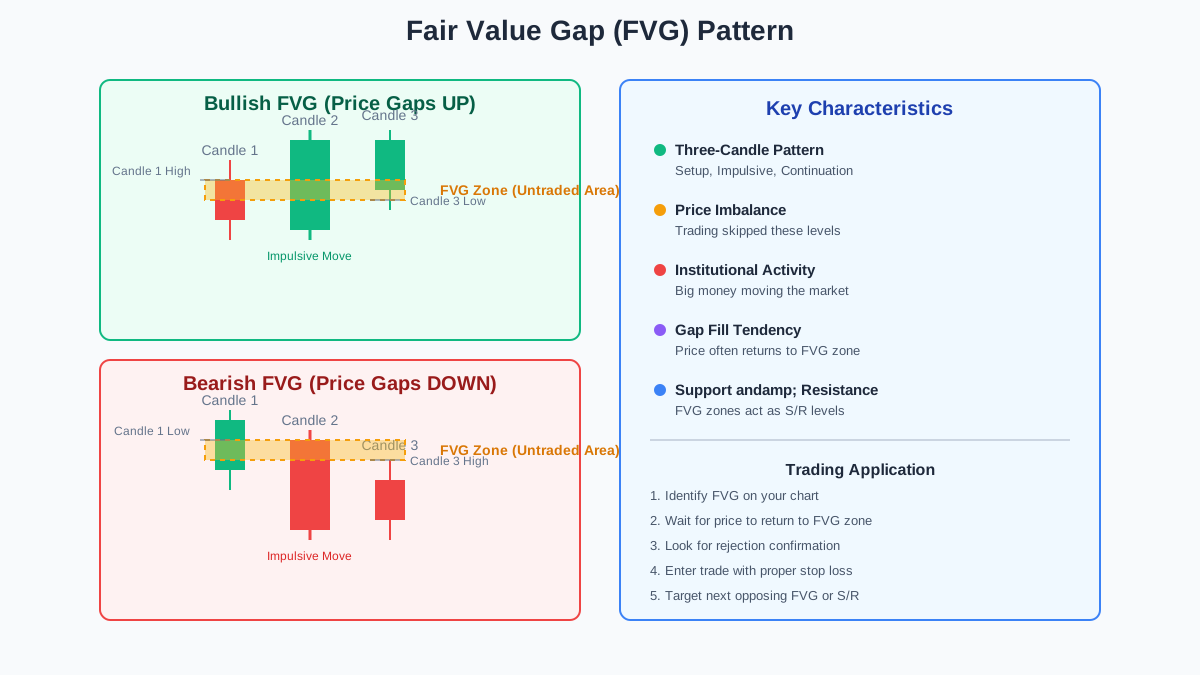
The Fair Value Gap is the untraded space between Candle 1 and Candle 3, created by the impulsive move in Candle 2
Why Do Fair Value Gaps Form?
Understanding WHY FVGs form has been crucial for me. It's not random—it's a sign of institutional activity. Here's what's really happening when an FVG forms:
1. Institutional Order Flow
When big players—institutional traders, hedge funds, banks—enter the market, they don't dip their toes in. they dive in. We're talking about massive orders that need to be filled. When an institution decides to buy (or sell), they often do it aggressively, pushing price through multiple levels at once. This creates the FVG.
Here's the thing: retail traders (you and me) can't move markets like this. Only the big money can. So when I see an FVG, I know—I mean, I really know—that institutional players are involved.
2. News and Events
Earnings reports, economic data releases, central bank announcements—these are catalysts that can trigger explosive moves. When news hits that everyone was waiting for, the market reacts instantly. Everyone rushes to trade at the same time, and price gaps through levels.
I've noticed FVGs are especially common right after major announcements. The market is trying to digest new information fast, and in that chaos, gaps form.
3. Liquidity Vacuums
This is a bit more advanced, but stay with me. Sometimes price hits a level where there are just no orders—no buyers, no sellers. It's like a vacuum. When price pushes into this area, it can accelerate because there's nothing to slow it down. This creates the gap.
Think about it: if there's no resistance (no sellers), buyers can push price up easily. If there's no support (no buyers), sellers can push price down easily. FVGs often form at these liquidity voids.
4. Breakout Momentum
When price breaks out of a consolidation range or a key level, it often does so with momentum. Traders who were sitting on the sidelines jump in, momentum traders join the move, and sometimes—just sometimes—price accelerates so fast that it gaps.
I see this a lot when price breaks above resistance or below support that everyone's been watching. The breakout triggers a rush of orders, and boom—FVG forms.
Key Insight: Every FVG tells a story. It's not just a pattern—it's evidence of strong buying or selling pressure. When I look at an FVG, I ask myself: "Who was trading here? What triggered this? Is this the start of a bigger move or just a temporary spike?" Understanding the context has made all the difference for me.
How I Identify Fair Value Gaps (Step-by-Step)
Alright, let's get practical. Here's my exact process for spotting FVGs on any chart. I've refined this over years, and it works whether you're trading forex, stocks, crypto, or indices.
Step 1: Scan for Strong Impulsive Moves
I start by looking at the chart and scanning for candles that just LOOK strong. What do I mean by strong?
- • Large real body (not much wick)
- • Clearly larger than surrounding candles
- • Moves decisively in one direction
- • Volume spike (if you have volume data)
These are my candidate candles for the middle candle of an FVG. I'm looking for candles that say, "Hey, something just happened here."
Step 2: Check the Candle Before
Once I find a strong impulsive candle, I look at the candle BEFORE it (Candle 1 in our pattern). I'm checking to see if there's a gap.
For a bullish FVG: I check if Candle 3's low is HIGHER than Candle 1's high. If it is, we have a gap—those price levels between Candle 1's high and Candle 3's low were skipped.
For a bearish FVG: I check if Candle 3's high is LOWER than Candle 1's low. If so, we have a bearish gap.
Step 3: Verify the Continuation
The candle AFTER the impulsive candle (Candle 3) should continue in the same direction. This confirms that the momentum was real, not just a one-candle spike.
If Candle 3 reverses or has a tiny body, I'm skeptical. I want to see confirmation that the move has legs.
Step 4: Mark the FVG Zone
Once I've confirmed the three-candle pattern, I draw a rectangle or highlight the area between:
- • Bullish FVG: From Candle 1's high to Candle 3's low
- • Bearish FVG: From Candle 1's low to Candle 3's high
This highlighted area is my FVG zone—my target area for potential trades.
Step 5: Wait for Price Return
Here's the thing—I don't just jump in as soon as I spot an FVG. I wait. I wait for price to come back to that zone. Sometimes this happens quickly, sometimes it takes days or even weeks.
When price approaches the FVG zone, that's when I start looking for entry signals. The FVG itself isn't the entry—it's the TARGET area.
Pro Tips from My Experience
✓ Multiple Timeframes: I always check FVGs on multiple timeframes. An FVG on the 4-hour chart is more significant than one on the 5-minute chart. I like to see FVGs aligning across timeframes—like an H4 FVG within a Daily FVG. That's powerful confluence.
✓ Size Matters: Not all FVGs are created equal. Bigger gaps (larger price ranges between Candle 1 and Candle 3) tend to be more significant. Tiny gaps might fill quickly and not provide much support/resistance. I focus on substantial gaps.
✓ Fresh vs. Tested: I track whether an FVG has already been tested (filled) or if it's "fresh." Untested FVGs are more reliable because price hasn't revisited them yet. Once an FVG is filled, it loses some of its power (though not always).
✓ Location Context: I always ask: WHERE is this FVG? Is it at key support/resistance? Is it at a psychological round number? Is it near previous highs/lows? FVGs at important levels are more significant than FVGs in the middle of nowhere.
Real-World FVG Trading Example

How price returns to fill a Fair Value Gap and how I trade the retest
How I Actually Trade FVGs (My Strategies)
Okay, here's where the rubber meets the road. I'm going to share the actual strategies I use. No theory—real, practical approaches that I've tested in the markets.
Strategy 1: FVG Bounce (My Go-To)
This is my bread-and-butter FVG strategy. I use it all the time, especially in trending markets.
How It Works:
- Step 1: Identify a bullish FVG in an uptrend (or bearish FVG in a downtrend). I want FVGs that align with the overall trend—trading with the trend, not against it.
- Step 2: Wait for price to return to the FVG zone. Sometimes price fills it completely, sometimes it just touches the edge. Either way, I'm ready.
- Step 3: Look for a rejection candle at the FVG. This could be a pin bar, engulfing candle, or any candle that shows price respecting the level. I need confirmation that buyers (or sellers) are stepping in.
- Step 4: Enter the trade on the close of the rejection candle or on the next candle. Stop loss goes below the FVG zone (for longs) or above it (for shorts).
- Step 5: Target the next opposing FVG or a previous high/low. I'm looking for the next logical target where price might stall.
Why I like it: This strategy plays on the "gap fill" tendency. Markets hate inefficiencies, and FVGs are inefficiencies. Price often bounces off these zones, giving us a high-probability entry.
Risk: Sometimes price blasts right through the FVG. That's why I always use a stop loss. If the FVG doesn't hold, I'm out quickly.
Strategy 2: FVG Breakout Continuation
When an FVG forms and price DOESN'T come back to fill it right away, that's a sign of strength. This strategy plays that strength.
How It Works:
- Step 1: Spot a fresh FVG forming. Ideally, this happens right after a breakout or news event.
- Step 2: Instead of waiting for price to return, I wait for a small pullback or consolidation near the FVG. I'm NOT waiting for a full fill.
- Step 3: Enter on a continuation signal—another impulsive candle in the same direction as the original FVG. This shows buyers/sellers are still in control.
- Step 4: Stop loss goes on the other side of the FVG or below the recent swing low/high.
- Step 5: Target the next major support/resistance level or a 1:2 or 1:3 risk-reward ratio.
Why I like it: When FVGs don't fill quickly, it shows the move is strong. Traders are jumping in, not waiting for a pullback. This strategy catches that momentum.
Risk: You're chasing price a bit, which I normally don't like. But if the momentum is real, it can work. Just keep stops tight.
Strategy 3: Confluence FVG (High Probability)
This is my favorite strategy when I want high-probability setups. I look for FVGs that align with other support/resistance factors.
How It Works:
- Step 1: Identify an FVG. Then, look for confluence—other factors that make this level important. This could be:
- • A previous support/resistance level
• A Fibonacci retracement level (38.2%, 50%, 61.8%)
• A psychological level (round numbers like $100, $1.00, etc.)
• A trendline
• Another FVG from a higher timeframe - Step 2: When price approaches this confluence zone, I'm laser-focused. The more factors aligning, the better.
- Step 3: Wait for price to touch the zone and show a reaction. This could be a rejection candle, a wick testing the level, or price getting "stuck" at the level.
- Step 4: Enter on the reaction signal. Stop loss goes below/above the entire confluence zone.
- Step 5: Target the next major level or use a trailing stop to let the trade run.
Why I like it: This is the highest probability approach because multiple factors are aligning. When an FVG sits right at a key support level AND a Fibonacci level, that's powerful. Institutions watch these levels too.
Risk: It requires patience. These setups don't happen every day. But when they do, they're worth waiting for.
My Golden Rule: I never trade an FVG in isolation. Always look at context. Is the market trending? Is price at a key level? What's the overall structure? The FVG is just one piece of the puzzle. Combine it with other analysis, and your win rate will improve dramatically.
FVG Mistakes I've Made (So You Don't Have To)
❌ Trading Every FVG I See
When I first learned about FVGs, I went crazy. I was trading every gap I saw. Big mistake. Most FVGs are noise—they get filled and nothing happens. Now I'm selective. I only trade FVGs that align with the trend, are at key levels, or show other confluence factors. Quality over quantity.
❌ Ignoring the Stop Loss
FVGs don't always hold. Sometimes price blows right through them. I used to think, "Oh, it's an FVG, it HAS to hold." Nope. Always use a stop loss. My rule: stop loss goes on the other side of the FVG zone. If price breaks through, the setup is invalid and I'm out.
❌ Forgetting to Check Higher Timeframes
I used to only look at the 15-minute chart. Then I'd wonder why my perfect FVG setup failed. Turns out, there was a massive opposing FVG on the 4-hour chart that I didn't see. Now I always check multiple timeframes. If the H1 FVG aligns with the H4 FVG, that's a much stronger setup.
❌ Entering Too Early
I see the FVG, and I want to get in RIGHT NOW. Bad idea. I've learned to wait for price to actually reach the FVG zone. Even better—I wait for a rejection candle or some confirmation that price is reacting to the level. Patience isn't easy, but it's profitable.
❌ Not Understanding Market Context
Trading a bullish FVG when the market is in a strong downtrend? That's fighting the trend. I look at the bigger picture first. Is the market ranging? Trending? Reversing? The FVG strategy should fit the market context. Don't force trades.
❌ Having Unrealistic Expectations
I used to think FVGs were magic. They're not. They're just another tool in the toolbox. Sometimes they work beautifully, sometimes they fail. That's trading. Don't expect 100% win rate. Aim for 50-60% with good risk-reward (1:2 or better), and you'll be profitable over time.
❌ Not Journaling My Trades
For the longest time, I didn't keep a trading journal. Big mistake. I had no idea which FVG setups were working and which weren't. Now I track every trade—entry, exit, win/loss, what happened. This helped me refine my strategies and avoid repeating mistakes.
Understanding Market Imbalance with FVGs
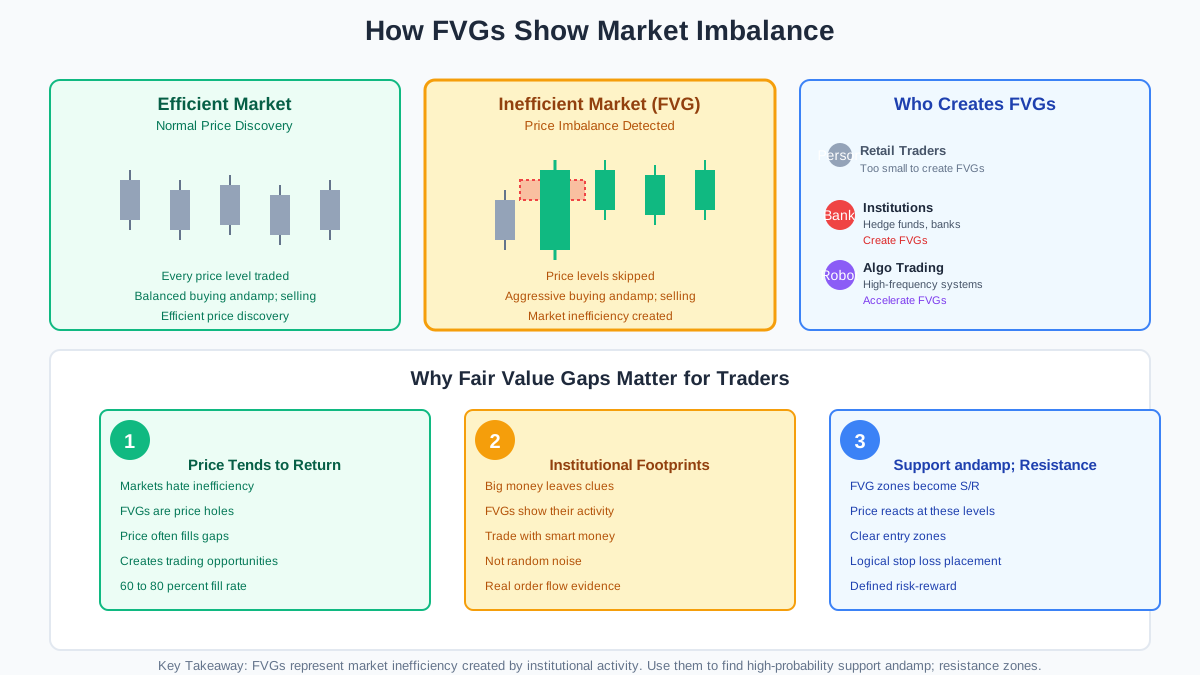
FVGs show where aggressive buying or selling created price inefficiency
Combining FVGs with Valuation Tools
Here's something most traders miss: Fair Value Gaps in technical analysis are great, but you know what's even better? Combining them with fundamental fair value calculations. This is where technical analysis meets fundamental analysis, and it's powerful.
Let me explain what I mean. Let's say you're trading stocks. You find a stock that's created a bullish FVG on the chart—technically, it looks like a buy. But here's the question: Is the stock fundamentally undervalued or overvalued? If it's overvalued and due for a correction, that technical FVG might fail.
My Integrated Approach
Here's how I combine technical FVG analysis with fundamental fair value:
- Step 1: Use fundamental analysis to determine if a stock is undervalued, fairly valued, or overvalued. I use DCF (Discounted Cash Flow) analysis for this. You can use my free DCF calculator to find the intrinsic value.
- Step 2: If the stock is fundamentally undervalued, I look for bullish FVGs on the chart. The fundamental undervaluation tells me the stock has upside potential; the FVG gives me a technical entry point.
- Step 3: If the stock is fundamentally overvalued, I skip bullish FVGs (too risky) but I pay attention to bearish FVGs. The fundamental overvaluation suggests downside risk; a bearish FVG could be the technical trigger for a correction.
- Step 4: Only trade when technicals (FVG) and fundamentals (fair value) align. This is confluence at its finest.
Practical Example
Let me give you a real example. Say I'm looking at Company XYZ:
- • Market price: $85 per share
- • Fair value (calculated using DCF): $110 per share
- • Assessment: Fundamentally undervalued by ~29%
So fundamentally, this stock looks attractive. Now I look at the chart and see:
- • The stock recently pulled back from $95 to $85
- • There's a bullish FVG between $80 and $82 that hasn't been filled
- • Price is currently approaching that FVG zone
This is a perfect setup! The fundamentals say the stock is undervalued, and the technicals (the FVG) give me a potential entry zone around $80-82. If price shows a rejection around that FVG, I'm buying. My target? Fair value at $110 (fundamental target) or nearby resistance (technical target).
Tools I Use
On this website, I've built several valuation calculators that I personally use for fundamental analysis. They're free, and they're the same tools I use to evaluate stocks:
DCF Calculator
Calculate the intrinsic value of any stock using the Discounted Cash Flow method. This is my go-to for finding fundamentally undervalued stocks.
Stock Valuation Calculator
Quick and easy stock valuation using multiple methods. Great for screening stocks quickly.
Benjamin Graham Formula Calculator
Use the classic formula from the father of value investing. Perfect for defensive investors.
Peter Lynch Fair Value Calculator
Calculate fair value using the PEG ratio method. Ideal for growth stocks.
Frequently Asked Questions About Fair Value Gaps
Q: Are Fair Value Gaps the same as regular gaps?
No, they're different. Regular gaps (like gap ups or gap downs) occur when price opens above or below the previous close, with no trading in between. Fair Value Gaps, on the other hand, are intraday patterns formed by three candles. FVGs are about price action within a trading session, not just gaps between sessions. Both represent price inefficiency, but FVGs are more specific to candlestick patterns.
Q: Do FVGs always get filled?
Not always. Many FVGs do get filled eventually—price has a tendency to return to inefficiencies—but not all, and not always quickly. Sometimes price moves so strongly that the FVG never fills (at least not for a long time). That's why I don't blindly assume every FVG will be filled. I look for confirmation and always use a stop loss in case the FVG doesn't hold.
Q: What timeframe is best for trading FVGs?
There's no "best" timeframe—it depends on your trading style. I personally use the 1-hour and 4-hour charts for swing trading, but I know traders who successfully use FVGs on the 15-minute chart for day trading and others who use the Daily chart for position trading. The key is consistency: if you're trading FVGs on the 1-hour chart, don't switch to the 5-minute chart for entries. Pick your timeframe and master it.
Q: Can I use FVGs for stocks, forex, and crypto?
Absolutely! FVGs work in any market that has candlestick charts. I use them in stocks, forex (especially major pairs like EUR/USD, GBP/USD), cryptocurrencies (Bitcoin, Ethereum), and indices (S&P 500, Nasdaq). The underlying principle—price inefficiency and the tendency to fill gaps—is universal across markets.
Q: Should I trade FVGs in ranging or trending markets?
Both, but differently. In trending markets, I trade FVGs in the direction of the trend (bullish FVGs in uptrends, bearish FVGs in downtrends). These tend to be more reliable. In ranging markets, I can trade both directions—FVGs at support for longs, FVGs at resistance for shorts. Just be aware that ranging markets can be choppy, so keep stops tight.
Q: How do I know if an FVG is still valid or if it's too old?
Great question. I consider an FVG "active" if it hasn't been filled yet (price hasn't traded in that zone). Once price fills the FVG, it loses some of its power—though it can still act as support/resistance. As for age, I pay more attention to higher timeframe FVGs (like on the Daily or 4-hour charts) because they stay relevant longer. Lower timeframe FVGs (like 5-minute) become less relevant after a few hours.
Q: What's the win rate for FVG trading?
Honestly, it varies. For me, when I trade FVGs with confluence (aligning with the trend, at key levels, with confirmation), I hit about 55-65% win rate. But remember, win rate isn't everything—risk-reward matters more. If I win 50% of the time but my winners are twice as big as my losers (1:2 risk-reward), I'm profitable. Don't chase a high win rate; chase positive expectancy.
Q: Can FVGs be used for options trading?
Yes, FVGs can work for options trading. I know traders who use FVGs to time entries for call and put options. For example, if they see a bullish FVG forming on a stock they're bullish on, they might buy call options when price retests the FVG. Just remember that options have time decay (theta), so timing is even more critical. The FVG gives you the timing, but fundamental analysis should guide your directional view.
Q: How many FVGs should I track at once?
Quality over quantity. I might spot dozens of FVGs on a chart, but I only mark the significant ones—the big ones, the ones at key levels, the ones that align with the trend. Usually, I'm tracking 3-5 active FVGs per market at any time. Any more than that and it gets overwhelming. Focus on the best setups, not all setups.
Q: Is FVG trading suitable for beginners?
FVG trading is accessible to beginners, but I'd recommend learning the basics first. Understand support and resistance, trend analysis, and basic candlestick patterns before diving into FVGs. Once you have those fundamentals down, FVGs are a great next step. Start on a demo account, practice identifying FVGs, and paper trade until you're consistently profitable. Don't rush—trading is a marathon, not a sprint.
Q: Can I automate FVG trading?
Yes, FVG patterns can be coded into automated trading systems or scanned with screener software. That said, I prefer manual trading because context matters. An automated system might see an FVG and trade it, but a human can look at the bigger picture—is there news coming out? Is the market about to close? Is this at a key psychological level? Automation has its place, but I believe learning to trade FVGs manually first makes you a better trader.
Q: How long does it typically take for an FVG to fill?
It varies wildly. Some FVGs fill within minutes or hours. Others take days, weeks, or even months. I've seen unfilled FVGs on Daily charts that have been open for years. There's no set timeline, which is why I don't "wait and hope" for FVGs to fill. I mark them, but I only trade them when price actually approaches the zone and shows a reaction. Don't anticipate—wait for price to act.
Q: What's the difference between FVG and Order Blocks?
Both are Smart Money Concepts, but they're different. An Order Block is the last up-candle (before a down-move) or last down-candle (before an up-move) that represents institutional buying/selling. An FVG is the gap created by impulsive movement. Traders often use both—Order Blocks show where institutions positioned themselves, FVGs show where they pushed price aggressively. They can be used together for confluence.
My Final Thoughts on Fair Value Gaps
Look, I've been trading long enough to know that there's no holy grail in trading. FVGs aren't magic. But here's what I've learned: they're one of the most reliable tools I've found for identifying potential support and resistance zones based on actual price action, not some arbitrary line I draw on a chart.
What I love about FVGs is that they're rooted in reality. They represent real price inefficiency—areas where the market moved so aggressively that it skipped levels. These aren't theoretical concepts; they're visible on any chart, and they make logical sense. The market doesn't like inefficiency, and price tends to return to these gaps.
But—and this is important—FVGs are just ONE tool. I never trade them in isolation. I combine them with:
- • Trend analysis (am I trading with the trend or against it?)
- • Support and resistance levels
- • Higher timeframe analysis
- • Fundamental analysis (using the valuation tools on this site)
- • Risk management (always, always, always use a stop loss)
When all these factors align, that's when I take the trade. And that's when FVGs become truly powerful.
If You're New to FVG Trading, Start Here:
- 1. Learn to identify FVGs accurately. Practice on historical charts. Get good at spotting the three-candle pattern.
- 2. Paper trade first. Don't use real money until you're consistently profitable on a demo account. Track your results.
- 3. Start with one strategy. I'd recommend the FVG Bounce strategy. Master it before trying others.
- 4. Be selective. Don't trade every FVG. Wait for the best setups with confluence.
- 5. Always use a stop loss. And respect it. If the stop is hit, move on.
- 6. Keep a trading journal. Review your trades weekly. What worked? What didn't? Adjust accordingly.
- 7. Be patient. Trading is a skill that takes time to develop. You won't get rich overnight, but with consistency and discipline, you can build wealth over time.
Remember: every professional trader was once a beginner. The difference is they stuck with it, learned from their mistakes, and kept improving. You can do the same.
Good luck, and trade smart!
Ready to Combine Technical and Fundamental Analysis?
Use my free valuation calculators to find fundamentally undervalued stocks, then trade them using FVG technical analysis. Best of both worlds.