Fair Value Gap Example: The Ultimate 2026 Guide with Real Charts
I'm going to show you actual fair value gap examples from my trading—no theory, just real charts, real setups, and how I trade them. You'll see bullish FVGs, bearish FVGs, and exactly how I enter and exit these trades.
Look, I've read countless articles about Fair Value Gaps (FVGs) that show you perfect textbook examples. But here's the thing: the market doesn't always give you textbook setups. In this guide, I'm going to show you REAL examples—messy, imperfect, but tradeable FVGs that I've actually traded.
We'll cover bullish FVG examples, bearish FVG examples, and I'll walk you through my exact decision-making process. I'll show you where I entered, where I placed my stop loss, where I took profits, and most importantly, WHY. This is the stuff I wish someone had taught me when I started trading FVGs.
Before we dive in: If you're new to Fair Value Gaps, I recommend reading my complete guide first: What is a Fair Value Gap? It'll give you the foundation you need.
Quick Recap: What Are We Looking For?
Before jumping into examples, let me remind you what a Fair Value Gap actually is. An FVG forms when we have a three-candle pattern:
📈Bullish Fair Value Gap (Price Gaps UP)
- Candle 1: The setup candle (can be green or red)
- Candle 2: A strong impulsive GREEN candle that pushes price up aggressively
- Candle 3: Another green candle that continues the upward move
- The FVG: The gap between Candle 1's HIGH and Candle 3's LOW
Translation: Price moved up so fast it skipped over certain price levels entirely
📉Bearish Fair Value Gap (Price Gaps DOWN)
- Candle 1: The setup candle (can be green or red)
- Candle 2: A strong impulsive RED candle that pushes price down aggressively
- Candle 3: Another red candle that continues the downward move
- The FVG: The gap between Candle 1's LOW and Candle 3's HIGH
Translation: Price dropped so fast it skipped over certain price levels entirely
The Golden Rule:
Fair Value Gaps are price imbalances. The market hates inefficiencies, so price often returns to "fill" these gaps. That return is where we trade.
Real Example 1: Bullish Fair Value Gap in EUR/USD
Let me walk you through a real trade I took on EUR/USD (the euro vs. US dollar). This is a forex pair, but the same principles apply to stocks, crypto, and indices.
Step 1: Spotting the FVG Formation
It was 8:00 AM on a Tuesday morning. I was scanning the 4-hour charts (my favorite timeframe for FVG trading). On EUR/USD, I noticed:
Price closed at 1.0850 (small red candle, minor pullback)
Huge green candle—price surged from 1.0850 to 1.0920 (70 pips in one 4-hour candle!)
Another green candle, closing at 1.0940 (continuation of the move)
The Bullish FVG:
- • Candle 1's HIGH: 1.0865
- • Candle 3's LOW: 1.0890
- • FVG Zone: 1.0865 to 1.0890 (25-pip gap)
This is a quality FVG! The gap is substantial (25 pips), and it was created by strong momentum.
Step 2: The Waiting Game
Here's where most traders mess up. They see the FVG and immediately buy. Don't do that. I waited.
Price continued higher for the next two candles, reaching 1.0980. That's 90 pips above the top of my FVG. I sat on my hands. I didn't FOMO in. I knew that if this was a quality FVG, price would eventually come back to test it.
Three days later (on the 4-hour chart, that's about 18 candles), I saw price starting to pull back. It dropped to 1.0950, then 1.0920. Getting closer to my FVG zone (1.0865-1.0890).
Pro Tip: I always wait for price to actually REACH the FVG zone before getting interested. Sometimes price fills FVGs quickly (within hours). Sometimes it takes days or even weeks. Patience isn't just a virtue in trading—it's profitable.
Step 3: Price Returns to the FVG
Finally, the moment I'd been waiting for. Price dropped into my FVG zone:
Price touched 1.0880—right in the middle of my FVG zone (1.0865-1.0890). Now I'm laser-focused. Is this going to be a support level? Let's see what price does here.
Step 4: The Entry Signal
I didn't buy the second price touched 1.0880. That's amateur hour. I waited for a reaction candle—confirmation that buyers were stepping in at this level.
Here's what happened:
A 4-hour candle formed at the FVG zone:
- • Opened at 1.0880 (inside FVG)
- • Dropped to 1.0870 (still inside FVG)
- • Closed at 1.0895 (above FVG)
- • This is a bullish rejection candle!
Price tested the FVG, got rejected (buyers stepped in), and closed above the zone. This is my entry signal.
Step 5: My Trade Execution
🎯 Entry: 1.0890
I entered on the close of the rejection candle. Some traders enter on the next candle's open, but I like to enter on the close for confirmation.
🛑 Stop Loss: 1.0845
I placed my stop loss below the entire FVG zone (45 pips below my entry). This is important—if price blows through the FVG, the setup is invalid and I'm out. Risk: 45 pips.
📊 Target: 1.0980 (Previous High)
I targeted the previous high at 1.0980 (90 pips above my entry). That's a 1:2 risk-reward ratio. If I lose, I lose 45 pips. If I win, I make 90 pips. Over time, this math works in my favor.
Step 6: The Outcome
Two days later, price hit my target at 1.0980. I closed the position for a +90 pip profit.
This trade illustrates why FVGs work: The market created an imbalance (the gap), price returned to fill it, found support, and then continued in the original direction.
💡 Key Takeaways from This Trade:
- • I waited for price to RETURN to the FVG (didn't chase)
- • I waited for a REJECTION CANDLE at the FVG (confirmation)
- • I placed my stop loss BELOW the FVG zone (invalidation point)
- • I targeted the previous high (logical profit target)
- • I maintained a 1:2 risk-reward ratio (math works over time)
Visualizing the Bullish FVG Example
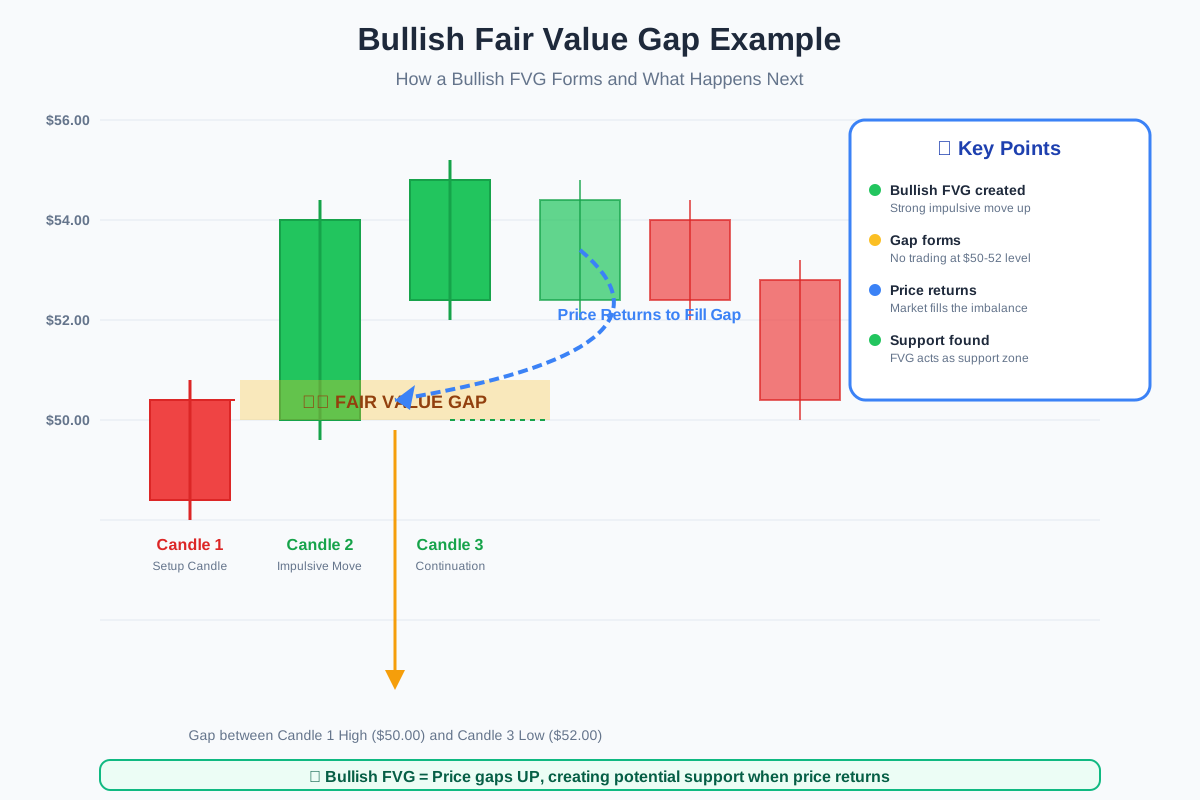
How a bullish FVG forms and how I traded it step-by-step
Real Example 2: Bearish Fair Value Gap in Apple (AAPL)
Now let's look at a bearish example—shorting a stock when a bearish FVG forms and price returns to test it. This trade was on Apple Inc. (AAPL) on the daily timeframe.
Step 1: The Bearish FVG Forms
Apple had been trading in a range between $180 and $195 for weeks. Then earnings came out, and... well, let me show you what happened:
Apple closed at $192.50 (green candle, hitting resistance)
Massive red candle—price crashed from $192 to $178 (gapped down on earnings disappointment!)
Another red candle, closing at $175.00 (continuation lower)
The Bearish FVG:
- • Day 1's LOW: $190.00
- • Day 3's HIGH: $185.00
- • FVG Zone: $185 to $190 ($5 gap!)
This is a MASSIVE bearish FVG on a daily chart. A $5 gap on Apple is significant. This gap is going to act as resistance going forward.
Step 2: Price Bottoms and Starts Recovering
After the earnings drop, Apple bottomed at $170. Then, over the next two weeks, it started recovering. Slowly. It climbed to $175, then $178, then $182.
Now I'm watching closely. Price is approaching my bearish FVG zone ($185-190). If price gets there and shows rejection, I'm looking to short.
Important: I'm not shorting just because there's a bearish FVG. I'm waiting to see HOW price reacts when it reaches that FVG zone. If price blasts right through it, no trade. If price gets rejected, that's my short setup.
Step 3: Price Tests the Bearish FVG
Three weeks after the FVG formed, price finally reached the zone:
Apple rallied to $187.50—right inside the FVG zone ($185-190). Here's what happened next:
- • Opened at $187.00 (inside FVG)
- • Rallied to $189.00 (still inside FVG, but getting close to the top)
- • Dropped and closed at $184.50 (below FVG!)
- • This is a bearish rejection candle!
Price tested the FVG zone, couldn't break through, and got rejected. Sellers stepped in. This is my short signal.
Step 4: My Short Trade Execution
🎯 Entry: $186.00
I entered short on the close of the rejection candle at $186. This was near the middle of the FVG zone—a good location because it gave me room to place my stop loss above the zone.
🛑 Stop Loss: $192.00
I placed my stop loss ABOVE the entire FVG zone (and above Day 1's low at $190). If price breaks above $192, the bearish thesis is invalid. Risk: $6 per share.
📊 Target: $170 (Previous Low)
I targeted the previous low at $170 ($16 below my entry). That's roughly a 1:2.6 risk-reward ratio. Even better than my minimum 1:2 requirement.
Step 4: The Outcome
This one took a bit longer. Price meandered lower over the next three weeks. No dramatic drop—just slow grinding downward. But eventually, it hit my target at $170.
Closed the position for a +$16 per share profit. That's $1,600 on a 100-share position—not bad for waiting three weeks.
💡 Why This Trade Worked:
- • The FVG was LARGE ($5 on a $190 stock is huge)
- • It formed on earnings (major catalyst)
- • Price respected it three weeks later (it wasn't just noise)
- • The rejection candle was clear (price tried to break through, failed)
- • My risk-reward was excellent (nearly 1:3)
Visualizing the Bearish FVG Example
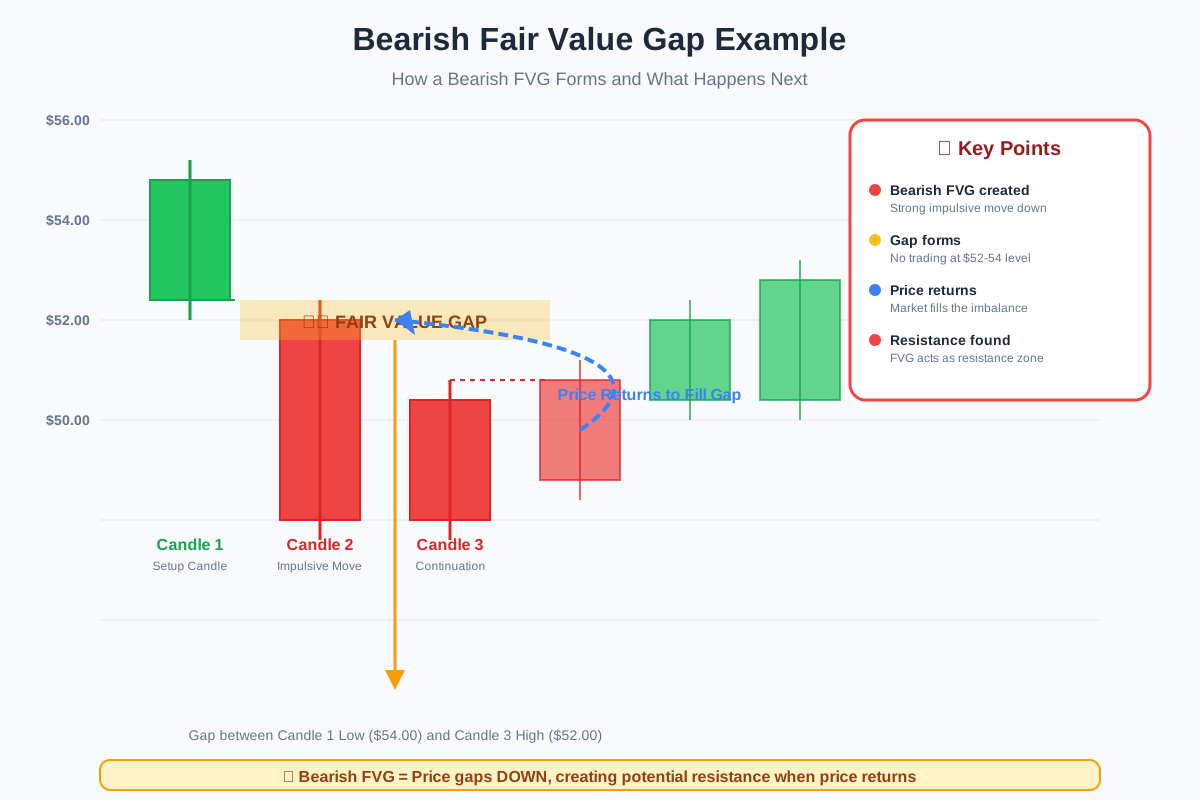
How a bearish FVG forms and how I shorted it when price returned
What Happens When FVGs Don't Work? (A Failed Example)
Not every FVG trade works out. And I want to be honest about my failures, not just my wins. Here's an FVG trade that didn't work—and what I learned from it.
The Setup That Looked Perfect
I was trading Bitcoin (BTC/USD) on the 4-hour chart. A bullish FVG formed:
BTC closed at $42,000
Massive green candle—BTC surged to $45,500
Continuation to $46,200
FVG Zone: $42,500 to $43,000—a $500 gap in Bitcoin. That's substantial. I marked the zone and waited.
Price Returned... And Blasted Right Through
Two days later, BTC started dropping. It fell to $44,000, then $43,500. Then it entered my FVG zone at $43,000.
I waited for a rejection candle. A sign that buyers were stepping in. Instead, here's what happened:
A massive red candle formed:
- • Opened inside the FVG at $43,000
- • Dropped THROUGH the entire FVG zone
- • Closed at $41,800—below Candle 1's close!
This is a FVG failure. Price didn't respect the zone. It blew right through it.
What I Did (And What You Should Do)
Here's the thing: I didn't enter this trade. I was waiting for a rejection candle, and I never got one. Price just sliced through the FVG like it wasn't even there.
But let's say I HAD entered long at $43,000 (when price first touched the FVG). Here's what I would have done:
❌ Wrong Way: Hold and Hope
Some traders would hold, thinking "it has to bounce, it's an FVG!" This is emotional trading. The market doesn't owe you anything.
✅ Right Way: Respect the Stop Loss
If I'd entered at $43,000 with a stop loss at $42,000 (below the FVG), I would have been stopped out at $42,000 for a $1,000 loss (on 1 BTC). That's trading. Sometimes you lose. The key is keeping losses small and letting winners run.
💡 What I Learned:
- • Not all FVGs are created equal. Context matters (BTC was in a downtrend, bad news came out)
- • Always wait for confirmation. Don't anticipate the bounce.
- • If price breaks through an FVG, the setup is invalid. Move on.
- • Never argue with the market. The market is always right.
Complete Trading Framework: How I Trade Every FVG
Based on my experience trading hundreds of FVG setups, here's the exact framework I use. This is what separates my winning trades from my losing ones.
Phase 1: Identification
- 1. Spot the three-candle pattern: Strong impulsive candle (Candle 2), continuation (Candle 3), gap between Candle 1 and Candle 3.
- 2. Check the gap size: I want FVGs that are at least 0.5% of price (for stocks) or 20+ pips (for forex). Tiny gaps often fill without providing support/resistance.
- 3. Mark the zone: I draw a rectangle from Candle 1's high/low to Candle 3's low/high. This is my FVG zone.
- 4. Check context: Is this FVG aligned with the trend? Is it at a key level (support/resistance, round number)? FVGs with confluence are more reliable.
Phase 2: The Wait
- 1. DO NOT enter immediately: I never chase price. If the FVG is bullish and price is shooting up, I wait. If the FVG is bearish and price is collapsing, I wait.
- 2. Let price do its thing: Sometimes price fills the FVG within hours. Sometimes it takes weeks. I don't care. I wait.
- 3. Monitor from a distance: I check the chart every few hours (or daily for swing trades). I don't stare at it. Patience.
Phase 3: The Approach
- 1. Price enters the FVG zone: Now I'm paying attention. This is the moment I've been waiting for.
- 2. Look for a reaction: Does price get rejected? Does it stall? Does it blow right through? I need to see RESPECT for the zone.
- 3. Wait for a candle CLOSE: I don't enter mid-candle. I wait for the candle to close to see what happened. A candle can look like a rejection mid-way, then close without one.
Phase 4: Entry
- 1. Confirmation required: For a bullish FVG, I want a rejection candle that closes ABOVE the FVG. For a bearish FVG, I want a rejection candle that closes BELOW the FVG.
- 2. Entry location: I enter on the close of the rejection candle (or the next candle's open). I don't try to time the perfect bottom or top—I'm okay with leaving a little money on the table for certainty.
- 3. Position sizing: I risk 1-2% of my account per trade. No exceptions. If my stop loss distance means I can only enter with a small position, so be it.
Phase 5: Risk Management
- 1. Stop loss placement: For longs (bullish FVG), stop loss goes BELOW the FVG zone. For shorts (bearish FVG), stop loss goes ABOVE the FVG zone. If price breaks the FVG, the setup is invalid.
- 2. Minimum risk-reward: I require at least 1:2 risk-reward. If I can't get that based on the next logical target, I skip the trade.
- 3. Targets: I target the next opposing FVG, previous high/low, or key support/resistance level. I don't get greedy—I take profits at predetermined levels.
Complete Trading Setup Visualization
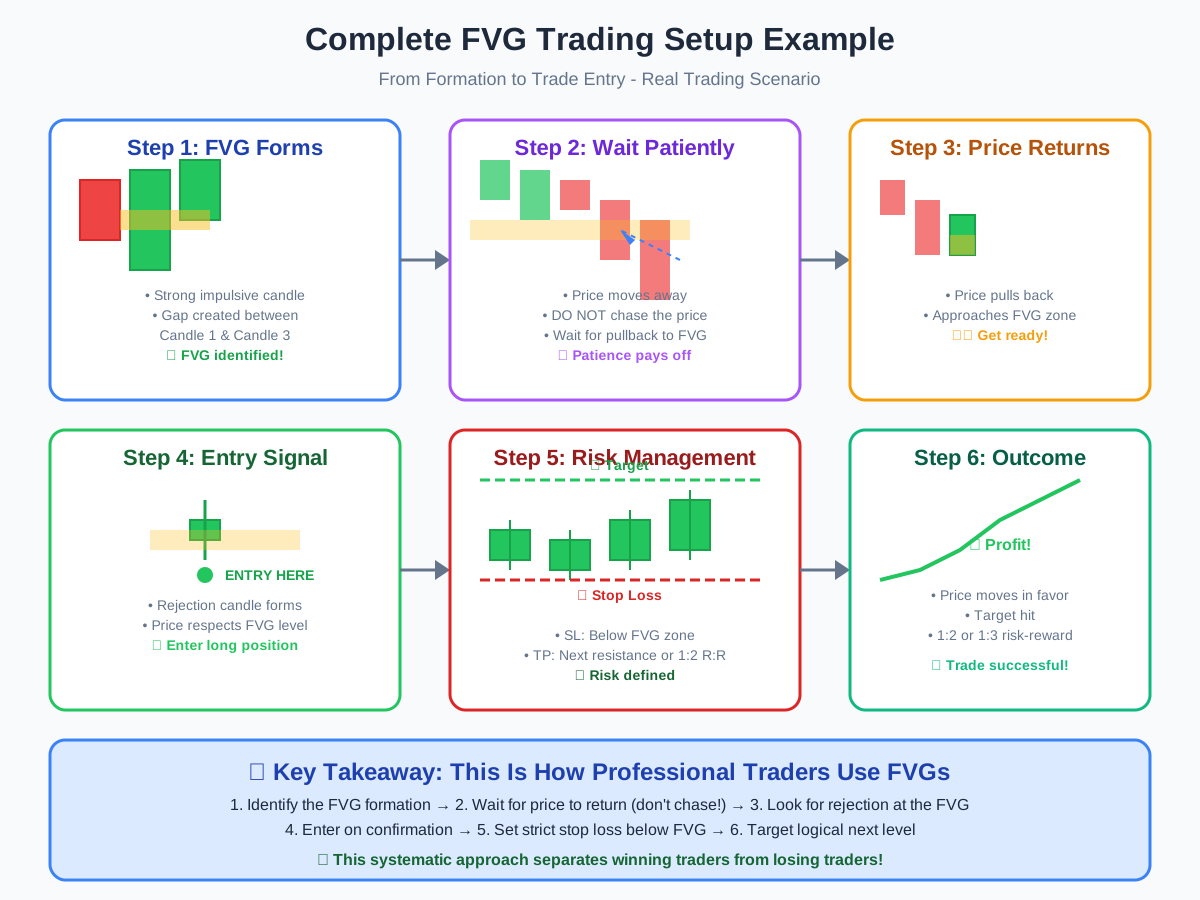
From FVG formation to trade entry: The complete process
Pro Tips: What I've Learned From Trading 100+ FVG Setups
1. Multiple Timeframe Analysis is Critical
My win rate skyrocketed when I started checking multiple timeframes. If I see a bullish FVG on the 4-hour chart, I check the Daily chart. Is there a Daily FVG in the same zone? If yes, that's powerful confluence. The best FVG trades are when you have FVGs aligning across timeframes.
2. Fresh FVGs Are More Reliable Than Tested Ones
An FVG that hasn't been tested yet (a "fresh" FVG) is more likely to provide support/resistance than an FVG that's already been filled multiple times. Once an FVG gets filled repeatedly, it loses its power. I prioritize fresh FVGs in my trading.
3. Bigger Gaps Tend to Be More Significant
Not all FVGs are equal. A 10-pip gap on EUR/USD? Might work, might not. A 50-pip gap? That's significant. Larger gaps represent stronger imbalances, and the market is more likely to respect them. I focus on substantial FVGs, not tiny gaps.
4. Location Matters: FVGs at Key Levels Are Gold
An FVG at a round number ($100, $1.00, etc.)? Powerful. An FVG at previous support/resistance? Even better. An FVG at a Fibonacci level (38.2%, 50%, 61.8%)? That's confluence. I get extra excited when FVGs align with other important levels.
5. Don't Trade FVGs in Isolation
FVGs are one tool in the toolbox, not the entire toolbox. I combine FVGs with:
- • Trend analysis (is price trending or ranging?)
- • Support and resistance levels
- • Fundamental analysis (is the stock fundamentally undervalued?)
- • Market sentiment (is the market panicking or euphoric?)
6. Combining FVGs with Fundamental Fair Value
Here's something most traders miss: You can combine technical FVG analysis with fundamental fair value analysis. For example, if a stock is fundamentally undervalued (according to my DCF calculator) AND it has a bullish FVG on the chart, that's powerful confluence. Technicals and fundamentals aligning? That's how you find high-probability trades.
Use my free DCF Calculator to determine if a stock is fundamentally undervalued before trading FVG setups.
7. Journal Every Trade
I track every FVG trade I take: entry, exit, win/loss, what happened, what I learned. This has been invaluable. I can look back and see which FVG setups work best for me, which timeframes have the highest win rate, and where I make the most mistakes. If you're not journaling, you're flying blind.
Frequently Asked Questions About Fair Value Gap Examples
Q: How long does it typically take for price to return to an FVG?
It varies wildly. On the 5-minute chart, FVGs might fill within minutes or hours. On the Daily chart, FVGs can take weeks or even months to fill. I've seen FVGs on the Weekly chart that took over a year to fill! There's no set timeline. Don't anticipate the return—wait for price to actually reach the FVG zone before getting interested.
Q: What percentage of FVGs actually work (provide support/resistance)?
In my experience, about 60-70% of FVGs get respected and provide some support or resistance. However, that doesn't mean 60-70% are winning trades. After factoring in stop losses, targets, and trade management, my actual win rate on FVG trades is around 55-60%. That's plenty profitable when combined with good risk-reward (1:2 or better). Remember: it's not about being right all the time—it's about making more when you win than you lose when you're wrong.
Q: Do FVGs work better in trending markets or ranging markets?
Both, but differently. In trending markets, I trade FVGs in the direction of the trend (bullish FVGs in uptrends, bearish FVGs in downtrends). These tend to be more reliable because you're trading with momentum. In ranging markets, I can trade both directions—FVGs at support for longs, FVGs at resistance for shorts. Both work, but trending markets typically have higher win rates for FVG trades.
Q: Should I enter as soon as price touches the FVG, or wait for confirmation?
Always wait for confirmation. Entering the second price touches the FVG is aggressive—and risky. I wait for a candle to CLOSE after touching the FVG. I want to see rejection—a wick, a hammer, a doji, some sign that buyers or sellers are stepping in. Yes, you'll sometimes get a slightly worse entry by waiting, but you'll also avoid getting run over when price blasts right through the FVG. Patience pays.
Q: What's the minimum size gap I should look for?
This depends on the asset and timeframe. For forex on the 4-hour chart, I want at least 20-30 pips. For stocks on the daily chart, I want at least 1-2% of price. For crypto, I want at least 0.5-1%. Tiny gaps often fill without providing any meaningful support or resistance. Bigger gaps represent stronger imbalances that the market is more likely to respect. That said, don't get too caught up in exact numbers—use your judgment and look at the context.
Q: Can you show an example where an FVG didn't work?
Absolutely! I shared one earlier in this guide—the Bitcoin trade where price blasted right through a $500 FVG like it wasn't even there. FVGs fail all the time, especially when: (1) There's major news that changes the fundamentals, (2) The market is in a strong trend that overpowers the FVG, or (3) The FVG is too small to be significant. That's why stop losses are non-negotiable. When an FVG fails, you need to get out quickly and move on to the next setup.
Q: How do you handle multiple FVGs on the same chart?
This happens all the time, especially in volatile markets. Here's how I handle it: I focus on the LARGEST and most RECENT FVGs. Small FVGs or FVGs that are far away from current price matter less. If I have multiple FVGs in the same zone (confluence), that's even better—it makes that level more significant. If FVGs conflict (one bullish, one bearish), I wait to see which one price respects first. The market will tell me which FVG matters.
Q: What timeframe is best for trading FVGs?
There's no "best" timeframe—it depends on your trading style and schedule. I personally prefer the 4-hour and Daily charts for swing trading. These timeframes produce quality FVGs that don't require constant monitoring. Day traders might use the 15-minute or 1-hour charts. Position traders might use the Weekly chart. Pick a timeframe that fits your lifestyle and master it. Don't jump between timeframes—consistency is key.
Q: Do FVGs work in all markets (stocks, forex, crypto, indices)?
Yes! FVGs work in any market that has candlestick charts. I've traded FVGs in stocks (Apple, Tesla), forex (EUR/USD, GBP/USD), crypto (Bitcoin, Ethereum), and indices (S&P 500, Nasdaq). The underlying principle—price imbalance and the tendency to fill gaps—is universal across markets. That said, different markets have different characteristics. Crypto is more volatile (larger FVGs but more false breakouts). Forex is less volatile (smaller FVGs but often more reliable). Adapt your approach to the market you're trading.
Q: How can I practice trading FVGs without risking real money?
Paper trading! Open a demo account with your broker and trade FVG setups with fake money. Track your results, take screenshots, journal your trades. Treat it like real money—if you wouldn't take a trade with real money, don't take it in your demo account. Once you're consistently profitable on demo for 1-2 months, transition to live trading with small position sizes. Build confidence gradually. There's no rush. The market will always be there.
Q: Can FVGs be combined with other Smart Money Concepts (SMC)?
Absolutely, and this is powerful. FVGs are just one Smart Money Concept. They can be combined with: (1) Order Blocks (the last opposing candle before a strong move), (2) Liquidity sweeps (areas where stop losses are clustered), (3) Breaker blocks (failed order blocks), and (4) Premium and discount zones (areas of value). When multiple SMC concepts align at the same level, that's high-probability confluence. That said, don't overcomplicate it. Start with FVGs, master them, then gradually add other concepts.
Q: What's the #1 mistake traders make with FVGs?
Chasing price. Traders see an FVG form and immediately enter, afraid they'll "miss the move." Don't do this. The FVG is the TARGET area, not the entry signal. Wait for price to come back to the FVG. Wait for rejection. Wait for confirmation. I know it's boring. I know it requires patience. But this is how winning traders trade. Losers chase. Winners wait. Be a winner.
My Final Thoughts: Examples Are Just the Beginning
I've shared real examples from my trading—winners and losers. But here's the thing: reading examples isn't enough. You need to experience FVGs yourself. You need to see them form in real-time, wait for price to return, feel the anxiety of not knowing if it'll work, and experience the satisfaction of a well-executed trade.
The examples I've shared aren't perfect textbook setups. They're real. The EUR/USD trade took patience. The Apple trade took weeks to play out. The Bitcoin trade failed. That's trading. It's not glamorous. But it is learnable.
If You're Starting with FVGs, Here's Your Roadmap:
- 1. Learn the basics. Read my guide on What is a Fair Value Gap? Understand the three-candle pattern.
- 2. Study historical charts. Go back and look at past FVGs. Did price return? Did the FVG hold? What happened next? Learn from history.
- 3. Paper trade first. Don't use real money until you're consistently profitable on demo. Track every trade.
- 4. Start with one timeframe. I recommend the 4-hour or Daily chart. Master it before trying others.
- 5. Be patient. Wait for quality setups. Not every FVG is tradeable. Some are noise. Trade the best, ignore the rest.
- 7. Always use a stop loss. No exceptions. FVGs fail. Protect yourself.
- 8. Keep learning. Markets evolve. Stay curious. Adapt your approach as needed.
Fair Value Gaps aren't magic. They're not a get-rich-quick scheme. They're a tool—a way to identify potential support and resistance zones based on actual price action. Used correctly, with proper risk management and patience, they can be a powerful addition to your trading toolkit.
Remember: Every professional trader was once a beginner. The difference? They stuck with it, learned from their mistakes, and kept improving. You can do the same.
Good luck, and trade smart!
Ready to Trade FVGs Like a Pro?
Combine technical FVG analysis with fundamental fair value calculations for high-probability setups. Use my free tools to find undervalued stocks, then trade them using FVG technical analysis.